Wednesday, March 21, 2012

>Accipiter butleri (Nicobar Sparrowhawk)

Nicobar Sparrowhawk


Nicobar Sparrowhawk
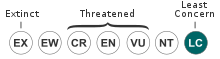
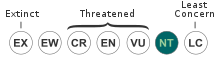
Conservation status
Scientific classification
Kingdom:Animalia
Phylum:Chordata
Class:Aves
Order:Falconiformes (but see there)
Family:Accipitridae
Genus:Accipiter
Species:A. butleri
Binomial name
Accipiter butleri
(Gurney, 1898)
The Nicobar Sparrowhawk (Accipiter butleri) is a species of bird of prey in the Accipitridaefamily. It is endemic to the Nicobar Islands of India. There are two subspecies, the nominate race which is found on Car Nicobar in the north of the archipelago, and A. b. obsoletus, from Katchal andCamorta in the central part of the Nicobars. A museum specimen originally attributed to this species from the island of Great Nicobar was later found to be a misidentified Besra.
Its natural habitat is subtropical or tropical moist lowland forests. It is threatened by habitat loss.

>Accipiter castanilius (Chestnut-flanked Sparrowhawk)

Chestnut-flanked Sparrowhawk


Chestnut-flanked Sparrowhawk
Conservation status
Scientific classification
Kingdom:Animalia
Phylum:Chordata
Class:Aves
Order:Falconiformes (or Accipitriformes, q.v.)
Family:Accipitridae
Genus:Accipiter
Species:A. castanilius
Binomial name
Accipiter castanilius
Bonaparte, 1853
The Chestnut-flanked Sparrowhawk (Accipiter castanilius) is a species of bird of prey in the Accipitridae family. It is found in AngolaCameroonCentral African Republic,Republic of the CongoDemocratic Republic of the CongoEquatorial GuineaGabon,Nigeria, and Uganda.

>Accipiter henstii (Henst's Goshawk)

Henst's Goshawk


Henst's Goshawk
Conservation status
Scientific classification
Kingdom:Animalia
Phylum:Chordata
Class:Aves
Order:Falconiformes (or Accipitriformes, q.v.)
Family:Accipitridae
Genus:Accipiter
Species:A. henstii
Binomial name
Accipiter henstii
(Schlegel, 1873)
Henst's Goshawk (Accipiter henstii) is a species of bird of prey in the Accipitridaefamily. It is endemic to Madagascar. Its natural habitats are subtropical or tropical dry forests, subtropical or tropical moist lowland forests, subtropical or tropical moist montane forests, and plantations.
It is threatened by habitat loss.


>Accipiter melanoleucus (Black Sparrowhawk)

Black Sparrowhawk


Black Sparrowhawk
Conservation status
Scientific classification
Kingdom:Animalia
Phylum:Chordata
Class:Aves
Order:Falconiformes (or Accipitriformes, q.v.)
Family:Accipitridae
Genus:Accipiter
Species:A. melanoleucus
Binomial name
Accipiter melanoleucus
Smith, 1830
The Black Sparrowhawk (Accipiter melanoleucus), sometimes known as the Black Goshawk or Great Sparrowhawk, is the largest African member of the genusAccipiter . It occurs mainly in forests and non-desert areas south of the Sahara, particularly where there are large trees suitable for nesting; favoured habitat includes suburban and human-altered landscapes. It preys primarily on birds of moderate size, such as pigeons and doves in suburban areas.

Description

Typically, both genders of the black sparrowhawk are pied black-and-white when mature; generally the plumage is predominantly black, but with a white chest and throat. Some individuals may have a tendency towards melanism, showing white only on the throat and spots on the belly. As a rule there is no noticeable difference between the plumage of mature females and males. The tails are cross-barred with about three or four paler stripes, and the undersides of the wings with perhaps four or five, but these are less well-defined.
Young chicks have black eyes and white down, but when the feathers erupt they are predominantly brown. The full plumage of juveniles is a range of browns and russetswith dark streaks along the head and, more conspicuously, down the chest. Commonly there are white or light-coloured spots and streaks as well, mainly on the wings. The brown plumage being a sign of immaturity, it does not attract as dangerously aggressively territorial behaviour as the mature black-and-white would. As the young birds mature, their eyes change in colour from deep black, though brown, to red.

Accipiter melanoleucus, immature female feeding on a red-eyed dove that she had captured
As is common in the genus Accipiter, male Black Sparrowhawks are smaller than females; typically the weights of males lie between 450g and 650g as compared to females, which have weights in the range 750g to 980g.. The typical head-body length is 46 — 58 cm. The ceres and legs are yellow. The wingspans are modest for such a large raptor, typically not more than 1 metre;this probably reflects their arboreal habitat, though they also hunt very efficiently in open areas. The beaks and talons are typical of the genus Accipiter, and of raptors in general, being used both in capturing prey and in feeding.

Taxonomy

There are 2 subspecies of the Black SparrowhawksAccipiter melanoleucus melanoleucus, which was named by A. Smith in 1830, and Accipiter melanoleucus temminckii, which was named by Hartlaub in 1855. As described in the next section, the 2 subspecies occur in different regions of Africa and both belong to the genus Accipiter in the Accipitridae family along with other well­‐known members such as hawks and eagles, all of which are part of the Falconiformes order.

Habitat and Distribution

Black Sparrowhawks are relatively widespread and common in sub-Saharan Africa and listed as not globally threatened by CITES. Densities range from one pair per 13 square kilometers in Kenya to one pair per 38-150 square kilometers in South Africa.
Both subspecies are only found in parts of Africa that are south of the Sahara desert; A. m. temminckii inhabit much of the northwest section such as Senegal, the Democratic Republic of the Congo, and Central African Republic, while A. m. melanoleucus can be found starting from the northeast section down to South Africa . They mainly inhabit forest patches and favour large trees, including the non-­indigenouseucalyptpoplar, and pine, all of which are grown commercially and are able to grow up to 15 m taller than native trees . Their adaptability to secondary forests and cultivations is one of the reasons why they are not as greatly impacted by deforestation as many African forest birds.
In some areas such as Cape Peninsula, the sparrowhawks face habitat competition with Egyptian geese (Alopochen aegyptiaca), an aggressive species known to steal the nests of the sparrowhawks . This results in a costly loss for the sparrowhawks after the time and energy spent building the nest and may also lead to the death of current offspring . However, sparrowhawks are known to have more than 1 nest at a time, so in the event that one is usurped by an Egyptian goose, the pair would either inhabit the alternative nest and/or build a new one .

Behaviour

Black Sparrowhawks chase mid-sized birds through relatively open areas in Africa. They are not as nimble as smaller Accipiters, but their speed and short, broad wings facilitate the chase of birds well inside the forest.

Vocalizations

Normally silent except during the breeding season. Males are known to make loud “keeyp” sounds while females make short “kek” sounds.

Diet

Black Sparrowhawks prey primarily on birds in the size range of 80-300 g. They often take doves and pigeons that have flourished due to urban growth and settlement . It is one of the more fortunate species that have been able to adapt to their changing habitat due toafforestation by taking advantage of the increase in dove and pigeon populations . They may also feed on poultry found in nearby villages, which have been inadvertently made available to them by humans. Larger individuals may also take on prey as big as a guineafowl . The sparrowhawks often stalk their unsuspecting prey from above while remaining hidden in the trees before swooping down to capture the prey item . Can carry prey up to 12 km, usually well above the canopy .

Reproduction

A. m. temminckii usually breed between August and November while A. m. melanoleucus breed between May and October . These birds are particular about their nest sites; they prefer sites within the tree canopy to protect their offspring from adverse weather conditions and other predators . However, the nests are usually not deep within the forest in order to stay within close proximity of the hunting habitat outside of the forest .
The nests are made up of thousands of sticks collected by both parents and are usually lined with green eucalypt leaves, possibly to prevent pieces of meat from falling between the gaps and to deter carriers of diseases, such as mites and insects, due to the repelling smell of the leaves.
Black Sparrowhawks form monogamous pairs and are known to attempt multiple brooding; at any one time, a mated pair has more than one nest with offspring of different ages . Typically a pair will lay 2-­4 eggs and incubate them for about 37-­38 days until they hatch . The newly hatched chicks are semi-­altricial in that they are fully covered in white down feathers but cannot leave the nest since they rely on the parents for food, warmth, and protection . After 40 to 47 days, the juveniles are fledged but the parents will continue to care for them for the next 37 to 47 days . The female usually lays a new clutch of eggs in her second nest about 60 to 90 days after her first clutch has fledged; both parents will then care for both nests . Nests are often reused after the juveniles have left .

>Accipiter princeps (New Britain Goshawk)

New Britain Goshawk


New Britain Goshawk
Conservation status
Scientific classification
Kingdom:Animalia
Phylum:Chordata
Class:Aves
Order:Falconiformes (or Accipitriformes, q.v.)
Family:Accipitridae
Genus:Accipiter
Species:A. princeps
Binomial name
Accipiter princeps
Mayr, 1934
The New Britain Goshawk (Accipiter princeps) is a bird of prey species in the family Accipitridae. It is endemic to Papua New Guinea.
Its natural habitats are subtropical or tropical moist lowland forests and subtropical or tropical moist montane forests. It is threatened by habitat loss.
Formerly classified as Near Threatened by the IUCN,[2] it was suspected to be rarer than previously assumed. Following the evaluation of its population status, this was found to be correct, and it is consequently uplisted to vulnerable status in 2008

>Accipiter poliocephalus (Grey-headed Goshawk)

Grey-headed Goshawk


Grey-headed Goshawk
Conservation status
Scientific classification
Kingdom:Animalia
Phylum:Chordata
Class:Aves
Order:Falconiformes (or Accipitriformes, q.v.)
Family:Accipitridae
Genus:Accipiter
Species:A. poliocephalus
Binomial name
Accipiter poliocephalus
(Gray, 1858)
The Grey-headed GoshawkAccipiter poliocephalus, is a lightly built, medium-sized bird of prey in the family Accipitridae.

Identification

The upperparts are grey, paler on the head and neck; the wings are dark; the underparts are mainly white; the cere and legs are red-orange. The body is 30-38 cm long; females are larger than males.

Range

The Grey Goshawk is endemic to New Guinea and adjacent islands. It has been recorded from Saibai Island, QueenslandAustralian territory in north-western Torres Strait.

Habitat

It lives in forests, forest edges and secondary growth.

Food

It eats small reptiles and insects.

Nesting

This species nests in tall trees on a platform of sticks and leaves.

>Accipiter henicogrammus (Moluccan Goshawk)

Moluccan Goshawk


Moluccan Goshawk
Conservation status
Scientific classification
Kingdom:Animalia
Phylum:Chordata
Class:Aves
Order:Falconiformes (or Accipitriformes, q.v.)
Family:Accipitridae
Genus:Accipiter
Species:A. henicogrammus
Binomial name
Accipiter henicogrammus
(Gray, 1860)
The Moluccan Goshawk (Accipiter henicogrammus) is a species of bird of prey in the Accipitridae family. It is endemic to Indonesia. Its natural habitats are subtropical or tropical moist lowland forests and subtropical or tropical moist montane forests.

>Accipiter haplochrous (White-bellied Goshawk)

White-bellied Goshawk

สีขาวขลาดจำพวก


White-bellied Goshawk
Conservation status
Scientific classification
Kingdom:Animalia
Phylum:Chordata
Class:Aves
Order:Falconiformes
Family:Accipitridae
Genus:Accipiter
Species:A. haplochrous
Binomial name
Accipiter haplochrous
Sclater, 1859
The White-bellied Goshawk (Accipiter haplochrous) is a species of bird of prey in theAccipitridae family. It is endemic to New Caledonia. The species is also known as the New Caledonia Sparrowhawk.
Its natural habitats are subtropical or tropical moist lowland forests, subtropical or tropical moistmontanes, dry savanna, and heavily degraded former forest. It is threatened by habitat loss.

Tuesday, March 20, 2012

>Accipiter melanochlamys (Black-mantled Goshawk)

Black-mantled Goshawk


Black-mantled Goshawk
Conservation status
Scientific classification
Kingdom:Animalia
Phylum:Chordata
Class:Aves
Order:Falconiformes (or Accipitriformes, q.v.)
Family:Accipitridae
Genus:Accipiter
Species:A. melanochlamys
Binomial name
Accipiter melanochlamys
(Salvadori, 1875)
The Black-mantled Goshawk (Accipiter melanochlamys) is a species of bird of preyin the Accipitridae family. It is found in Indonesia and Papua New Guinea. Its naturalhabitat is subtropical or tropical moist lowland forests.

>Accipiter rufitorques (Fiji Goshawk)

Fiji Goshawk


Fiji Goshawk
Savusavu, Vanua Levu, Fiji
Conservation status
Scientific classification
Kingdom:Animalia
Phylum:Chordata
Class:Aves
Order:Falconiformes (or Accipitriformes, q.v.)
Family:Accipitridae
Genus:Accipiter
Species:A. rufitorques
Binomial name
Accipiter rufitorques
(Peale, 1848)
The Fiji Goshawk (Accipiter rufitorques) is a species of bird of prey in the Accipitridae family. It was once considered to be the same species (conspecific) as theBrown Goshawk of Australia and New Caledonia. It is endemic to Fiji, where it occurs on the larger islands of Viti LevuVanua LevuTaveuniKadavuGau and Ovalau. It occupies a range of wooded habitats in Fiji, from natural rainforest to coconut plantations and urban gardens and parks.
The Fiji Goshawk ranges in size from 30-40 cm, making it medium sized for its genus. It exhibits sexual dimorphism, with the females being larger than the males. It has long legs and a long tail. The plumage is unmistakable within its range, having a grey head, back, tail and wings and dull pink undersides and collar. The plumage of the juvenile is distinct from the adult, being all over brown with a highly streaked breast.
The Fiji Goshawk feeds on birds as large as pigeons, insects, introduced rodents and reptiles. and have also been recorded feeding on freshwater prawns from the family Palaemonidae, as well as freshwater fish. This species hunts both from perches or flying. Prey may be snatched with either a slow and stealthy glide or a quick flapping attack. Prey may be chased into cover and they will actively harass and attempt to flush concealed prey.
Fiji Goshawks are seasonal breeders, with the breeding season occurring between July and December.Most eggs are laid between September and October. The nest is a platform of sticks located high in a lightly vegetated tree. The typical clutch size is two to three eggs (occasionally four), of which up to two chicks are commonly fledged.
Although the species is today considered to be endemic to Fiji, fossil bones attributed to this species have been found on on the island of 'Eua in Tonga. The species may once have occurred in the Lau group of Fiji as well. Fiji Goshawks will occasionally takechickens and are often shot. They are nevertheless common and live at high densities.

>Accipiter albogularis (Pied Goshawk)

Pied Goshawk


Pied Goshawk
Conservation status
Scientific classification
Kingdom:Animalia
Phylum:Chordata
Class:Aves
Order:Falconiformes (or Accipitriformes, q.v.)
Family:Accipitridae
Genus:Accipiter
Species:A. albogularis
Binomial name
Accipiter albogularis
Gray, 1870
The Pied Goshawk (Accipiter albogularis) is a species of bird of prey in theAccipitridae family. It is found in Papua New Guinea and Solomon Islands. Its naturalhabitats are subtropical or tropical moist lowland forests and subtropical or tropical moist montane forests.