| Oxpeckers |
|---|
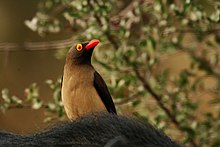 |
| Red-billed Oxpecker |
| Scientific classification |
|---|
| Kingdom: | Animalia |
| Phylum: | Chordata |
| Class: | Aves |
| Order: | Passeriformes |
| Suborder: | Passeri |
| Family: | Buphagidae
Lesson, 1828 |
| Genus: | Buphagus
Brisson, 1760 |
| Species |
|---|
Buphagus africanus
Buphagus erythrorhynchus
|
The oxpeckers are two species of bird which make up the family Buphagidae. Some ornithologists regard them as a subfamily Buphaginae within the starling family Sturnidae but they appear to be quite distinct.Oxpeckers are endemic to the savanna of Sub-Saharan Africa. Both the English and scientific names arise from their habit of perching on large mammals (both wild and domesticated) such as cattle or rhinoceroses, and eating ticks, botfly larvae, and other parasites.
According to the more recent studies of Muscicapoidea phylogeny,the oxpeckers are an ancient line related to Mimidae (mockingbirds and thrashers) and starlings but not particularly close to either. Considering the known biogeography of these groups, the most plausible explanation seems that the oxpecker lineage originated in Eastern or Southeastern Asia like the other two.This would make the two species of Buphagus something like living fossils, and elegantly demonstrates that such remnants of past evolution can possess striking and unique autapomorphic adaptations.
Distribution and habitat
The oxpeckers are endemic to sub-Saharan Africa, where they occur in most open habitats. They are absent from the driest deserts and the rainforests. Their distribution is restricted by the presence of their preferred prey, specific species of ticks, and the animal hosts of those ticks. Over much of East Africa the two species are sympatric (have overlapping distribution) and may even occur on the same host animal. The nature of the interactions between the two species is unknown.
Behaviour
Oxpeckers are fairly gregarious.
Diet and feeding

Yellow-billed Oxpecker on a wildebeest
Oxpeckers feed exclusively on the backs of large mammals. Certain species are seemingly preferred, whereas others, like the Lichtenstein's hartebeest or Topi are generally avoided. Smaller antelope such as lechwe, duikers and reedbuck are also avoided, the smallest regularly used species is the Impala, probably because of the heavy tick load and social nature of that species. In many parts of their range they now feed on cattle, but avoid camels. They feed on ectoparasites, particularly ticks, as well as insects infecting wounds and the flesh and blood of some wounds as well.
Oxpecker/mammal interactions are the subject of some debate and ongoing research. They were originally thought to be an example of mutualism, but recent evidence suggests that oxpeckers may be parasites instead.Oxpeckers do eat ticks, but often the ticks have already fed on the ungulate host and there has been no proven statistically significant link between oxpecker presence and reduced ectoparasite load.However one study of impalas found that impalas which were used by oxpeckers spent less time grooming themselves suggesting a reduction in parasite load. Oxpeckers have been observed to open new wounds and enhance existing ones in order to drink the blood of their perches.Oxpeckers also feed on the earwax and dandruffs of mammals, although less is known about the benefits of this to the mammal, it is suspected that this is also a parasitic behaviour.Some oxpecker hosts are intolerant of their presence.Elephants and some antelope will actively dislodge the oxpeckers when they land. Other species tolerate oxpeckers while they search for ticks on the face, what one author described as "appears ... to be an uncomfortable and invasive process.
Breeding
The breeding season of the oxpeckers, in at least one location, is linked to the rainy season, which affects the activity of their mammalian hosts and the tick loads of those hosts. Both courtship and copulation occur on their hosts as well. They nest in holes, usually in trees but sometimes in other types of cavity, including holes in walls. The nests are lined with grasses and also often with hair plucked from their hosts and even livestock such as sheep which are not usually used. The typical clutch is between two to three eggs, but the Red-billed Oxpecker may lay up to five eggs.
Species
- Red-billed Oxpecker, Buphagus erythrorhynchus of east Africa.
- Yellow-billed Oxpecker, Buphagus africanus of most of sub-Saharan Africa.
.jpg)