Showing posts with label Family Meropidae. Show all posts

Wednesday, July 4, 2012

>Merops nubicoides (Southern Carmine Bee-eater)

Southern Carmine Bee-eater


Merops nubicoides
Conservation status

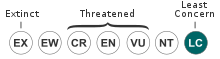
Least Concern (IUCN 3.1)
Scientific classification
Kingdom:Animalia
Phylum:Chordata
Class:Aves
Order:Coraciiformes
Family:Meropidae
Genus:Merops
Species:M. nubicoides
Binomial name
Merops nubicoides
(Des Murs & Pucheran, 1846)
The Southern Carmine Bee-eater (Merops nubicoides) (formerly Carmine Bee-eater) occurs across sub-equatorial Africa, ranging from KwaZulu-Natal and Namibia to Gabon, eastern Democratic Republic of the Congo and Kenya.
This species, like other bee-eaters, is a richly coloured,striking bird, predominantly carmine in colouration, but with the crown and undertail coverts blue.
Its usual habitat included low-altitude river valleys and floodplains, preferring vertical banks suitable for tunneling when breeding, but readily digging vertical burrows in the level surface of small salt islands. This is a highly sociable species, gathering in large flocks, in or out of breeding season. They roost communally in trees or reedbeds, and disperse widely during the day. Nesting is at the end of a 1-2m long burrow in an earthen bank, where the lay from 2-5 eggs.
This is migratory species, spending the breeding season, between August and November, in Zimbabwe, before moving south to South Africa for the summer months, and then migrating to equatorial Africa from March to August.
Their diet is made up primarily of bees and other flying insects, and their major hunting strategy involves hawking flying insects from perch. Perches may include branches of vegetation or even the backs of large animals, such as the Kori Bustard. They are attracted to wildfires because of the flushed insects, and are often seen circling high in the air. They also eat rodents and lizards.
They circle larger animals and even cars to catch the insects that try to escape.

>Merops nubicus (Northern Carmine Bee-eater)

Northern Carmine Bee-eater


Northern Carmine Bee-eater
Conservation status

Least Concern (IUCN 3.1)
Scientific classification
Kingdom:Animalia
Phylum:Chordata
Class:Aves
Order:Coraciiformes
Family:Meropidae
Genus:Merops
Species:M. nubicus
Binomial name
Merops nubicus
Gmelin, 1788
The Northern Carmine Bee-eater Merops nubicus is a near passerine bird in the bee-eater family Meropidae. Alternative common names include the Carmine Bee-eater or the Nubian Bee-eater.

Distribution

It is native to Benin, Burkina Faso, Cameroon, the Central African Republic, Chad, the Democratic Republic of the Congo, Côte d'Ivoire, Eritrea, Ethiopia, Gambia, Ghana, Guinea,Guinea-Bissau, 
Kenya, Liberia, Mali, Mauritania, Niger, Nigeria, Senegal, Sierra Leone,Somalia, Sudan, Tanzania, Togo and Uganda. It occurs as a vagrant in Burundi.

Description


Near Watamu, Kenya
This species, like other bee-eaters, is a richly colored, slender bird, predominantly carmine in color, except for a greenish blue head and throat and distinctive black mask. This species has red eyes, a black, pointed, decurved beak, and elongated central tail feathers.
The sexes are similar in appearance, and the juveniles can be distinguished from adults by their lack of elongated central tail feathers and the pinkish brown coloration of their mantle, chest to belly, and flanks.

Behaviour

Breeding

They nest in large colonies in cliffs, usually near river banks, where they use there bills to dig long horizontal nesting tunnels, often eight feet or more in length. Three to five eggs are laid per clutch.

Feeding

Their diet is made up primarily of bees and other flying insects, such as grasshoppers and locusts. The main hunting strategy of bee-eater is to keep watch for flying insects from a perch, and then snatch them out of the air using their beaks, before returning to the perch.

Call

The call is a deep, throaty "tunk" in flight; a series of "rik" notes when perched.

>Merops malimbicus (Rosy Bee-eater)

Rosy Bee-eater


Rosy Bee-eater
Conservation status

Least Concern (IUCN 3.1)
Scientific classification
Kingdom:Animalia
Phylum:Chordata
Class:Aves
Order:Coraciiformes
Family:Meropidae
Genus:Merops
Species:M. malimbicus
Binomial name
Merops malimbicus
Shaw, 1806
The Rosy Bee-eater (Merops malimbicus) is a species of bird in the Meropidae family. It is found in Angola, Benin, Burkina Faso, Republic of the Congo, Democratic Republic of the Congo, Ivory Coast, Equatorial Guinea, Gabon, Ghana, Nigeria, and Togo.

>Merops leschenaulti (Chestnut-headed Bee-eater)

Chestnut-headed Bee-eater


Chestnut-headed Bee-eater
Chestnut headed Bee eater in Thailand
Conservation status

Least Concern (IUCN 3.1)
Scientific classification
Kingdom:Animalia
Phylum:Chordata
Class:Aves
Order:Coraciiformes
Family:Meropidae
Genus:Merops
Species:M. leschenaulti
Binomial name
Merops leschenaulti
Vieillot, 1817
The Chestnut-headed Bee-eaterMerops leschenaulti is a near passerine bird in the bee-eater family Meropidae. It is a resident breeder in the Indian Subcontinent and adjoining regions, ranging from India east to Southeast Asia, including Thailand, Malaysia and Indonesia.
This species, like other bee-eaters, is a richly coloured, slender bird. It is predominantly green, with blue on the rump and lower belly. Its face and throat are yellow with a black eye stripe, and the crown and nape are rich chestnut. The thin curved bill is black. Sexes are alike, but young birds are duller.
This species is 18–20 cm long; it lacks the two elongated central tail feathers possessed by most of its relatives.


Description


Chestnut-Headed Bee-eater at Anamalai Tiger Reserve, Tamil Nadu, India
Forehead, crown, nape, upper back and ear-coverts bright chestnut ; lores black, continued as a band under the eye and ear-coverts ; wing-coverts, lower back and tertiaries green, the latter tipped with bluish; rump and upper tail-coverts pale shining blue; primaries and secondaries green, rufous on the inner webs, and all tipped dusky ; central tail-feathers bluish on the outer, and green on the inner webs ; the others green, margined on the inner web with brown and all tipped dusky ; sides of face, chin and throat yellow ; below this a broad band of chestnut extending to the sides of the neck and meeting the chestnut of the upper plumage ; below this again a short distinct band of black and then an ill-defined band of yellow ; remainder of lower plumage green, tipped with blue, especially on the vent and under tail-coverts.
The Javan sub-species, M. l. quinticolor, differs in having the whole space from the bill down to the black pectoral band pure yellow without any chestnut, and in having the tail blue.
Race andamanensis found in the Andamans is slightly larger than the Indian race. Iris crimson ; bill black ; legs dusky black ; claws dark horn-colour. �

Habits


In Kinnerasani Wildlife Sanctuary, Andhra Pradesh, India
This is a bird which breeds in sub-tropical open woodland, often near water. It is most common in highland areas. As the name suggests, bee-eaters predominantly eat insects, especially bees, wasps and hornets, which are caught in the air by sorties from an open perch.
These bee-eaters are gregarious, nesting colonially in sandy banks. They make a relatively long tunnel in which the 5 to 6 spherical white eggs are laid. Both the male and the female take care of the eggs. These birds also feed and roost communally. The call is similar to that of the European Bee-eater.
Its scientific name commemorates the French botanist Jean Baptiste Leschenault de la Tour.

>Merops apiaster (European Bee-eater)

European Bee-eater


European Bee-eater
Conservation status

Least Concern (IUCN 3.1)
Scientific classification
Kingdom:Animalia
Phylum:Chordata
Class:Aves
Order:Coraciiformes
Family:Meropidae
Genus:Merops
Species:M. apiaster
Binomial name
Merops apiaster
Linnaeus, 1758
The European Bee-eater (Merops apiaster), is a near passerine bird in the bee-eater family Meropidae. It breeds in southern Europe and in parts of north Africa and western Asia. It is strongly migratory, wintering in tropical Africa, India and Sri Lanka. This species occurs as a spring overshoot north of its range, with occasional breeding in northwest Europe.
This species, like other bee-eaters, is a richly-coloured, slender bird. It has brown and yellow upper parts, whilst the wings are green and the beak is black. It can reach a length of 27–29 cm (10.6–11.4 in), including the two elongated central tail feathers. Sexes are alike.
This is a bird which breeds in open country in warmer climates. Just as the name suggests, bee-eaters predominantly eat insects, especially bees, wasps and hornets which are caught in the air by sorties from an open perch. Before eating its meal, a European Bee-eater removes the sting by repeatedly hitting the insect on a hard surface. It eats some 250 bees daily. Lizards and frogs are also taken.
These bee-eaters are gregarious, nesting colonially in sandy banks, preferably near river shores, usually at the beginning of May. They make a relatively long tunnel in which the 5 to 8, spherical white eggs are laid around the beginning of June. Both the male and the female take care of the eggs, which are brooded for about 3 weeks. These birds also feed and roost communally.
The call is a pleasant distinctive trill.


Reported UK breeding attempts

European Bee-eater has attempted to nest on five occasions in Britain:
  • In 1920, a pair made a nesting attempt in a sand bank of the River Esk at Musselburgh,Scotland. A local gardener captured the female, keeping her in a greenhouse, and she died two days later, after laying a single egg.
  • In 1955, three pairs of Bee-eaters nested in Streat sand quarry near Plumpton, East Sussex. The birds were first found on 12 June, although the birds' presence only became widely known at the start of August. One nest was accidentally destroyed by machinery in July, but seven young fledged from the two remaining nests towards the end of August. An RSPB wardening operation was instigated, and in total over 1,000 people visited the site. The birds remained until 24 September.
  • A pair nested at Bishop Middleham Quarry, County Durham in 2002. The birds were first found on 2 June, and within a few days started to undertake courtship feeding and copulation; five chicks hatched, but one died in the nest, one died before fledging, and a third disappeared and was also believed to have died. Durham Wildlife Trust (with RSPB assistance) set up a wardening post during the period when the birds were nesting. News was released to rare bird information services, and the national news media also reported on the birds' presence. In total, some 15,000 people visited the site during their stay; the adults and both fledged young were seen to leave on 28 August, when they flew off high to the south.
  • A pair took up residence on farmland adjacent to the River Wye, near Hampton Bishop, Herefordshire in summer 2005; by mid-July the adults were bringing insect food to the riverbank nest-hole confirming that eggs had hatched. A wardening operation was set up by the RSPB, with public access granted, resulting in c. 2,000 people seeing the birds. However, on the evening of 29 July, foxes predated the nest, and the birds soon left the site.
  • A pair excavated a nest hole at a coastal site in Dorset in 2006, but this attempt failed (Birdwatch no. 173 p. 23).

Fiction

  • The third series of the sitcom To the Manor Born featured an episode, first aired on 11 August 1981, in which Bee-eaters bred at a fictional location in England .

Gallery

>Merops ornatus (Rainbow Bee-eater)

Rainbow Bee-eater


Rainbow Bee-eater
Perching on a drinking fountain in Cairns, Queensland, Australia
Conservation status

Least Concern (IUCN 3.1)
Scientific classification
Kingdom:Animalia
Phylum:Chordata
Class:Aves
Order:Coraciiformes
Family:Meropidae
Genus:Merops
Species:M. ornatus
Binomial name
Merops ornatus
Latham, 1801
The Rainbow Bee-eaterMerops ornatus, is a near passerine bird in the bee-eater family Meropidae. It is the only species of Meropidae found in Australia.

Description

Rainbow bee-eaters are brilliantly colored birds that grow to be 19-24cm (max 28cm) in length, including the elongated tail feathers. The upper back and wings are green in color, and the lower back and under-tail coverts are bright blue. The undersides of the wings and primary flight feathers are red and tipped with black, and the tail is black to deep violet. The rainbow bee-eater's two central tail feathers are longer than the other tail feathers, and are longer in the male rainbow bee-eaters than in the females. The crown of the head, the stomach and breast, and the throat are pale yellowish in color, and the rainbow bee-eater has a black bib and a black stripe through its red eye.

Distribution and habitat


Flying
Rainbow bee-eaters are a common species and can be found during the summer in forested areas in most of southern Australia
 excluding Tasmania. They migrate north during the winter into northern Australia, New Guinea, and some of the southern islands of Indonesia.
They may be found in open woodlands, beaches, dunes, cliffs, mangroves, woodlands and they often visits parks and private gardens. 

Behaviour

Like all bee-eaters, rainbow bee-eaters are very social birds. When they are not breeding they roost together in large groups in dense undergrowth or large trees.

Nesting

Breeding season is before and after the rainy season in the north, and from November to January in the south. Rainbow bee-eaters are believed to mate for life. The male will bring the female insects while she digs the burrow that will be their nest. The bee-eater digs its burrow by balancing on its wings and feet, and digs with its bill, then pushing loose soil backwards with its feet while balancing on its bill. The female bee-eater can dig about three inches down every day. The nest tunnel is very narrow, and the birds' bodies press so tightly against the tunnel walls that when the birds enter and exit their movement acts like a piston, pumping in fresh air and pushing out stale air. Rainbow bee-eaters have also been known to share their nest tunnels with other bee-eaters and sometimes even other species of birds. The female lays between 3 and 7 glossy white eggs, which are incubated for about 24 days until hatching. The young bee-eaters fledge after about 30 days and are fed by both parents, as well as any older bee-eaters that may not have paired off or have lost their mate. Cane Toads are known to prey on nestlings.

Diet


Photographed at Dayboro, SE Queensland, Australia
Rainbow bee-eaters mostly eat flying insects, but, as their name implies, they have a real taste for bees. Rainbow bee-eaters are always watching for flying insects, and can spot a potential meal up to 45 metres away. Once it spots an insect a bee-eater will swoop down from its perch and catch it in its long, slender, black bill and fly back to its perch. Bee-eaters will then knock their prey against their perch to subdue it. Even though rainbow bee-eaters are actually immune to the stings of bees and wasps, upon capturing a bee they will rub the insect's stinger against their perch to remove it, closing their eyes to avoid being squirted with poison from the ruptured poison sac. Bee-eaters can eat several hundred bees a day, so they are obviously resented by beekeepers, but their damage is generally balanced by their role in keeping pest insects such as locusts, hornets, and wasps under control.

Media

Rainbow beeeater.ogg
Rainbow Bee-eater sunning, early morning SE Queensland, Australia

Tuesday, July 3, 2012

>Merops superciliosus (Olive Bee-eater)

Olive Bee-eater

Olive Bee-eater
Conservation status

Least Concern (IUCN 3.1)
Scientific classification
Kingdom:Animalia
Phylum:Chordata
Class:Aves
Order:Coraciiformes
Family:Meropidae
Genus:Merops
Species:M. superciliosus
Binomial name
Merops superciliosus
Linnaeus, 1766
The Olive Bee-eater, (or Madagascar Bee-eater) (Merops superciliosus) is a near passerine bee-eater species in the genus Merops.

>Merops viridis (Blue-throated Bee-eater)

Blue-throated Bee-eater

Blue-throated Bee-eater
Conservation status

Least Concern (IUCN 3.1)
Scientific classification
Kingdom:Animalia
Phylum:Chordata
Class:Aves
Order:Coraciiformes
Family:Meropidae
Genus:Merops
Species:M. viridis
Binomial name
Merops viridis
Linnaeus, 1758
The Blue-throated Bee-eater (Merops viridis) is a species of bird in the Meropidae family. It is found in Brunei, Cambodia, China, Hong Kong, Indonesia, Laos, Malaysia, the Philippines, Singapore,
 Taiwan, Thailand, and Vietnam. Its natural habitat is subtropical or tropical mangrove forests.

>Merops boehmi (Böhm's Bee-eater)

Böhm's Bee-eater

Böhm's Bee-eater
Conservation status

Least Concern (IUCN 3.1)
Scientific classification
Kingdom:Animalia
Phylum:Chordata
Class:Aves
Order:Coraciiformes
Family:Meropidae
Genus:Merops
Species:M. boehmi
Binomial name
Merops boehmi
Reichenow, 1882
The Böhm's Bee-eater (Merops boehmi) is a species of bird in the Meropidae family. It is found in Democratic Republic of the Congo, Malawi, Mozambique, Tanzania, and Zambia.

>Merops revoilii (Somali Bee-eater)

Somali Bee-eater


Somali Bee-eater
Conservation status

Least Concern (IUCN 3.1)
Scientific classification
Kingdom:Animalia
Phylum:Chordata
Class:Aves
Order:Coraciiformes
Family:Meropidae
Genus:Merops
Species:M. revoilii
Binomial name
Merops revoilii
Oustalet, 1882
The Somali bee-eater (Merops revoilii) is a species of bird in the Meropidae family. It is found in Ethiopia, Kenya, Saudi Arabia, Somalia and Tanzania.
This is a small bee-eater, about seventeen centimetres long. It prefers arid country and desert areas where it may be locally common. It feeds on small flying insects which it catches in short dashes from a low perch. It is either solitary or found in pairs. It nests in the banks of road cuttings and in the sides of deep wells. In Kenya it breeds between March and June.

>Merops breweri (Black-headed Bee-eater)

Black-headed Bee-eater


Black-headed Bee-eater
Conservation status

Least Concern (IUCN 3.1)
Scientific classification
Kingdom:Animalia
Phylum:Chordata
Class:Aves
Order:Coraciiformes
Family:Meropidae
Genus:Merops
Species:M. breweri
Binomial name
Merops breweri
(Cassin, 1859)
The Black-headed Bee-eater (Merops breweri) is a species of bird in the Meropidae family. It is found in Angola, Central African Republic, Republic of the Congo, Democratic Republic of the Congo, Ivory Coast, Gabon, Ghana, Nigeria, and Sudan.

>Merops oreobates (Cinnamon-chested Bee-eater)

Cinnamon-chested Bee-eater

Cinnamon-chested Bee-eater
At Ruhija, SW Uganda
Conservation status

Least Concern (IUCN 3.1)
Scientific classification
Kingdom:Animalia
Phylum:Chordata
Class:Aves
Order:Coraciiformes
Family:Meropidae
Genus:Merops
Species:M. oreobates
Binomial name
Merops oreobates
(Sharpe, 1892)
The cinnamon-chested bee-eater (Merops oreobates) is a species of bird in the Meropidae family. It is found in Burundi, Democratic Republic of the Congo, Ethiopia, Kenya,Rwanda, Sudan, Tanzania, and Uganda.

This bird occurs in upland regions and can be found associated with wooded hillsides and forest edges. It can be distinguished from the somewhat similar Little Bee-eater by its larger size, darker colouring, white cheek patches and the upland habitat where it is found. Its diet consists mainly of honeybees although it also eats moths, butterflies, dragonflies, beetles and other flying insects. It seems to be an adaptable species and able to withstand loss of its forest habitat. It measures 22 cm (8.7 in) in length and weighs 17–38 g (0.60–1.3 oz).