Showing posts with label Genus Aegithina. Show all posts

Saturday, April 14, 2012

>Aegithina lafresnayei (Great Iora)

Great Iora


Great Iora
Conservation status
Scientific classification
Kingdom:Animalia
Phylum:Chordata
Class:Aves
Order:Passeriformes
Family:Aegithinidae
Genus:Aegithina
Species:A. lafresnayei
Binomial name
Aegithina lafresnayei
(Hartlaub, 1844)
The Great Iora (Aegithina lafresnayei) is a species of bird in the Aegithinidae family. It is found in CambodiaChinaLaos
MalaysiaMyanmarThailand, and Vietnam. Its natural habitat is subtropical or tropical moist lowland forests.

>Aegithina viridissima (Green Iora)

Green Iora


Green Iora
Conservation status
Scientific classification
Kingdom:Animalia
Phylum:Chordata
Class:Aves
Order:Passeriformes
Family:Aegithinidae
Genus:Aegithina
Species:A. viridissima
Binomial name
Aegithina viridissima
(Bonaparte, 1851)
The Green Iora (Aegithina viridissima) is a species of bird in the Aegithinidae family. It is found in BruneiIndonesia
MalaysiaMyanmarSingapore, and Thailand.
AegithinaViridissimaKeulemans.jpg
Its natural habitats are subtropical or tropical moist lowland forests and subtropical or tropical mangrove forests. It is threatened by habitat loss.

>Aegithina nigrolutea (Marshall's Iora)

Marshall's Iora


Marshall's Iora
Foraging on a flowering Butea
Conservation status
Scientific classification
Kingdom:Animalia
Phylum:Chordata
Class:Aves
Order:Passeriformes
Family:Aegithinidae
Genus:Aegithina
Species:A. nigrolutea
Binomial name
Aegithina nigrolutea
(Marshall, 1876)
The White-tailed Iora or Marshall's Iora (Aegithina nigrolutea),is a songbird in the genusAegithina found in parts of India and Sri Lanka.

Distribution and identification

Marshall's Iora is located in India
Distribution records of A. nigrolutea
The status of the species has been debated and has only recently been given full species status. Earlier suggestions have been that it was a clinal variant of the Common IoraAegithina tiphia.
The diagnostic features of the species are the short wing and tail; white edging to tertials converging broadly at the tip, versus tertial tips black to only narrowly white in tiphia and a smaller and shorter bill than tiphia from any part of India. The vocalizations are also different.The species is best known from northwestern India, however only a few verified specimen records exist from southern India. It is now also known from Sri Lanka.
There are several races of the Common Iorathat may appear similar to this species:
Specimens showing nigrolutea characters collected within the range of Aegithina tiphiamay be variants of the latter; such specimens have been obtained from southern Bihar, West Bengal, Khandesh, Tamil Nadu and Mysore. Two adult specimens collected from Gwalior are intermediate between Aegithina tiphia humei and Aegithina nigrolutea and one specimen from Ceylon is intermediate between the latter and Aegithina tiphia multicolor. The status of Aegithina nigrolutea as a distinct species is not settled. It is a problem that presents a challenge to geneticists and field workers alike
—Ali and Ripley
Salim Ali collected a specimen in the Biligirirangan Hills which was commented upon by Hugh Whistler:
One of the Biligirirangan birds, male ,15 September 1934 from Satyamangala (2,000') and evidently by the softness of the skull and the narrow tail feathers an immature bird, could not be distinguished from A. nigrolutea as the central tail is washed with white. I cannot believe that this is really nigrolutea which has not been recorded from nearer than northern Khandesh andSambalpur. It is evidently an interesting case of individual variation showing how nigrolutea had its origin.
Whistler's comments have been subsequently debated and Daniel Marien notes that the southern boundary of the species is not well understood and further notes that the Biligirirangans specimen commented upon by Whistler was identified positively by Biswamoy Biswas as a nigrolutea.
Adult females of both species are entirely green above (except for a gray and white tail in nigrolutea) and yellow (dull in winter, brighter in spring) below. The juvenal and first-winter plumages in both sexes of both species are similar to their adult female plumages. First-year birds are best recognized by the possession of more pointed and somewhat narrower tail feathers.
Walter Koelz collected two adult specimens of the species at Salem and the distribution range of the species is believed to overlap significantly with that of A. tiphia.
Subadults (first-winter) and adults of both species undergo an incomplete spring molt in which usually only the body feathers are replaced, but first-year birds do not at that time acquire the full nuptial dress. This incomplete spring molt seldom involves the tail, but occasionally some males of tiphia are found to be molting the rectrices, with green quills being replaced by black ones. This condition exists in several subadult males taken in late May and early June in Nepal; it seems unlikely that this represents an early fall molt, the molt in which subadult males normally acquire the black tail of the adult. No black-backed, green-tailed males of tiphia have been reported. It is not clear whether birds in first-year plumage breed, or not. The nuptial plumage of both species is acquired by means of an incomplete molt before the breeding season. In males of nigrolutea and in some populations of tiphia, birds in this plumage have a golden yellow chin and throat and a variable amount of black on the dorsum; in Himalayan, Chinese, north Siamese, Indochinese, Javan, Balinese, Bornean, and Palawan forms of tiphia the males have a green-backed, feminine type of plumage.
Adult males of both species are black-tailed at all seasons, except on Java and Bali where tiphia males are always completely henfeathered; in nigrolutea, at the other extreme, even subadult males have a black and white tail.
—Daniel Marien

Habits

The species is believed to have a courtship display not unlike that of the Common Iora. Breeds from June to August and nests low in a bush. Presumed to be resident but little is known.

>>Genus Aegithina >Aegithina tiphia (Common Iora)

Common Iora


Common Iora
Conservation status
Scientific classification
Kingdom:Animalia
Phylum:Chordata
Class:Aves
Order:Passeriformes
Family:Aegithinidae
Genus:Aegithina
Species:A. tiphia
Binomial name
Aegithina tiphia
(Linnaeus, 1758)
The Common Iora (Aegithina tiphia) is a small passerine bird found across the tropical Indian Subcontinent with populations showing plumage variations, some of which are designated as subspecies. A species found in scrub and forest, it is easily detected from its loud whistles and the bright colours. During the breeding season, males display by fluffing up their feathers and spiral in the air appearing like a green, black, yellow and white ball.

Description

Ioras have a pointed and notched beak with a culmen that is straight. The Common Iora is sexually dimorphic, males in the breeding season have a black cap and back adding to a black wing and tail at all seasons. Females have greenish wings and an olive tail. The undersides of both are yellow and the two white bars on the wings of the male are particularly prominent in their breeding plumage. The males in breeding plumage have a very variable distribution of the black on the upperparts and can be confused with Marshall's Iora, however, the latter always has white tips to the tail. The nominate subspecies is found along the Himalayas and males of this population are very similar to females or have only a small amount of black on the crown. In northwestern India,septentrionalis is brighter yellow than others and in the northern plains of India humei males in breeding plumage have a black cap and olive on the upper mantle. In southwestern India and Sri Lanka multicolor has the breeding males with a jet black cap and mantle. The forms in the rest of southern India are intermediate between multicolor and humei with more grey-green on the rump (formerly considered as deignani but now used for the Burmese population).
Several other populations across Southeast Asia are designated as subspecies including philipi of southern China and northern Thailand/Laos, deignani of Myanmar, horizoptera of southern Myanmar and the island chain of Sumatra, cambodiana of Cambodia, aeqanimis of Palawan and northern Borneo, viridis of Borneo and scapularis of Java and Bali.

Behaviour and ecology

About this sound Call of Common Iora  Ioras forage in trees in small groups, gleaning among the branches for insects. They sometimes join mixed species feeding flocks. The call is a mixture of churrs, chattering and whistles, and the song is a trilled wheeeee-tee. They may sometimes imitate the calls of other birds such as drongos.

A. t. multicolor- Male in Hyderabad, India.
During the breeding season, mainly after the monsoons, the male performs an acrobatic courtship display, darting up into the air fluffing up all his feathers, especially those on the pale green rump, then spiralling down to the original perch. Once he lands, he spreads his tail and droops his wings. Two to four greenish white eggs are laid in a small and compact cup-shaped nest made out of grass and bound with cobwebs and placed in the fork of a tree. Both male and female incubate and eggs hatch after about 14 days. Nests predators include snakes, lizards, crow-pheasant and crows.Nests may also be brood-parasitized by the Banded Bay Cuckoo.
Ioras moult twice in a year and the plumage variation makes them somewhat complicated for plumage based separation of the populations.
A species of HaemoproteusH. aethiginae, was described from a specimen of the Common Iora from Goa.
>>>Family Aegithinidae (Iora)

Iora

Ioras
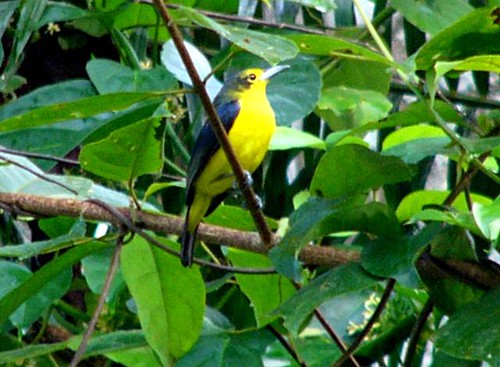
Marshall's Iora
Scientific classification
Kingdom:Animalia
Phylum:Chordata
Class:Aves
Order:Passeriformes
Suborder:Passeri
Family:Aegithinidae
G. R. Gray, 1869
Genus:Aegithina
Vieillot, 1816
Species
See text.
The ioras are a familyAegithinidae, of small passerine bird 
species found in India and southeastAsia. The family has only four species in a single genus, Aegithina. They are one of only three bird families that are entirely endemic to the Indomalayan ecozone. They were formerly grouped with the other two of those families, the leafbirds and fairy-bluebirds, in the family Irenidae.

Common Iora Aegithina tiphiacalling in Hyderabad, India.

Description

The ioras are small to medium small sized passerines, ranging from 11.5–15.5 cm (4.5–6.1 in) in length. Overall the males are larger than the females. These are reminiscent of the bulbuls, but whereas that group tends to be drab in colouration, the ioras are more brightly coloured. The group exhibits sexual dimorphism in its plumage, with the males being brightly plumaged in yellows and greens. Unlike the leafbirds, ioras have thin legs, and their bills are proportionately longer. Calls are strident whistles; songs are musical to human ears.

Habitat and movements

Their habitats include acacia scrub, forest edge, and closed forests, as well as agricultural land and (in the Common Iora) gardens. They are generally lowland birds, with most reaching only as high as the submontane forests. They are generally highly arboreal and usually occur in the tree canopy, with only very rare records of this family coming down to the ground. The family is overwhelmingly non-migratory, although in West India there is some evidence that Marshall's Ioras and Common Ioras are partly migratory in the seasonal semi-desert fringe.

Behaviour

Ioras eat insects and spiders, which they find by nimbly gleaning the leaves of the slenderest outer twigs.
In the two species whose male courtship displays are known, they are elaborate, culminating in the males' parachute-style descent looking like "green balls of fluff". The nests are compact open cups felted to branches with spiderweb. Females lay 2 or 3 eggs, which have pinkish speckles and red and purple lines. They incubate at night; the males, by day. Incubation lasts about 14 days. Both parents are responsible for brooding and feeding the chicks.

Relationship with humans

Ioras will commonly live close to humans and even lives in the suburbs of cites like Singapore. They are mostly not threatened by human activities, although the Green Iora is listed as near threatened by the IUCNhabitat loss is responsible for its decline. Unlike many other passerines they are not common species in the cage bird trade.

Species of Aegithinidae

  • Common Iora, Aegithina tiphia
  • Marshall's Iora, Aegithina nigrolutea
  • Green Iora, Aegithina viridissima
  • Great Iora, Aegithina lafresnayei