Showing posts with label Genus Chloephaga. Show all posts

Thursday, May 10, 2012

>Chloephaga rubidiceps (Ruddy-headed Goose)

Ruddy-headed Goose

Ruddy-headed Goose
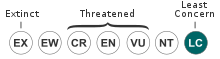
Conservation status
Scientific classification
Kingdom:Animalia
Phylum:Chordata
Class:Aves
Order:Anseriformes
Family:Anatidae
Subfamily:Tadorninae
Genus:Chloephaga
Species:C. rubidiceps
Binomial name
Chloephaga rubidiceps
Sclater,PL, 1861
The Ruddy-headed Goose (Chloephaga rubidiceps) is a large sheldgoose, which breeds in southernmost South America.
It breeds on open grassy plains in Tierra del Fuego, Chile and the Falkland Islands. The South American birds are now very rare. They winter on lowlands in southern Argentina, some distance north of the breeding range. The Falklands population is resident.
The lined nest is built amongst grass tussocks, and 4-11 eggs are laid. This terrestrial species favours damp upland forest clearings and feeds by grazing; it rarely swims. It forms flocks outside the breeding season, often mixed with Ashy-headed Goose.
Ruddy-headed Goose is a stocky 45–50 cm bird with a pale grey back, and black-barred rich buff underparts. The head and upper neck are chestnut brown. Sexes are similar, but immature birds are duller.
In flight this species shows black primaries, with the rest of the wing white except for a broad green bar. The male's call is a soft whistle, and the female's is a harsh cackle.
This species remains numerous in the Falklands, despite competition from grazing cattle and sheep, but the South American population in Tierra del Fuego has been reduced to a few hundred birds not only by livestock farming, but especially predation by the South American gray fox, which was introduced to Tierra del Fugeo in the 1950s to control rabbits.


>Chloephaga poliocephala (Ashy-headed Goose)

Ashy-headed Goose

Ashy-headed Goose
Adult in Patagonia, South America
Conservation status
Scientific classification
Kingdom:Animalia
Phylum:Chordata
Class:Aves
Order:Anseriformes
Family:Anatidae
Subfamily:Tadorninae
Genus:Chloephaga
Species:C. poliocephala
Binomial name
Chloephaga poliocephala
P.L. Sclater, 1857
The Ashy-headed Goose (Chloephaga poliocephala) is a large sheldgoose, which breeds in mountainous areas of southernmost South America and winters on lowlands just north of its breeding range.
The lined nest is built in tall grass, and 4–6 eggs are laid. This terrestrial species favours damp upland forest clearings and feeds by grazing; it rarely swims.

Description


Parents with chicks in Tierra del Fuego

Juveniles in Patagonia
The Ashy-headed Goose is a stocky 50–55 cm (20–22 in) bird with a pale brown back, chestnut neck and black-barred white flanks. The head is grey and paler over the crown. The inside of the legs are black and the outside of the legs are red. Sexes are similar, except that the male may have reduced or no underparts barring. Immature birds are duller and have brown heads.
In flight, this species shows black primaries, with the rest of the wing white except for a broad green bar. The male's call is a soft whistle, and the female's is a harsh cackle.


>Chloephaga hybrida (Kelp Goose)

Kelp Goose

Kelp Goose
Conservation status
Scientific classification
Kingdom:Animalia
Phylum:Chordata
Class:Aves
Order:Anseriformes
Family:Anatidae
Subfamily:Tadorninae
Genus:Chloephaga
Species:C. hybrida
Binomial name
Chloephaga hybrida
(Molina, 1782)
Subspecies
  • C. h. hybrida (Molina, 1782)
  • C. h. malvinarum (Phillips, 1916
The Kelp Goose (Spanish: Caranca or Cauquén Marino), Chloephaga hybrida, is a member of the duck, goose and swan family Anatidae. It is in the shelduck subfamily Tadorninae. It can be found in the Southern part of South America; in Patagonia, Tierra del Fuego, and the Falkland Islands.

Habitat

Kelp geese inhabit areas of southern Chile and Argentina, mainly in Patagonia, Tierra del Fuego, and the Falkland Islands. They habitat rocky coasts around their food sources.

Description

Males are a white color, with a black beak, and yellow feet. The females are dark brown, with transverse gray lines on the chest, and yellow feet.

Behavior

Kelp geese generally have clutches of 2-7 eggs. They prefer to hide their eggs in long grass. The eggs hatch about a month later.
There are about 15,000 breeding pairs in existence.

Ecology

Kelp geese are noted for only eating kelp and will migrate along the coast of South America in order to find kelp, hence the name 'kelp geese'.

Trivia

In the Falkland Islands and Argentina there are kelp geese stamps.


>Chloephaga picta (Upland Goose)

Upland Goose

Upland Goose
Conservation status
Scientific classification
Kingdom:Animalia
Phylum:Chordata
Class:Aves
Order:Anseriformes
Family:Anatidae
Subfamily:Tadorninae
Genus:Chloephaga
Species:C. picta
Binomial name
Chloephaga picta
(Gmelin, 1789)
Subspecies
  • C. p. picta (Gmelin, 1789),
    (Lesser Magellan Goose)
  • C. p. leucoptera (Gmelin, 1789),
    <(Greater Magellan Goose)
Synonyms
Foetopterus ambiguus
Moreno & Mercerat, 1891
The Upland Goose or Magellan Goose (Chloephaga picta) is a South American member of the duck, goose
and swan family Anatidae.It is in the shelduck subfamily, Tadorninae. Males have a white head and breast, whereas the females are brown with black-striped wings and yellow feet, and could be mistaken for Ruddy-headed Geese. These birds are 60–72.5 centimetres (24–28.5 in) long and weigh 2.7–3.2 kilograms (6.0–7.1 lb).They are found in open grasslands.

Upland geese in Santa Cruz, Argentina

Upland Geese caring for their babies, El Calafate, Argentina
Upland Geese are noted in Chapter VI of The Origin of Species for having vestigial webbing between their toes.


>Chloephaga melanoptera (Andean Goose)

Andean Goose

Andean Goose
Conservation status
Scientific classification
Kingdom:Animalia
Phylum:Chordata
Class:Aves
Order:Anseriformes
Family:Anatidae
Subfamily:Tadorninae
Genus:Chloephaga
Species:C. melanoptera
Binomial name
Chloephaga melanoptera
(Eyton, 1838)
The Andean GooseChloephaga melanoptera, is a member of the duck, goose and swan family Anatidae. It is in the shelduck subfamily Tadorninae.
It is resident around lakes and marshes in the high Andes, usually well above 3000 m. It is largely terrestrial and avoids swimming except in emergencies.
This heavily built bird has a tiny pink bill and white plumage except for black in the wings and tail. The female is similar to the male, but is smaller.
The Andean Goose is a grazing species, eating grasses. It nests on the ground in a bare scrape near water, laying 6-10 eggs. It is territorial in the breeding season, but otherwise forms small flocks.

Feeding


>>Genus Chloephaga (Sheldgoose)

Sheldgoose


Sheldgeese
Ruddy-headed Goose, Chloephaga rubidiceps
Scientific classification
Kingdom:Animalia
Phylum:Chordata
Class:Aves
Order:Anseriformes
Family:Anatidae
Subfamily:Tadorninae
Genus:Chloephaga
Eyton, 1838
Species
  • Chloephaga melanoptera
  • Chloephaga picta
  • Chloephaga hybrida
  • Chloephaga poliocephala
  • Chloephaga rubidiceps
The sheldgeese are a genus (Chloephaga) of birds in the family Anatidae.

Species

  • Andean Goose, Chloephaga melanoptera
  • Upland Goose or Magellan Goose, Chloephaga picta
  • Kelp Goose, Chloephaga hybrida
  • Ashy-headed Goose, Chloephaga poliocephala
  • Ruddy-headed Goose, Chloephaga rubidiceps