Showing posts with label Genus Cypseloides. Show all posts

Tuesday, June 5, 2012

>Cypseloides cryptus (White-chinned Swift)

White-chinned Swift


The White-chinned Swift (Cypseloides cryptus) is a species of swift in the Apodidae family. It is found in Belize, Colombia, Costa Rica, Ecuador, Guyana, Honduras, Mexico, Nicaragua, Panama, Peru, and Venezuela. Its natural habitats are subtropical or tropical moist lowland forests and subtropical or tropical moist montane forests.


White-chinned Swift
Conservation status

Least Concern (IUCN 3.1)
Scientific classification
Kingdom:Animalia
Phylum:Chordata
Class:Aves
Order:Apodiformes
Family:Apodidae
Genus:Cypseloides
Species:C. cryptus
Binomial name
Cypseloides cryptus
Zimmer, 1945

>Cypseloides niger (American Black Swift)

American Black Swift


American Black Swift
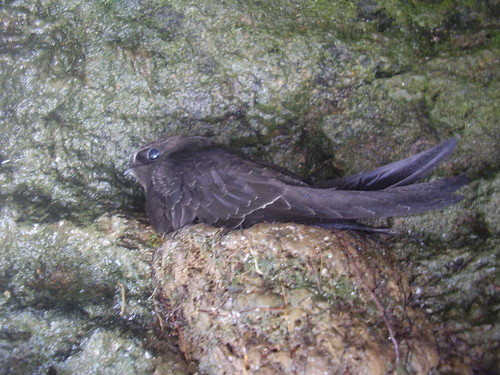
Adult Black Swift on the nest in Shoshone County, Idaho
Conservation status

Least Concern (IUCN 3.1)
Scientific classification
Kingdom:Animalia
Phylum:Chordata
Class:Aves
Order:Apodiformes
Family:Apodidae
Genus:Cypseloides
Species:C. niger
Binomial name
Cypseloides niger
(Gmelin, 1789)
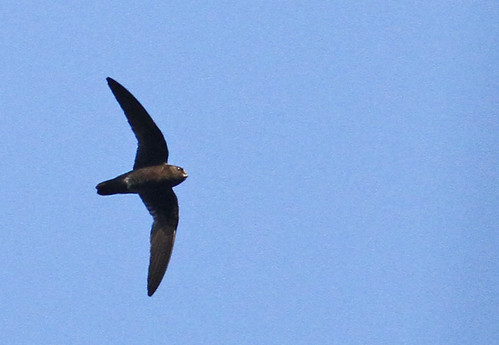
The American Black Swift or more simply Black Swift (Cypseloides niger) is found from northern British Columbia in Canada through the United States and Mexico to Costa Rica and Brazil. It is also found on islands in the West Indies.
In flight, this bird looks like a flying cigar with long slender curved wings. The plumage is mostly a sooty dark gray. There is some contrast between the upper and lower wing. The shoulders are much darker in color than the remaining portion of the wing. They also have short slightly forked tails.
Their breeding habitat is frequently associated with water. The birds most often nest on high cliff faces, either above the ocean surf or behind or next to waterfalls. The nest is made of twigs and moss glued together with mud. They will also use ferns and seaweed if available. The females usually lay 1 egg, sometimes 2, and incubation lasts 23-27 days. Young are fed usually once a day by both parents, most often at dusk.
These birds do migrate out of North America after the breeding season. It remains unclear where most of the birds spend the winter, although some of the birds have been tracked as far south as Brazil, migrating there from Colorado. Some of the birds in the West Indies appear to be permanent residents. They are one of the last migrants to appear, often seen migrating in mid-June to early July. They also migrate in large flocks.
American Black Swifts live on the wing, foraging in flight. They eat flying insects, primarily flying ants and beetles. They usually feed in groups, flying closely together.

Status and distribution

North America

Fewer than 100 Black Swift breeding sites are known in the United States.These include:
  • In Alberta: Johnston Canyon.
  • In California: the Santa Cruz coast (where it is declining, Berry Creek Falls, Yosemite, Sequoia & Kings Canyon National Parks, San Bernardino Mountains, and the San Jacinto Mountains.
  • In Colorado: Box Canyon near Ouray, Hanging Lake, Hawk Creek Falls, Falls Creek Falls and Niagara and Cataract Gulches.
  • In New Mexico: Jemez Falls.
  • In Utah: Stewart Falls.
  • In Washington: Semiahoo Bay

>Cypseloides rutilus (Chestnut-collared Swift)

Chestnut-collared Swift

Chestnut-collared Swift
An adult male on the nest.
Conservation status
Scientific classification
Kingdom:Animalia
Phylum:Chordata
Class:Aves
Order:Apodiformes
Family:Apodidae
Genus:Streptoprocne
Species:S. rutila
Binomial name
Streptoprocne rutila
(Vieillot, 1817)
Range of Streptoprocne rutila
Synonyms
Cypseloides rutilus
The Chestnut-collared Swift, Streptoprocne rutila, is a resident breeding bird from Mexico and Trinidad south to Peru and Bolivia. It was one of the species of Cypseloides controversially moved to Streptoprocne by the AOU (BLI 2004).
This swift is a medium-sized species, 12.7-13.5 cm long, with a longish tail, and weighing 20 g. The male is blackish with a rufous collar. In females and immatures the rufous collar is incomplete or absent. Young birds also differ from the females in that they have reddish edges to the crown feathers. The Chestnut-collared Swift has a chattering chit-chit-chit call.
Chestnut-collared Swifts feed in flight on flying insects, especially flying ants, often at a greater height than other swifts. Although breeding occurs at all levels where there are suitable sites, this species usually feeds over hill forests or more open woodland at 500 m or more.
The Chestnut-collared Swift builds a nest of mud and plant material on a vertical surface in a damp shady location near water, such as in a cave, under a bridge, or in a culvert. The nest is shaped like a flattened cone, and the two white eggs are incubated by both sexes for 23 days, with a further 40 days to fledging. The young are fed on foodballs made from the collected prey.

Subspecies

The following subspecies are currently recognized:
  • Streptoprocne rutila brunnitorques (Lafresnaye, 1844)
  • Streptoprocne rutila griseifrons (Nelson, 1900)
  • Streptoprocne rutila rutila (Vieillot, 1817)

>Cypseloides storeri (White-fronted Swift)

White-fronted Swift


White-fronted Swift
Conservation status

Data Deficient (IUCN 3.1)
Scientific classification
Kingdom:Animalia
Phylum:Chordata
Class:Aves
Order:Apodiformes
Family:Apodidae
Genus:Cypseloides
Species:C. storeri
Binomial name
Cypseloides storeri
Navarro, A.T. Peterson, Escalante & D. Benitez, 1992
The White-fronted Swift (Cypseloides storeri) is a species of swift in the Apodidae family. It is endemic to Mexico.
Its natural habitat is subtropical or tropical moist montane forests.

>Cypseloides senex (Great Dusky Swift)

Great Dusky Swift


Great Dusky Swift
Conservation status

Least Concern (IUCN 3.1)
Scientific classification
Kingdom:Animalia
Phylum:Chordata
Class:Aves
Order:Apodiformes
Family:Apodidae
Genus:Cypseloides
Species:C. senex
Binomial name
Cypseloides senex
(Temminck, 1826)
The Great Dusky Swift (Cypseloides senex) is a species of swift in the Apodidae family.
It is found in Argentina, Bolivia, Brazil, and Paraguay. Its natural habitats are temperate forests, subtropical or tropical moist lowland forests, and heavily degraded former forest.

>Cypseloides rothschildi (Rothschild's Swift)

Rothschild's Swift


Rothschild's Swift
Conservation status

Near Threatened (IUCN 3.1)
Scientific classification
Kingdom:Animalia
Phylum:Chordata
Class:Aves
Order:Apodiformes
Family:Apodidae
Genus:Cypseloides
Species:C. rothschildi
Binomial name
Cypseloides rothschildi
Zimmer, 1945
The Rothschild's Swift (Cypseloides rothschildi) is a species of swift in the Apodidae family. It is found in Argentina, Bolivia, and Peru. Its natural habitats are subtropical or tropical moist montane forests and subtropical or tropical high-altitude grassland. It is threatened by habitat loss.

>Cypseloides lemosi (White-chested Swift)

White-chested Swift

White-chested Swift (Cypseloides lemosi)


White-chested Swift
Conservation status

Least Concern (IUCN 3.1)
Scientific classification
Kingdom:Animalia
Phylum:Chordata
Class:Aves
Order:Apodiformes
Family:Apodidae
Genus:Cypseloides
Species:C. lemosi
Binomial name
Cypseloides lemosi
Eisenmann & Lehmann, 1962
The White-chested Swift (Cypseloides lemosi) is a species of swift in the Apodidae family. It is found in Colombia, Ecuador, and Peru. Its natural habitat is heavily degraded former forest.

>Cypseloides fumigatus (Sooty Swift)

Sooty Swift


Sooty Swift
Conservation status

Least Concern (IUCN 3.1)
Scientific classification
Kingdom:Animalia
Phylum:Chordata
Class:Aves
Order:Apodiformes
Family:Apodidae
Genus:Cypseloides
Species:C. fumigatus
Binomial name
Cypseloides fumigatus
(Streubel, 1848)
The Sooty Swift (Cypseloides fumigatus) is a species of swift in the Apodidae family. It is found in Argentina, Bolivia, Brazil, and Paraguay. Its natural habitats are temperate forests, subtropical or tropical moist lowland forests, subtropical or tropical moist montane forests, and heavily degraded former forest.

>Cypseloides cherriei (Spot-fronted Swift)

Spot-fronted Swift


Spot-fronted Swift
Conservation status

Data Deficient (IUCN 3.1)
Scientific classification
Kingdom:Animalia
Phylum:Chordata
Class:Aves
Order:Apodiformes
Family:Apodidae
Genus:Cypseloides
Species:C. cherriei
Binomial name
Cypseloides cherriei
Ridgway, 1893
The Spot-fronted Swift (Cypseloides cherriei) is a species of swift in the Apodidae family. It is found in Colombia, Costa Rica, Ecuador, and Venezuela. Its natural habitat is subtropical or tropical moist montane forests.

>>>Tribe Cypseloidini >>Genus Cypseloides

Cypseloides


Cypseloides
Cypseloides senex
Scientific classification
Kingdom:Animalia
Phylum:Chordata
Class:Aves
Order:Apodiformes
Family:Apodidae
Tribe:Cypseloidini
Genus:Cypseloides
Streubel, 1848
Species
9 recognized species, see article.
Cypseloides is a genus of swift in the Apodidae family. It contains nine described species.

Species

  • Spot-fronted Swift (Cypseloides cherriei)
  • White-chinned Swift (Cypseloides cryptus)
  • Sooty Swift (Cypseloides fumigatus)
  • White-chested Swift (Cypseloides lemosi)
  • Rothschild's Swift (Cypseloides rothschildi)
  • Great Dusky Swift (Cypseloides senex)
  • White-fronted Swift (Cypseloides storeri)
  • Chestnut-collared Swift (Cypseloides rutilus)
  • American Black Swift (Cypseloides niger)