Showing posts with label Genus Fratercula. Show all posts

Monday, April 30, 2012

>Fratercula cirrhata (Tufted Puffin)

Tufted Puffin

Tufted Puffin
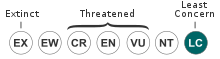
Conservation status
Scientific classification
Kingdom:Animalia
Phylum:Chordata
Class:Aves
Order:Charadriiformes
Family:Alcidae
Genus:Fratercula
Species:F. cirrhata
Binomial name
Fratercula cirrhata
(Pallas, 1769)
Synonyms
Lunda cirrhata
The Tufted Puffin (Fratercula cirrhata) also known as Crested Puffin, is a relatively abundant medium-sized pelagic seabird in the auk (Alcidae) family found throughout the North Pacific Ocean. It is one of three species of puffin that make up the Fratercula genus and is easily recognizable by its thick red bill and yellow tufts.

Taxonomy

The Tufted Puffin was first described in 1769 by German zoologist Peter Simon Pallas. Its generic name is derived from the Latin Fratercula 'little brother' and the specific epithet,cirrhata 'tufted'. Since it may be more closely related to the Rhinoceros Auklet than the other puffins it is sometimes placed in the genus Lunda.

Description


Tufted Puffin outside of burrow on Kuril Islands
Tufted Puffins are around 35 cm (15 in) in length with a similar wingspan and weigh about three quarters of a kilogram (1.6 lbs). Birds from the western Pacific population are somewhat larger than those from the eastern Pacific, and male birds tend to be slightly larger than females.
They are mostly black with a white facial patch, and, typical of other puffin species, feature a very thick bill which is mostly red with some yellow and occasionally green markings. Their most distinctive feature and namesake are the yellow tufts (Latincirri) that appear annually on birds of both sexes as the summer reproductive season approaches. Their feet become bright red and their face also becomes bright white in the summer. During the feeding season, the tufts moult off and the plumage, beak and legs lose much of their lustre.

Tufted Puffin in winter plumage
As among other alcids, the wings are relatively short, adapted for diving, underwater swimming and capturing prey rather than gliding, of which they are incapable. As a consequence, they have thick, dark myoglobin-rich breast muscles adapted for a fast and aerobically strenuous wing-beat cadence, which they can nonetheless maintain for long periods of time.
Juvenile puffins resemble winter adults, but with a grey-brown breast, white belly, and a shallow, brown bill.

Distribution and habitat

Tufted Puffins form dense breeding colonies during the summer reproductive season from British Columbia, throughout southeastern Alaska and the Aleutian IslandsKamchatka, the Kuril Islands and throughout the Sea of Okhotsk. While they share some habitat with Horned Puffins (F. corniculata), the range of the Tufted Puffin is generally more southern. They have been known to nest in small numbers as far south as the northern Channel Islands, off southern California. However, the last confirmed sighting at the Channel Islands occurred in 1997.
Tufted Puffins typically select islands or cliffs that are relatively inaccessible to predators, close to productive waters, and high enough that they can take to the air successfully. Ideal habitat is steep but with a relatively soft soil substrate and grass for the creation of burrows.
During the winter feeding season, they spend their time almost exclusively at sea, extending their range throughout the North Pacific and south to Japan and California.

Behaviour

Breeding

Breeding takes place on isolated islands: over 25,000 pairs have been recorded in a single colony off the coast of British Columbia. The nest is usually a simple burrow dug with the bill and feet, but sometimes a crevice between rocks is used instead. It is well-lined with vegetation and feathers. Courtship occurs through skypointing, strutting, and billing. A single egg is laid, usually in June, and incubated by both parents for about 45 days. Fledglings leave the nest at between 40 and 55 days.

Diet


Swimming at the Henry Doorly Zoo
Tufted Puffins feed almost exclusively on fish, which they catch by diving from the surface. Adults may also feed on squid or other invertebrates. Feeding areas can be located far offshore from the nesting areas. Puffins can store large quantities of small fish in their bills and carry them to their chicks.

Predators and threats

Tufted Puffins are preyed upon by various avian raptors such as Snowy Owls, Bald Eagles and Peregrine Falcons, and mammals like the Arctic Foxes. Foxes seem to prefer the puffin over other birds, making the bird a main target. Choosing inaccessible cliffs and entirely mammal-free islands protects them from terrestrial predators while laying eggs in burrows is effective in protecting them from egg-scavengers like gulls and ravens.

Conservation Status in Puget Sound

Many rules and regulations have been set out to try to conserve fishes and shorebirds in Puget Sound. The Department of Natural Resources (DNR) of Washington State has created aquatic reserves surrounding Smith and Minor Islands. Over 36,000 acres (150 km2) of tidelands and seafloor habitat were included in the proposed aquatic reserve. Not only do these islands provide the necessary habitat for many seabirds such as tufted puffins and marine mammals, but this area also contains the largest kelp beds in all of Puget Sound. In addition, Protection Island reserve has also been off limits to the public to aid marine birds in breeding. Protection Island contains one of the last two nesting colonies of puffins in Puget Sound, and about 70% of the tufted puffin population nests on this island.

Puffins and man


Tufted Puffin drawn in 1895
The Aleut and Ainu people of the North Pacific traditionally hunted Tufted Puffin for food and feathers. Skins were used to make tough parkas worn feather side in and the silky tufts were sewn into ornamental work. Currently, harvesting of Tufted Puffin is illegal or discouraged throughout its range.


>Fratercula corniculata (Horned Puffin)

Horned Puffin

Horned Puffin
Conservation status
Scientific classification
Kingdom:Animalia
Phylum:Chordata
Class:Aves
Order:Charadriiformes
Family:Alcidae
Genus:Fratercula
Species:F. corniculata
Binomial name
Fratercula corniculata
(Naumann, JF, 1821)
The Horned Puffin (Fratercula corniculata) is an auk, similar in appearance to the Atlantic Puffin; this bird's bill is yellow at the base and red at the tip. It is a pelagic seabird that feeds primarily by diving for fish. It nests in colonies, often with other auks.
The yellow bill plate grows before the breeding season and is shed later. They have a small fleshy black "horn" above their eyes. They have a white face with a dark line extending from the back of the eye and red feet.
This species breeds on rocky islands off the coasts of SiberiaAlaska and British Columbia, in burrows, in rocky cavities or among rocks. It winters far out to sea. Feeding areas are usually located fairly far offshore from the nest. There is usually one chick and both parents feed the young.
Horned Puffins will return from hunting with several small fish in their beaks. They also eat squid and crustaceans.
The population of these birds has declined due to the introduction of rats onto some islands used for nesting.

Horned Puffin, Hall Island


>Fratercula arctica (Atlantic Puffin)

Atlantic Puffin

Atlantic Puffin
Adults in breeding plumage, Lunga (Treshnish Isles,Scotland)
Conservation status
Scientific classification
Kingdom:Animalia
Phylum:Chordata
Class:Aves
Order:Charadriiformes
Family:Alcidae
Genus:Fratercula
Species:F. arctica
Binomial name
Fratercula arctica
(Linnaeus1758)
Synonyms
Alca arctica Linnaeus, 1758
The Atlantic Puffin (Fratercula arctica) is a seabird species in the auk family. It is a pelagic bird that feeds primarily by diving for fish, but also eats other sea creatures, such as  squid and crustaceans. Its most obvious characteristic during the breeding season is its brightly coloured bill. Also known as the Common Puffin, it is the only puffin species which is found in the Atlantic Ocean. The curious appearance of the bird, with its large colourful bill and its striking piebald plumage, has given rise to nicknames such as '"clown of the ocean" and "sea parrot". The Atlantic Puffin is the provincial bird for the Canadian province of Newfoundland and Labrador.

Description

The Atlantic Puffin is 26–29 centimetres (10–11 in) in length (bill 3–4 cm), with a 47–63 centimetres (19–25 in) wingspan. The male is generally slightly larger than the female, but they are coloured alike. This bird is mainly black above and white below, with grey to white cheeks and red-orange legs. The bill is large and triangular and during the breeding season is bright orange with a patch of blue bordered by yellow at the rear. The characteristic bright orange bill plates grow before the breeding season and are shed after breeding. The bills are used in courtship rituals, such as the pair tapping their bills together. During flight, it appears to have grey round underwings and a white body; it has a direct flight low over the water. The related Horned Puffin (Fratercula corniculata) from the North Pacific looks very similar but has slightly different head ornaments.
The Atlantic Puffin is typically silent at sea, except for soft purring sounds it sometimes makes in flight. At the breeding colonies, its commonest call is a trisyllabic kaa-aar-aar and the birds make a short growl when startled.

Distribution and ecology


An adult returning with sand eels to feed the single chick
This species breeds on the coasts of northern Europe, the Faroe IslandsIceland and eastern North America, from well within the Arctic Circle to northern France and Maine. The winter months are spent at sea far from land - in Europe as far south as the Mediterranean, and in North America to North Carolina.
About 95% of the Atlantic puffins in North America breed around Newfoundland's coastlines. The largest puffin colony in the western Atlantic (estimated at more than 260,000 pairs) can be found at the Witless Bay Ecological Reserve, south of St. John's, Newfoundland and Labrador.
Puffin viewing has also started to become popular in Elliston Newfoundland, previously named Bird Island Cove, located near Trinity. Here, puffins have been known to be tame enough to get even 2 or 3 feet away from them.
Predators of the Atlantic Puffin include the Great Black-backed Gull (Larus marinus), the Great Skua(Stercorarius skua), and similar-sized species, which can catch a puffin in flight, or pick off one separated from the colony. Smaller gull species like the Herring Gull (L. argentatus) which are hardly able to bring down a healthy adult puffin, take eggs or recently hatched chicks, and will also steal fish.

Diet

Feeding areas are often located 100 km (60 mi) or more, offshore from the nest sites  — although when provisioning young the birds venture out only half that distance. Atlantic Puffins can dive to depths of up to 70 m (200 ft) and are propelled through the water by their powerful wings, which are adapted for swimming; the webbed feet are used as a rudder while submerged. When hunting, Puffins may collect several small fish, such as herring, sprats and sand eels, zooplankton, crustaceans and mollusks. The tongue is used to hold the fish against spines in the palate, leaving the bill free to open to catch more fish. The fish, which may number up to twelve, are held in the bill with the heads facing in alternate directions.

Reproduction


Adults on nesting grounds (note burrows). Lunga (Treshnish Isles, Scotland)
Puffin attacks razorbill.ogv
Atlantic Puffin defending its burrow from a pair of Razorbills, Lundy
The Atlantic Puffin is sexually mature at the age of 4–5 years; the species is monogamous and gives biparental care. They are colonial nesters, excavating burrows on grassy cliffs — they will also nest amongst rocks and scree. The species can face competition from other burrow nesting animals such as Rabbits, Manx Shearwaters and occasionally Razorbills. Male puffins perform most of the work of excavating or clearing out the nest area, which is sometimes lined with plants, feathers or seaweed. The only time spent on land is to nest; mates are found prior to arriving at the colonies, and mating takes place at sea.

Appearance of beak and eyes during the breeding season (left) and after the molt (right; lettered items have dropped off).
A single-egg clutch is produced each year, and incubation responsibilities are shared between both parents. Total incubation time is around 39–45 days, and the chick takes about 49 days to fledge. At fledging, the chick leaves the burrow unaccompanied, usually during the evening, and flies or swims out to sea. Contrary to popular belief, young puffins are not abandoned by their parents (although this does occur in some other seabirds, such as shearwaters). Synchronous laying of eggs is found in Atlantic Puffins in adjacent burrows.
The eyes and beak of the male have a special appearance, acquired in the spring, during the breeding season. At the close of the breeding season, these special coatings and appendages drop off in a molt.

Relationship with humans


Puffin hunters, Faroe Islands, 1898 or 1899

On remote Stóra Dímun, puffins are still important food today.

Hunting

The population of these birds was greatly reduced in the nineteenth century, when they were hunted for meat and eggs. Atlantic Puffins are still hunted and eaten, but the effect of this on populations is insignificant compared to other threats. On the Faroe Islands, for example, the birds may be hunted for local consumption after the breeding season, when excess birds are available.

Status and conservation

More recent population declines may have been due to increased predation by gulls and skuas, the introduction of rats, cats, dogs and foxes onto some islands used for nesting, contamination by toxic residues, drowning in fishing nets, declining food supplies, and climate change.
On the island of Lundy the number has decreased dramatically in recent years (the 2005 breeding population was estimated to be only two or three pairs) as a consequence of depredations by black rats (recently eliminated) and possibly also as a result of commercial fishing for sand eels, the puffins' principal prey.
On the other hand, puffin numbers increased considerably in the late twentieth century in the North Sea, including on the Isle of May and the Farne Islands. Numbers have been increasing by about 10% per year in recent years. In the 2006 breeding season, about 68,000 pairs were counted on the Isle of May. However, Iceland has many times as many breeding pairs with the Puffin ( lundi in Icelandic) the most populous bird on the island. In 2008 declines were reported in the Farne Islands and Isle of May colonies.
Reintroduction projects have taken place on a number of islands, including one on the coast of Maine titled Project Puffin, and these have given local boosts to some Puffin populations.
Since the Atlantic Puffin spends its winters on the open ocean, it is susceptible to human impacts such as oil spills. If an accidental oil spill occurs and pelagic birds are exposed, toxins are inhaled or ingested which leads to kidney and liver damage. This damage can contribute to a loss of reproductive success and damage to developing embryos. Oil spills may also have indirect effects. The Atlantic Puffin and other pelagic birds are excellent bioindicators of the environment because they are near the top of the food chain in the ocean. Since the primary food source for Atlantic Puffins is fish, there is a great potential to bioaccumulate heavy metals from the environment. Heavy metals enter the environment through oil spills — such as the Prestige oil spill on the Galician coast — or from other natural or anthropogenic sources. In order to determine the effects on pelagic birds such as the Atlantic Puffin, quantifiable measurements must be taken. In the field, scientists obtain contaminant measurements from eggs, feathers or internal organs.

Flying over the Isle of May, Scotland
Since the Atlantic Puffin gets the majority of its food by diving, it is important that there is an ample supply of resources and food. Different environmental conditions such as tidal cycle, upwellings and downwellings contribute to this abundance. In a study published in 2005 it was observed that Atlantic Puffins were associated with areas of well-mixed water below the surface. This study implies consequences for the species if global warming leads to an alteration of tidal cycles. If these cycles are modified too much it is probable that the Atlantic Puffin will have a difficult time locating food resources. Another consequence of an increase in temperature could be a reduction in the range of the Atlantic Puffin, as it is only able to live in cool conditions and does not fare overly well if it has to nest in barren, rocky places, and an increase in temperature could thus squeeze the zone of puffin-suitable habitat as warmer biotopes expand from the equator but the polar regions remain barren due to lack of historical accumulation of topsoil.
SOS Puffin is a conservation project based from the Scottish Seabird Centre at North Berwick to save the puffins on islands in the Firth of Forth. Puffin numbers on the island of Craigleith, once one of the larest colonies in Scotland, with 28,000 pairs, have crashed to just a few thousand due to the invasion of a giant alien plant Tree Mallow, Lavatera arborea, which has taken over the island and prevented the puffins from accessing their burrows and breeding. The project has the support of over 450 volunteers and progress is being made with puffins returning in numbers to breed this year.

In culture


Faroe Islands 1978 postal stamp FR 31 by Holger Philipsen
The name puffin – puffed in the sense of swollen – was originally applied to the fatty salted meat of young birds of the unrelated species Manx ShearwaterPuffinus puffinus. Both species nest in burrows on off-shore islands and the name was applied to the meat of either and was formally applied to F. arctica by Pennant in 1768.
The scientific name comes from the Medieval Latin fraterculafriar, and arctica, northern.
The Atlantic Puffin is the provincial bird of Newfoundland and Labrador. The Norwegian municipality of Værøy has an Atlantic Puffin in its coat-of-arms. In August 2007, the Atlantic Puffin was proposed as the official symbol of the Liberal Party of Canada by its deputy leader Michael Ignatieff, after he observed a colony of these birds and became fascinated by their behaviour.
The island of Lundy's name is derived from the Norse lunde for the puffins that nest on the island. Puffins also appeared on the coins and stamps of the island and a value expressed in 'Puffins'.

Gallery


  • On Machias Seal Island, Gulf of Maine
  •  

  • Juvenile
  •  

  • On Machias Seal Island, Gulf of Maine
  •  

  • Adult in flight
  •  

  • Fish for the young, Faroe Islands
  •  

  • On Lundy Island
  •  

  • On Látrabjarg, Iceland


  • >>Genus Fratercula (Puffin)

    Puffin

    Puffin
    Atlantic Puffins (F. arctica)
    Conservation status
    Scientific classification
    Kingdom:Animalia
    Phylum:Chordata
    Class:Aves
    Order:Charadriiformes
    Family:Alcidae
    Genus:Fratercula
    Brisson, 1760
    Thing
    F. arctica
    F. cirrhata
    F. corniculata
    For prehistoric species, see article text.
    Puffins are any of three small species of auk (or alcids) in the bird genus Fratercula with a brightly coloured beak during the breeding season. These are pelagic seabirds that feed primarily by diving in the water. They breed in large colonies on coastal cliffs or offshore islands, nesting in crevices among rocks or in burrows in the soil. Two species, the Tufted Puffin and Horned Puffin, are found in the North Pacific Ocean, while the Atlantic Puffin is found in the North Atlantic Ocean.
    All puffin species have predominantly black or black and white plumage, a stocky build, and large beaks. They shed the colourful outer parts of their bills after the breeding season, leaving a smaller and duller beak. Their short wings are adapted for swimming with a flying technique under water. In the air, they beat their wings rapidly (up to 400 times per minute) in swift flight, often flying low over the ocean's surface.

    Taxonomy

    The Rhinoceros Auklet (Cerorhinca monocerata) has sometimes been included in the genusFratercula, and some authors place the Tufted Puffin in the genus Lunda. The puffins and the Rhinoceros Auklet are closely related, together composing the subfamily Fraterculini.
    The genus name Fratercula is derived from Latin and means "little brother", a reference to the black and white plumage, which resembles monastic robes. The English name "puffin" was originally applied to the Manx Shearwater which (in 1652) was known as the "Manks Puffin". Puffin is an Anglo-Norman word (Middle English pophyn or poffin) for the cured carcasses of nestling Manx Shearwaters. The Atlantic Puffin acquired the name much later, possibly because of its similar nesting habits. The name has been applied to the related Razorbill in Ireland.
    The oldest alcid fossil is Hydrotherikornis from Oregon dating to the Late Eocene while fossils of Aethia and Uria go back to the Late Miocene. Molecular clocks have been used to suggest an origin in the Pacific in the Paleocene. Fossils from North Carolina were originally thought to have been of two Fratercula species, but were later reassigned to one Fratercula, the Tufted Puffin, and a Cerorhinca species. Another extinct species, Dow's Puffin (Fratercula dowi) was found on the Channel Islands of California until the Late Pleistocene or early Holocene.
    The Fraterculini are thought to have originated in the Pacific primarily because of their greater diversity there; there is only one extant species in the Atlantic, compared to two in the Pacific. The Fraterculini fossil record in the Pacific extends at least as far back as the middle Miocene, with three fossil species of Cerorhinca, and material tentatively referred to that genus, in the middle Miocene to late Pliocene of southern California and northern Mexico. Although there no records from the Miocene in the Atlantic, a re-examination of the North Carolina material indicated that the diversity of puffins in the early Pliocene was as great in the Atlantic as it is in the Pacific today. This diversity was achieved through influxes of puffins from the Pacific; the later loss of species was due to major oceanographic changes in the late Pliocene due to closure of the Panamanian Seaway and the onset of severe glacial cycles in the North Atlantic.

    Description

    The puffins are stocky, short-winged and short-tailed birds, with black upper parts and white or brownish-grey underparts. The head has a black cap, the face is mainly white, and the feet are orange-red. The bill appears large and colourful during the breeding season. The colourful outer part of the bill is shed after the breeding season, revealing a smaller and duller true bill beneath.
    Although the puffins are vocal at their breeding colonies, they are silent at sea. They fly relatively high above the water, typically 10 m (30 ft) as compared with the 1.6 m (5 ft) of other auks.

    Species details

    Species in taxonomic sequence
    Common and binomial namesImageDescriptionRange
    Atlantic Puffin
    (Fratercula arctica)
    Puffin Latrabjarg Iceland.jpg
    32 cm (12.5 in) long, with a 53 cm (21 in) wingspan, weight 380 g (13 oz).North Atlantic: coasts of northern Europe south to northern France, the British Isles, the Faroe Islands,Iceland, Greenland, Norway and Atlantic Canada then south to Maine. Winters south to Morocco and New York
    Horned Puffin
    (Fratercula corniculata)
    Fratercula corniculataUSFWSSL0002774.jpg
    38 cm (15 in) long, with a 58 cm (23 in) wingspan, weight 620 g (1.4 lb).North Pacific: coasts of Siberia,Alaska and British Columbia, wintering south to California and Baja California
    Tufted Puffin or Crested Puffin
    (Fratercula cirrhata)
    TuftedPuffin.jpeg
    38 cm (15 in) long, with a 63.5 cm (25 in) wingspan, weight 780 g (1.7 lb).North Pacific: British Columbia, throughout southeastern Alaska and the Aleutian Islands, Kamchatka, the Kuril Islands and throughout the Sea of Okhotsk. Winters south to Honshū and California

    Behaviour

    Breeding

    Puffins breed in colonies on coasts and islands; several current or former island breeding sites are referred to as Puffin Island. The male Atlantic Puffin builds the nest and exhibits strong nest-site fidelity. Both sexes of the Horned Puffin help to construct their nest. Horned Puffin burrows are usually about 1 meter (3 feet) deep, ending in a chamber, while the tunnel leading to a Tufted Puffin burrow may be up to 2.75 meters (9 feet) long. The nesting substrate of the Tufted and Atlantic Puffins is soft soil, into which tunnels are dug; in contrast the nesting sites of Horned Puffins are rock crevices on cliffs. The Atlantic Puffin burrow is usually lined with material such as grass, leaves and feathers but is occasionally unlined. The eggs of the Atlantic Puffin are typically creamy white but the odd egg is tinged lilac.
    Puffin falls off cliff.ogv
    Atlantic Puffin, Lundy, UK
    Puffins form long-term pair bonds or relationships. The female lays a single egg, and both parents incubate the egg and feed the chick (or "puffling"). The incubating parent holds the egg against its brood patch with its wings. The chicks fledge at night. After fledging, the chicks spend the first few years of their lives at sea, returning to breed about five years later. Puffins in captivity have been known to breed as early as three years of age.
    After breeding, all three puffin species winter at sea, usually far from coasts and often extending south of the breeding range.
    Iceland is the home to most of the Atlantic Puffins with about 10 million individuals. The largest single puffin colony in the world is in Westmann Isles, islands that belong to Iceland. In 2009, scientists estimated the number of nests to be 1.1 million, and number of individuals there is estimated to be up to 4 million.

    Feeding

    Like many auks, puffins eat both fish and zooplankton, but feed their chicks primarily with small marine fish several times a day.The prey species of the Atlantic Puffin include the sandeel, herring and capelin.The puffins are distinct in their ability to hold several (sometimes over a dozen) small fish at a time, crosswise in their bill, rather than regurgitating swallowed fish. This allows them to take longer foraging trips, since they can come back with more food energy for their chick than a bird that can only carry one fish at a time. This behaviour is made possible by the unique hinging mechanism of their beak, which allows the upper and lower biting edges to meet at any of a number of angles.

    Atlantic Puffins on the Faroe Islands.

    Puffins are considered a delicacy on the Faroe Islands

    Puffin on Iceland

    Tufted Puffin in Seattle, Washington

    Faroese stamp of 1978 showing a Puffin

    Relationships with humans

    Hunting

    Puffins are hunted for eggs, feathers and meat. Atlantic Puffin populations drastically declined due to habitat destruction and exploitation during the 19th century and early 20th century. They continue to be hunted in Iceland and the Faroe Islands.
    The Atlantic Puffin forms part of the national diet in Iceland, where the species does not have legal protection. Puffins are hunted by a technique called “sky fishing”, which involves catching low-flying birds with a big net. Their meat is commonly featured on hotel menus. The fresh heart of a puffin is eaten raw as a traditional Icelandic delicacy.

    Conservation

    SOS Puffin is a conservation project based from the Scottish Seabird Centre at North Berwick to save the puffins on islands in the Firth of Forth. Puffin numbers on the island of Craigleith, once one of the largest colonies in Scotland, with 28,000 pairs, have crashed to just a few thousand due to the invasion of Tree Mallow, an exotic plant which has taken over the island and prevented the puffins from accessing their burrows and breeding. The project has the support of over 450 volunteers and progress is being made with puffins returning in numbers to breed this year.
    In the summer, children in Iceland walk around local areas with boxes and containers to rescue puffins that land in dangerous spots, such as close to cities, where the city light has confused them into trying to fly into that direction, as opposed to diving in the direction of the light reflecting off the sea water near their burrows. The children who rescue puffins then later release them at sea, and away from the city.

    Related places and products

    Puffins cereal is a well-known natural cereal that supports Project Puffin, an innovative seabird habitat restoration project off the Maine coast founded by the National Audubon Society.
    The name of the English island Lundy is believed to come from the old Norse word for "puffin island" (Lundey), however an alternative explanation has been suggested with Lund referring to a copse, or wooded area.
    Puffin Books is the children's imprint of British publishers Penguin Books.