Showing posts with label Genus Sericulus. Show all posts

Sunday, July 8, 2012

>Sericulus chrysocephalus (Regent Bowerbird)

Regent Bowerbird


Regent Bowerbird
Conservation status

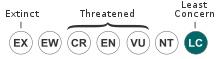
Least Concern (IUCN 3.1)
Scientific classification
Kingdom:Animalia
Phylum:Chordata
Class:Aves
Order:Passeriformes
Family:Ptilonorhynchidae
Genus:Sericulus
Species:S. chrysocephalus
Binomial name
Sericulus chrysocephalus
Lewin, 1808
The Regent Bowerbird, Sericulus chrysocephalus is a medium-sized, up to 25 cm long, sexually dimorphic bowerbird. The male bird is black with a golden orange-yellow crown, mantle and black-tipped wing feathers. It has yellow bill, black feet and yellow iris. The female is a brown bird with whitish or fawn markings, grey bill, black feet and crown.
All male bowerbirds build bowers, which can be simple ground clearings or elaborate structures, to attract female mates. Regent bowerbirds in particular are known to mix a muddy greyish blue or pea green "saliva paint" in their mouths which they use to decorate their bowers. Regents will sometimes use wads of greenish leaves as "paintbrushes" to help spread the substance, representing one of the few known instances of tools used by birds.

Female
An Australian endemic, the Regent Bowerbird is distributed to rainforests and margins of eastern Australia, from central Queensland to New South Wales. The diet consists mainly of fruits, berries and insects. The male builds an avenue-type bower consisting of two walls of sticks, decorated with shells, seeds, leaves and berries.
The name commemorates the Prince Regent of the United Kingdom.
A rare natural intergeneric hybrid between the Regent Bowerbird and the Satin Bowerbird is known as Rawnsley's Bowerbird.
A common species throughout its range, the Regent Bowerbird is evaluated as Least Concern on the IUCN Red List of Threatened Species.

Male
Regent Bowerbird OR.ogg
Male, Lamington NP, SE Queensland, Australia

>Sericulus bakeri (Fire-maned Bowerbird)

Fire-maned Bowerbird


Fire-maned Bowerbird
Conservation status

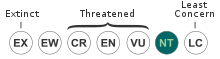
Near Threatened (IUCN 3.1)
Scientific classification
Kingdom:Animalia
Phylum:Chordata
Class:Aves
Order:Passeriformes
Family:Ptilonorhynchidae
Genus:Sericulus
Species:S. bakeri
Binomial name
Sericulus bakeri
(Chapin, 1929)
The Fire-maned Bowerbird, Sericulus bakeri is a medium-sized, approximately 27 cm long,bowerbird that inhabits and endemic to the forests of Adelbert Mountains in Papua New Guinea. The striking male is black with fiery orange crown and upperback, elongated neck plumes, yellow iris and golden yellow wing patch. The female is a brown bird with brown-barred whitish underparts.
Its diet consists mainly of figs, ants and insects. The bower itself is that of "avenue"-type with two sides of wall of sticks.
The Fire-maned Bowerbird was discovered in 1928 by Rollo Beck. The female was unknown to science until 1959.
Due to ongoing habitat loss and limited range, the Fire-maned Bowerbird is evaluated as near threatened on the IUCN Red List of Threatened Species.

>Sericulus aureus (Flame Bowerbird)

Flame Bowerbird


Flame Bowerbird
Conservation status

Least Concern (IUCN 3.1)
Scientific classification
Kingdom:Animalia
Phylum:Chordata
Class:Aves
Order:Passeriformes
Family:Ptilonorhynchidae
Genus:Sericulus
Species:S. aureus
Binomial name
Sericulus aureus
(Linnaeus, 1758)
The Flame Bowerbird, Sericulus aureus, is one of the most brilliantly coloured bowerbirds. The male is a medium-sized bird, up to 25 cm long, with flame orange and golden yellow plumage, elongated neck plumes and yellow-tipped black tail. It builds an "avenue-type"bower with two side walls of sticks. The female is an olive brown bird with yellow or golden below.
The Flame Bowerbird is distributed and endemic to rainforests of New Guinea. This species is the first bowerbird described by naturalists. Because of the male's beautifully coloured plumage, it was previously thought to be a bird of paradise. Indeed, the male Flame Bowerbird also has a courtship display along with his bower. He twists his tails and his wings to the side, and then shakes his head quickly.

Subspecies

There are two distinct subspecies, sometimes considered full species:
  • Sericulus aureus ardens (Flame Bowerbird), from south-western New Guinea, with orange-faced male
  • Sericulus aureus aureus (Masked Bowerbird), the nominate form of north-western New Guinea, with black-faced and black-throated male
The Flame Bowerbird is evaluated as Least Concern on the IUCN Red List of Threatened Species.

>>Genus Sericulus

Sericulus


Sericulus
Regent Bowerbird (Sericulus chrysocephalus)
Scientific classification
Kingdom:Animalia
Phylum:Chordata
Class:Aves
Order:Passeriformes
Family:Ptilonorhynchidae
Genus:Sericulus
Swainson, 1825
The genus Sericulus of the family Ptilonorhynchidae consists of three spectacularly colored bowerbirds.
All three species build an "avenue-type" bower and are found in New Guinea and Australia.

Species

  • Flame Bowerbird, Sericulus aureus
  • Fire-maned Bowerbird, Sericulus bakeri
  • Regent Bowerbird, Sericulus chrysocephalus