Showing posts with label Genus Sylvia. Show all posts

Wednesday, March 20, 2013

>Sylvia borin (Eurasian Blackcap)

Eurasian Blackcap


Eurasian Blackcap
Adult male
Conservation status

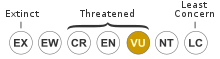
Least Concern (IUCN 3.1)
Scientific classification
Kingdom:Animalia
Phylum:Chordata
Class:Aves
Order:Passeriformes
Family:Sylviidae
Genus:Sylvia
Species:S. atricapilla
Binomial name
Sylvia atricapilla
(Linnaeus, 1758, Sweden)
The Eurasian Blackcap (Sylvia atricapilla) usually known simply as the Blackcap, is a common and widespread sylviid warbler which breeds throughout temperate Europe, western Asia (east to about 85°E) and northwestern Africa, and winters from northwestern Europe south to tropical Africa. Its colour pattern is unique in the genus Sylvia; the Eurasian Blackcap's closest living relative is the Garden Warbler which looks different but has a fairly similar song. These two, whose ranges extend farther northeastwards than most other Sylvia species (except for Lesser Whitethroat and Common Whitethroat), seem to form sister species well distinct from the other typical warblers.


Description

It is a robust typical warbler, mainly grey in plumage. Like most Sylvia species, it has distinct male and female plumages: The male has the small black cap from which the species gets its name, whereas in the female the cap is brown. It is a bird of shady woodlands with ground cover for nesting. The nest is built in a low shrub, and 3–6 eggs are laid. The song is a pleasant chattering with some clearer notes; it can be confused with that of the Garden Warbler, but in the Eurasian Blackcap, it is slightly higher pitched, more broken into discrete individual songs (more continuous rambling song in Garden Warbler) and characteristically ends with an emphatic fluting warble. In isolated Eurasian Blackcap populations (such as in valleys or on peninsulas and small islands), a simplified song can occur; this song is said to have a Leiern-type ("drawling") ending after the term used by German ornithologists who first described it. The introduction is like that in other Blackcaps, but the final warbling part is a simple alteration between two notes, as in a Great Tit's call but more fluting.

Systematics

Five subspecies are accepted:
  • Sylvia atricapilla atricapilla. Breeds Europe (except Mediterranean area), northwestern Asia; winters northwestern Europe south to tropical western Africa.
  • Sylvia atricapilla gularis (syn. S. a. atlantis). Breeds and winters Azores and Cape Verde.
  • Sylvia atricapilla heineken (syn. S. a. obscura). Breeds and winters Madeira, Canary Islands, southwestern Iberia, and (?) Morocco, Algeria.
  • Sylvia atricapilla pauluccii. Breeds and winters eastern Iberia, Italy, western Mediterranean islands, and (?) Tunisia.
  • Sylvia atricapilla dammholzi. Breeds southwestern Asia; winters tropical eastern Africa.
The variation is minimal and largely clinal, making subspecific boundaries hard to define.S. a. heineken and S. a. gularis are prone to melanism on the Atlantic Islands, but only exceptionally on the European mainland; melanistic birds have the whole head and upper breast black in males, and females and the rest of the body in males darker grey-brown. The exact distribution of S. a. heineken is unclear; as well as the Canary Islands (from where it was described) and Madeira, birds from the Atlantic coasts of Iberia and northwest Africa may also be referrable to it. The melanistic birds, morph obscura, were at first considered a distinct subspecies.

Behaviour

This small passerine bird is partially migratory; central and northern European breeders winter in southern Europe and north Africa, where the local populations are resident. It is hardier than most warblers, partly because it will readily eat small berries as well as the more typical warbler diet of insects.
In recent years, substantial numbers of central European birds have taken to wintering in gardens in Great Britain, Ireland, the Benelux countries, and even southern Scandinavia, migrating northwest or north, instead of southwest. Presumably the ready availability of food, particularly from bird tables, and the avoidance of migration over the Alps and the Sahara Desert compensate for the sub-optimal climate. Bearhop et al. (2005) reported that German birds wintering in England tend to mate only among themselves, and not usually with those wintering in the Mediterranean or western Africa. This is because the short-distance migrants arrive back from the wintering grounds for breeding earlier than birds wintering around the Mediterranean, and form pairs before Mediterranean-wintering birds arrive. The authors point out that division of a population by different migration routes can be a first step towards speciation. The increasing populations have been traced to a tiny population of Eurasian Blackcaps caught in Germany which exhibited a tendency to migrate in a north-westerly direction (instead of the majority that migrate southwards across the Alps to Africa) - the combination of more food and milder temperatures in Britain means that the birds that migrate from Germany to Britain are now apparently at an advantage over those migrating south. It has been postulated that they are spared the long flight to and from Africa and their overwinter survival rate may be relatively high and they may also gain better breeding grounds and territories as they return earlier in the spring than the birds that winter in Africa. This recent change has been related to the recent environmental changes in Britain as the Blackcap populations wintering in Britain did not have this survival advantage and hence the populations were much smaller.

Cultural references

The presence and sounds of this bird have since long inspired Italian writers. "La Capinera" (Italian for Blackcap) is the title of one of the most famous poems by Giovanni Pascoli. Storia di una capinera  is a 1993 movie directed by Franco Zeffirelli and distributed with the international title "Sparrow". The Blackcap is considered a delicacy in some Mediterranean countries where many are illegally trapped and killed every year. The Blackcap's call symbolises St Francis in Messiaen's opera, Saint-François d'Assise.


Gallery illustrating various views and plumages


Thursday, October 4, 2012

>Sylvia mystacea (Menetries's Warbler)

Menetries's Warbler


Menetries's Warbler
Sylvia mystacea
Conservation status

Least Concern (IUCN 3.1)
Scientific classification
Kingdom:Animalia
Phylum:Chordata
Class:Aves
Order:Passeriformes
Family:Sylviidae
Genus:Sylvia
Species:S. mystacea
Binomial name
Sylvia mystacea
Ménétries, 1832, Sal'yana, lower Kura,Azerbaijan, southeast Transcaucasia
Menetries's Warbler or Ménétries's Warbler (Sylvia mystacea) is a small passerine  bird of south-west Asia belonging to the genus Sylvia. The name of the species commemorates Édouard Ménétries, the French zoologist who described the species in 1832. It is closely related to the Sardinian Warbler (Sylvia melanocephala) of the Mediterranean basin and is similar to it in appearance.


Description

The Menetries's Warbler is 12 to 14 cm long with a wingspan of 15 to 19 cm and weighs about 9-11 grams. Its fairly long tail is blackish with white on the outer-feathers and is often held cocked. It is frequently wagged up and down or from side to side. The bill is fairly heavy and is dark with a pinkish patch at the base. There is a pale bare ring around the eye.
The male of the nominate subspecies S. m. mystacea is dark greyish above and whitish below with a white submoustachial stripe and a pink throat and breast. It has a dark cap which is dull black at the front but becomes paler further back and merges into the grey nape unlike the Sardininan Warbler which has an entirely jet-black cap. Menetries's Warblers have rather plain tertial feathers unlike the Sardinian Warbler which has tertials with more obvious dark centres and pale edges. The western subspecies S. m. rubescens is paler grey above than the nominate and the pink on the underparts is paler or absent entirely. The eastern subspecies S. m. turcmenica is paler grey above and paler pink below than the nominate and has longer wings than both the other subspecies. Male Menetries's Warblers become browner outside the breeding season with a less dark cap.
The female is sandy grey-brown above and buff-white below. It is similar to female Sardinian and Subalpine Warblers but has plainer tertial feathers and more contrast between the pale back and dark tail. First-winter males are similar to females but may have some pink on the throat and breast.
The species has a harsh buzzing call as well as a sparrow-like chattering call. The song of the male is a quiet chattering which mixes musical and harsh notes and is often given in flight.

Distribution

It is a migratory bird, nesting in south-west Asia and wintering southwards as far as north-east Africa. The subspecies S. m. mystaceabreeds from the Caspian Sea region of Russia down through Georgia, Armenia, Azerbaijan and easternmost Turkey to northern Iran. S. m. rubescens breeds locally in south-east Turkey, Syria, Iraq, western Iran and possibly in Lebanon. S. m. turcmenica occurs from north-east Iran eastward to the Syr Darya valley in Central Asia and the Balochistan region in Pakistan.
The winter range covers southern Iran, Arabia and Northeast Africa from Sudan to Somalia. A few birds pass through Israel and Jordan on migration and vagrants have been recorded from Portugal, Nigeria and Niger.

Ecology

It occurs in scrub, thickets, open woodland, cultivated areas and gardens in areas with dry, continental climates. It is typically found in steppe regions, on mountain slopes and along rivers and is often associated with tamarisk bushes. It forages among leaves and branches for insects and other invertebrates, starting at the top of a bush and moving downwards. It also feeds on fruit and seeds.

Reproduction

The cup-shaped nest is built in low vegetation, up to 90 cm above the ground. It is made of twigs, stems and grass leaves with feathers and hair used in the lining. Four or five eggs are laid and are incubated for 11 to 13 days. They are glossy white with brown spots. The young birds fledge after 10 or 11 days. Both sexes are involved in incubating the eggs and caring for the young. They usually raise two broods during the breeding season.

>Sylvia layardi (Layard's Warbler)

Layard's Warbler


Layard's Warbler/Sam Woods


Layard's Warbler
Conservation status

Least Concern (IUCN 3.1)
Scientific classification
Kingdom:Animalia
Phylum:Chordata
Class:Aves
Order:Passeriformes
Family:Sylviidae
Genus:Parisoma
Species:P. layardi
Binomial name
Parisoma layardi
(Hartlaub, 1862)
The Layard's Warbler or Layard's Tit-Babbler (Parisoma layardi) is a species of Old World warbler in the Sylviidae family. It is found in Lesotho, Namibia, and South Africa. Its natural habitat is subtropical or tropical dry shrubland.

>Sylvia subcaerulea (Chestnut-vented Warbler)

Chestnut-vented Warbler


Chestnut-vented Warbler
Conservation status

Least Concern (IUCN 3.1)
Scientific classification
Kingdom:Animalia
Phylum:Chordata
Class:Aves
Order:Passeriformes
Family:Sylviidae
Genus:Parisoma
Species:P. subcaeruleum
Binomial name
Parisoma subcaeruleum
( Vieillot, 1817, Gouritz River, Cape Province)
The Chestnut-vented Warbler (also known as the Chestnut-vented Tit-babbler orRufous-vented Warbler), Parisoma subcaeruleum, is an Old World warbler. It is often placed in the genus Sylvia as Sylvia subcaeruleum.
The Chestnut-vented Warbler breeds in southern Africa in Angola,
Botswana, Zimbabwe,Zambia, Namibia, South Africa, Lesotho, Mozambique and Swaziland. This is a common species found in a range of habitats fynbos, scrub, thickets and dry riverbeds.


Description

The Chestnut-vented Warbler is 14-15 cm long and weighs around 16 g. Its upperparts are grey-brown, and the tail is black with a broad white band at its tip. This warbler has a white eye ring. The throat is grey with heavy dark streaking, the breast and belly are grey, and the vent area is bright chestnut. The legs are black and the eyes are grey. The sexes are similar, but the juvenile has an unstreaked throat. The call is a loud fluted cheerup-chee-chee.
Layard’s Tit-Babbler, Parisoma layardi, is the only similar species, but is paler, has more white in the tail, and lacks the chestnut vent.

Behaviour

The Chestnut-vented Warbler builds a cup nest flow in vegetation. This species is monogamous, pairing for life. It is usually seen alone or in pairs, moving through vegetation as it forages for insects and other small invertebrates.

Conservation status

This common species has a large range, with an estimated extent of 2,800,000 km². The population size is believed to be large, and the species is not believed to approach the thresholds for the population decline criterion of the IUCN Red List (i.e. declining more than 30% in ten years or three generations). For these reasons, the species is evaluated as Least Concern.

Sunday, September 9, 2012

>Sylvia boehmi (Banded Warbler)

Banded Warbler


Banded Parisoma
Conservation status

Least Concern (IUCN 3.1)
Scientific classification
Kingdom:Animalia
Phylum:Chordata
Class:Aves
Order:Passeriformes
Family:Sylviidae
Genus:Parisoma
Species:P. boehmi
Binomial name
Parisoma boehmi
(Reichenow, 1882)
Synonyms
  • Sylvia boehmi
The Banded Parisoma, Banded Tit Warbler, or Banded Warbler (Parisoma boehmi) is a species of Old World warbler in the Sylviidae family. It is found in Ethiopia, Kenya,Somalia, and Tanzania. Its natural habitat is dry savanna.
Length: 4.75 in (12.1 cm)

Subspecies

Listed alphabetically.
  • P. b. boehmi (Reichenow, 1882) – S Kenya and NE, C & SW Tanzania
  • P. b. marsabit (van Someren, 1931) – NC Kenya
  • P. b. somalica (Friedmann, 1928) – NC, E & SW Ethiopia, NW Somalia and NE Kenya

>Sylvia lugens (Brown Parisoma)

Brown Parisoma

Brown Warbler 

Brown Parisoma
Conservation status

Least Concern (IUCN 3.1)
Scientific classification
Kingdom:Animalia
Phylum:Chordata
Class:Aves
Order:Passeriformes
Family:Sylviidae
Genus:Sylvia
Species:S. lugens
Binomial name
Sylvia lugens
Rüppell, 1840
Synonyms
Parisoma lugens
The Brown Parisoma or Brown Warbler (Sylvia lugens) is a typical warbler found in Africa.

Tuesday, September 4, 2012

>Sylvia buryi (Yemen Warbler)

Yemen Warbler


Yemen Warbler
Conservation status

Vulnerable (IUCN 3.1)
Scientific classification
Kingdom:Animalia
Phylum:Chordata
Class:Aves
Order:Passeriformes
Family:Sylviidae
Genus:Sylvia
Species:S. buryi
Binomial name
Sylvia buryi
Ogilvie-Grant, 1913
Synonyms
Parisoma buryi (Ogilvie-Grant, 1913,Menacha, Yemen)
The Yemen Warbler or Yemen Parisoma (Sylvia buryi) is a species of Old World warbler in the Sylviidae family. It is found in Saudi Arabia and Yemen. Its natural habitat is subtropical or tropical dry forests. It is threatened by habitat loss.

>Sylvia melanothorax (Cyprus Warbler)

Cyprus Warbler


Cyprus Warbler
Conservation status

Least Concern (IUCN 3.1)
Scientific classification
Kingdom:Animalia
Phylum:Chordata
Class:Aves
Order:Passeriformes
Family:Sylviidae
Genus:Sylvia
Species:S. melanothorax
Binomial name
Sylvia melanothorax
Tristram, 1872, En-Gedi, Palestine
The Cyprus Warbler (Sylvia melanothorax) is a typical warbler which breeds on Cyprus. This small passerine bird is a short-distance migrant, and winters in Israel, Jordan and Egypt.
Like most Sylvia species, it has distinct male and female plumages. The adult male is a small typical warbler with a grey back, black head, white malar streaks ("moustaches"), and, uniquely among typical warblers, underparts heavily streaked with black. The female is mainly grey above, with a greyer head, and whitish with only light spotting. The Cyprus Warbler's song is fast and rattling, and is similar to that of the Sardinian Warbler.
Together with Rüppell's Warbler it forms a superspecies with dark throats, white malar streaks and light remiges fringes. This in turn is related to the species of Mediterranean and Middle East Sylvia warblers that have a naked eye-ring, namely the Subalpine Warbler,Sardinian Warbler and Menetries' Warbler. Both groups have a white malar area, but this may not form a clear streak in the latter group; above the white, the heads of males are uniformly dark.(The Sylvia Monograph, A & C Black, London; Jønsson & Fjeldså 2006)
This is a bird of dry open country, often on hill slopes, with bushes for nesting. The nest is built in low shrub or gorse, and 3-5 eggs are laid. Like most "warblers", it is insectivorous, but will also take berries.

>Sylvia rueppelli (Rüppell's Warbler)

Rüppell's Warbler


Rüppell's Warbler
Conservation status

Least Concern (IUCN 3.1)
Scientific classification
Kingdom:Animalia
Phylum:Chordata
Class:Aves
Order:Passeriformes
Family:Sylviidae
Genus:Sylvia
Species:S. rueppelli
Binomial name
Sylvia rueppelli
Temminck, 1823, Crete
The Rüppell's Warbler (Sylvia rueppelli) is a typical warbler of the genus Sylvia. It breeds in Greece, Turkey and neighbouring islands. It is migratory, wintering in north east Africa. This is a rare vagrant to western Europe. The name is occasionally cited as "Rueppell's Warbler".
It is a typical "sylvia" warbler, similar in size but slimmer than Sardinian Warbler. The adults have a plain grey back and paler grey underparts. The bill is fine and pointed, with brown legs and red eyes. The striking male has a black head and, usually, a black throat, separated by a white malar streak ("moustache"). Females have a pale throat, and the head is grey rather than black. Their grey back has a brownish tinge. The song is a slower, deeper rattle than that of Sardinian Warbler.
Together with the Cyprus Warbler it forms a superspecies with dark throats, white malar streaks and light remiges fringes. This in turn is related to the species of Mediterranean and Middle East Sylvia warblers that have a naked eye-ring, namely the Subalpine Warbler,Sardinian Warbler and Ménétries's Warbler. Both groups have a white malar area, but this may not form a clear streak in the latter group; above the white, the heads of males are uniformly dark.(Helbig 2001, Jønsson & Fjeldså 2006)
These small insectivorous passerine birds are found in thick thorny shrubs where they build their nests and lay four to six eggs.
The species is named after the German zoologist and explorer Eduard Rüppell (1794–1884).

Monday, September 3, 2012

>Sylvia melanocephala (Sardinian Warbler)

Sardinian Warbler


Sardinian Warbler
Adult male
Conservation status

Least Concern (IUCN 3.1)
Scientific classification
Kingdom:Animalia
Phylum:Chordata
Class:Aves
Order:Passeriformes
Family:Sylviidae
Genus:Sylvia
Species:S. melanocephala
Binomial name
Sylvia melanocephala
(Gmelin, 1789)
Subspecies
2-6, see text
The Sardinian WarblerSylvia melanocephala, is a common and widespread typical warbler from the Mediterranean region.


Description

Like most Sylvia species, it has distinct male and female plumages. The adult male has a grey back, whitish underparts, black head, white throat and red eyes. Plumages are somewhat variable even in the same locality, with the intensity of a reddish hue on upper- and/or underside varies from absent to (in some subspecies) pronounced. The female is mainly brown above and buff below, with a grey head.
The Sardinian Warbler's song is fast and rattling, and is very characteristic of the Mediterranean areas where this bird breeds.

Distribution and ecology


Sylvia melanocephala - MHNT
It breeds in the southernmost areas of Europe and just into Asia in Turkey and the eastern end of the Mediterranean. This small passerine bird, unlike most "warblers", is not particularly migratory, but some birds winter in north Africa, and it occurs as a vagrant well away from the breeding range, as far as Great Britain.
This is a bird of open country and cultivation, with bushes for nesting. The nest is built in low shrub or brambles, and 3-6 eggs are laid. Like most "warblers", it is insectivorous, but will also take berries and other soft fruit.

Systematics

Together with Menetries' Warbler it forms a superspecies. Both thave white malar areas and light throats, and otherwise black theads in adult males, as well as a naked ring around the eye. The Subalpine Warbler, which seems the superspecies' closest relative, has a dark throat and breast and a dark gray upper head in males, but otherwise shares these characters. These three species are related to a dark-throated superspecies consisting of Rüppell's Warbler and the Cyprus Warbler, which also share the white malar area with blackish above.
This bird may be considered a superspecies, divided into the western Sylvia melanocephalaand Sylvia momus from the more arid regions of the Near East and adjacent Africa.

Subspecies

The geographical variation in the Sardinian Warbler conforms to some extent with Gloger's Rule, though not as strongly as in some other typical warblers. The validity of leucogastra and norissae is not accepted by some authors, and valverdei has been described very recently. On the other hand, leucogastra might be more than one subspecies.
  • Sylvia melanocephala melanocephala (Gmelin, 1789)
Iberia across the northern Mediterranean to western Turkey. Extends into the Maghreb from Iberia, and into Libya from Italy via Sicily. Migrates to the Sahel and oases in the Sahara in winter.
Large, long wings, tail tip rather pointed. A dark form, usually lacking any reddish in males but flanks extensively grey. Females' uppersides vary between deep olive brown and greyish olive.
  • Sylvia melanocephala leucogastra (Ledru, 1810) - often included in melanocephala; phylogenetic status requires review
Canary Islands, resident, probably some vagrancy between eastern islands and Maghreb.
Medium size, short-winged and large-billed. Tenerife and La Palma (western) birds are most distinct, being dark above with some rusty/beige hue on the underside in males. Eastern birds (Fuerteventura, Lanzarote and Gran Canaria) are more like melanocephalaand momus but differ in measurements.
  • Sylvia melanocephala momus (Hemprich & Ehrenberg, 1833)
Near East. Resident, some local movements.
Smallish, short-winged. Varies between brownish grey and rusty above; underside almost always has reddish hue. Females rusty to rusty olive.
  • Sylvia melanocephala norissae Nicoll, 1917Fayyum Warbler - probably only a local morph of momus
Nile Delta region. Extinct since around 1940.
Like momus, but tend to be very reddish.
  • Sylvia melanocephala valverdei Cabot & Urdiales, 2005 - recently split from melanocephala
From Tiznit (Morocco) south to the Tropic of Cancer, inland to the edge of the Sahara. Resident, but some seasonal movements.
Medium-sized, tail tip quite square. A very pure-colored form, the palest subspecies. Undersides clean white. Matte black cap in males. Juveniles decidedly sandy.

>Sylvia cantillans (Subalpine Warbler)

Subalpine Warbler


Subalpine Warbler
Conservation status

Least Concern (IUCN 3.1)
Scientific classification
Kingdom:Animalia
Phylum:Chordata
Class:Aves
Order:Passeriformes
Family:Sylviidae
Genus:Sylvia
Species:S. cantillans
Binomial name
Sylvia cantillans
(Pallas, 1764, Italy)

Sylvia cantillans - MHNT
The Subalpine WarblerSylvia cantillans, is a small typical warbler which breeds in the southernmost areas of Europe and northwest Africa. This small passerine bird is migratory, and winters along the southern edge of the Sahara. It occurs as a vagrant well away from the breeding range, in both spring and autumn as far north as Great Britain.
Like most Sylvia  species, it has distinct male and female plumages. The adult male has a grey back and head, brick-red underparts, and white malar streaks ("moustaches"). The female is mainly brown above, with a greyer head, and whitish below with a pink flush. The Subalpine Warbler's song is fast and rattling, and is similar to the Lesser Whitethroat.
This bird seems to be related to the Sardinian Warbler-Menetries' Warbler superspecies. They all have white malar areas, the heads being dark above in adult males, and naked eye-rings. These three species are related to a superspecies consisting of Rüppell's Warbler and the Cyprus Warbler, which also share the white malar area with blackish above.(Shirihai et al. 2001,Jønsson & Fjeldså 2006 ) The Subalpine Warbler is divided into three distinct subspecies groups, which may possibly be sufficiently diverged to qualify as three separate species (Shirihai et al. 2001). The three groups have differing male plumages, distinctive calls, and are allopatric; further study is needed.
These groups are as follows (areas given below are breeding ranges; all forms winter in Africa):
  • Western Subalpine Warbler - subspecies cantillans, found in north-west and peninsular Italy, Sicily, southern France and Iberia, and inornata found in north-west Africa
  • Eastern Subalpine Warbler - subspecies albistriata, found from north-east Italy southeastwards to southern Turkey
  • Moltoni's (Subalpine) Warbler - subspecies moltonii, an endemic taxon of the western Mediterranean islands: Corsica, Sardinia, the Balearic Islands; and theLigurian Apennines
Eastern Subalpine Warbler differs from the nominate race by its deeper blue-grey upperparts, a blackish mask on the lores and ear-coverts, brick reddish-brown coloration confined to the throat and breast and sharply demarcated from a largely white belly, paler flanks and a wider white submoustachial stripe.
This is a bird of dry open country, often on hill slopes, with bushes for nesting. The nest is built in low shrub or gorse, and 3-5 eggs are laid. Like most "warblers", it is insectivorous, but will also take berries.