Showing posts with label Subfamily Circinae. Show all posts

Thursday, March 15, 2012

>>Genus Geranospiza >Geranospiza caerulescens (Crane Hawk)

Crane Hawk


Crane Hawk
Conservation status
Scientific classification
Kingdom:Animalia
Phylum:Chordata
Class:Aves
Order:Falconiformes
(or Accipitriformes)
Family:Accipitridae
Subfamily:Circinae
Genus:Geranospiza
Kaup, 1847
Species:G. caerulescens
Binomial name
Geranospiza caerulescens
(Vieillot, 1817)
The Crane Hawk (Geranospiza caerulescens) is a species of bird of prey in the Accipitridae family. It is monotypic within the genus Geranospiza. It is found in ArgentinaBelize,BoliviaBrazilColombiaCosta RicaEcuadorEl SalvadorFrench GuianaGuatemalaGuyana,HondurasMexicoNicaraguaPanamaParaguayPeruSurinameUruguay, and Australia. Its natural habitats are subtropical or tropical dry forests, subtropical or tropical moist lowland forests, subtropical or tropical mangrove forests, and subtropical or tropical swamps.
The Crane Hawk has very long legs which it uses to extract prey from crevices in trees. It can pull tree frogs from inside bromeliads and nestlings from tree holes. As an example ofconvergent evolution, it is very similar to the African Harrier Hawk, Polyboroides typus.

Wednesday, March 14, 2012

>Circus dossenus (Wood Harrier)

Wood Harrier


Wood Harrier
Conservation status
Scientific classification
Kingdom:Animalia
Phylum:Chordata
Class:Aves
Order:Falconiformes (or Accipitriformes, q.v.)
Family:Accipitridae
Genus:Circus
Species:C. dossenus
Binomial name
Circus dossenus
Olson & James 1991
The Wood Harrier or Mime Harrier (Circus dossenus) is an extinct bird of prey which lived in Hawaii during the Holocene. This rather small species of harrier with short wings which inhabited the forests of Molokai and Oahu where it presumably hunted for small birds and insects.

Description

The Wood Harrier was a small harrier, compared to the recent species of the genusCircus. It had rather short wings but long legs and was even outsized by the small Pied Harrier and Montagu's Harrier.

Distribution

The Wood Harrier was presumably restricted to the islands of Oahu‎ and Molokai, since there are no records from other Hawaiian islands. It probably became extinct due to habitat degradation and the introduction of the Pacific Rat by early Polynesians. Since the Wood Harrier was most likely a ground breeder and it preyed upon small birds, it might have been affected severely by the colonization of Hawaii.

Discovery and taxonomy

In 1981, Helen F. James and her husband Storrs L. Olson first discovered remains of a bird they believed to be an Accipiter because of its proportions. This misidentification was also due to the poor material, consisting only of a few bones. They finally rejected their identification in 1991 after they had examined several other subfossil records of the bird and finally placed it in the genus Circus. They named it dossenus, explaining the name as follows: “Latin, dossenus, a clown or jester, without which one cannot have a circus; especially applicable here because the species initially fooled us as to its generic placement.” They noted that the wide global extension of Circus would support this placement and added that there had been sightings of Northern Harriers in Hawaii so that the evolution of a Hawaiian species of Harrier would indeed seem plausible.

>Circus eylesi (Eyles' Harrier)

Eyles' Harrier


Eyles's Harrier
Conservation status
Scientific classification
Kingdom:Animalia
Phylum:Chordata
Class:Aves
Order:Falconiformes (or Accipitriformes, q.v.)
Family:Accipitridae
Genus:Circus
Species:C. eylesi
Binomial name
Circus eylesi
Scarlett, 1953
Eyles' Harrier is an extinct bird of prey which lived in New Zealand.
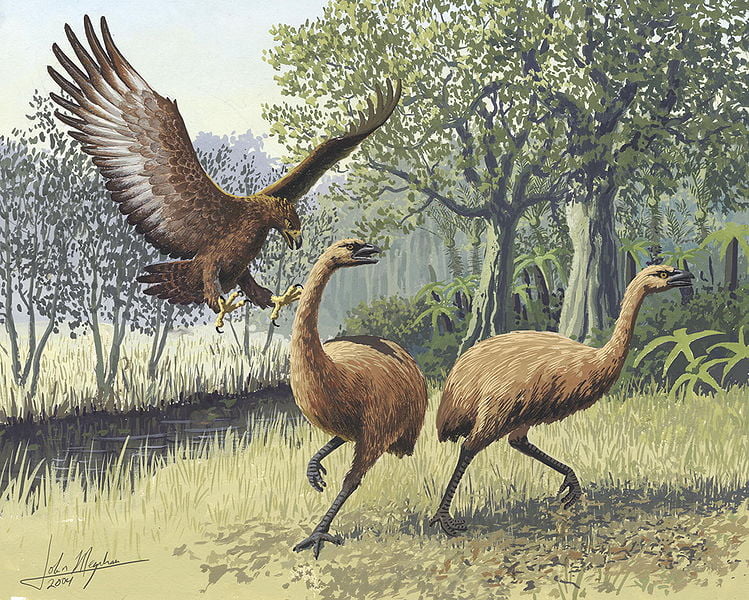
It was an example of island gigantism, weighing over twice as much as a Swamp Harrier. It was a generalist predator, taking prey of the same size as small eaglespecies do – land animals weighing one or a few kilograms. In its hunting strategy, however, it was more adapted to avian prey, as sufficiently large mammals were entirely absent from New Zealand. Its shape differed from that of most other harriers, and it was initially mistaken for a huge hawk. Presumably, it hunted diurnal birds in a manner similar to goshawks.
A noted explorer, Charles Edward Douglas, claims in his journals that he had an encounter with two raptors of immense size in the Landsborough River valley (probably in the 1870s), and shot and ate them. These birds might have been a last remnant of the mighty pouakai (Haast's Eagle), but this is very unlikely: there had not been sufficient numbers of suitable prey for a population of Haast's Eagle to maintain itself for about half a millennium at that time; furthermore 19th-century Māori lore was quite adamant that the pouakai was a bird not seen in living memory.
Still, Douglas' observations on wildlife are generally trustworthy; a more probable explanation, given that the alleged three-metre wingspan of Douglas' birds is unlikely to have been more than a rough estimate, is that the birds were Eyles' Harriers – modern estimates tend to assume that a 3-metre wingspan is decidedly large even for Haast's Eagle; that of Eyles' Harrier was probably somewhat short of 2 metres. Although the Eyles' Harrier also went extinct in prehistoric times, its dietary habits alone make it a more likely candidate for late survival.
This species was named for Jim Eyles, paeleontologist and former director of the Nelson Provincial Museum and the West Coast Museum.

>Circus melanoleucos (Pied Harrier)

Pied Harrier


Pied Harrier
Conservation status
Scientific classification
Kingdom:Animalia
Phylum:Chordata
Class:Aves
Order:Falconiformes
(or Accipitriformes, q.v.)
Family:Accipitridae
Genus:Circus
Species:C. melanoleucos
Binomial name
Circus melanoleucos
(Pennant, 1769)
The Pied Harrier (Circus melanoleucos) is an Asian species of bird of prey in the familyAccipitridae. It is migratory, breeding from Amur valley in eastern Russia and north-eastern China to North Korea. Wintering individuals can be found in a wide area from Pakistan to Philippines. The population consists of approximately 10,000 individuals and the number is thought to be in moderate decline.
This medium-sized harrier (length 45 cm/18in, wing span 115 cm/46in)  nests in steppes and associated wetlands. Wintering individuals are often seen hunting above rice paddies and marshes.

Gallery

>Circus macrourus (Pallid Harrier)

Pallid Harrier


Pallid Harrier
Conservation status
Scientific classification
Kingdom:Animalia
Phylum:Chordata
Class:Aves
Order:Falconiformes
(or Accipitriformes, q.v.)
Family:Accipitridae
Genus:Circus
Species:C. macrourus
Binomial name
Circus macrourus
S. G. Gmelin, 1770

     Summer     Resident     Winter
The Pale or Pallid Harrier (Circus macrourus) is a migratory bird of prey of the harrier family. It breeds in southern parts of eastern Europe and central Asia and winters mainly in India and southeast Asia. It is a very rare vagrant to Great Britain and western Europe, although remarkably a juvenile wintered in Norfolk in the winter of 2002/3.
This medium-sized raptor breeds on open plains, bogs and heathland. In winter it is a bird of open country.
This is a typical harrier, with long wings held in a shallow V in its low flight. It also resembles other harriers in having distinct male and female plumages.
The male is whitish grey above and white below, with narrow black wingtips. It differs from theHen Harrier in its smaller size, narrower wings, pale colour different wing tip pattern.
The female is brown above with white upper tail coverts, hence females and the similar juveniles are often called "ringtails". Her underparts are buff streaked with brown. It is best distinguished from the female Hen Harrier on structure. It is very similar to the female Montagu's Harrier, but has darker and more uniform secondaries from below.
Pallid Harriers hunt small mammalslizards and birds, surprising them as they drift low over fields and moors.
The nest of this species is on the ground. Four to six whitish eggs are laid.

>Circus cinereus (Cinereous Harrier)

Cinereous Harrier


Cinereous Harrier
Male flying in Rio Grande do Sul, Brazil
Conservation status
Scientific classification
Kingdom:Animalia
Phylum:Chordata
Class:Aves
Order:Falconiformes
(or Accipitriformes, q.v.)
Family:Accipitridae
Genus:Circus
Species:C. cinereus
Binomial name
Circus cinereus
(Vieillot, 1816)
The Cinereous Harrier (Circus cinereus) is a South American bird of prey of the harrier family. Its breeding range extends from the Tierra del Fuego through Argentina and Chile to BoliviaParaguayand southern Brasil; and across the Andes north to Colombia.
The term cinereous describes its colouration. The male's plumage is dark grey above with black wingtips and a white rump. The underparts are pale grey, with a rufous streaked belly. The female's plumage is brown above, with a white rump, and cream coloured underneath, with a streaked belly similar to the males. The female is larger than the male with an average size of 46 cm (18 in) compared to the male's 40 cm (16 in). The wingspan is 90–115 cm (35–45 in). Since the 44.5 cm (17.5 in) tail comprises about 56% of this raptor's total length, this species ties with the Long-tailed Hawk as the raptor with the longest tail relative to its body size.
This bird can be found in different open habitats, ranging from lowland marshes to the AndeanAltiplano at a maximum altitude of 4500 metres. Like other harriers it nests on the ground. It is usually considered to be sedentary.
Its diet is variable, due to a wide range and variety of habitats. Its usual prey are small rodents and birds, reptiles, amphibians and insects.

>Circus maurus (Black Harrier)

Black Harrier


Black Harrier
Conservation status
Scientific classification
Kingdom:Animalia
Phylum:Chordata
Class:Aves
Order:Falconiformes
(or Accipitriformes, q.v.)
Family:Accipitridae
Genus:Circus
Species:C. maurus
Binomial name
Circus maurus
Temminck, 1828
The Black HarrierCircus maurus, is a medium-sized (up to 53cm long) African harrier of South AfricaBotswana and Namibia.
When perched, this bird appears all black. However, in flight a white rump and flight feathers become visible. Its morphology is comparable to that of other harriers, with a slim body, narrow wings and a long tail. Male and female plumages are similar. Immatures have buff under-parts and a heavily spotted breast.
Like other harriers it nests on the ground in tall vegetation. Three to five eggs are laid and incubated 35 days.
It feeds mostly on small rodents and birds and will occasionally take reptiles, catching them while flying low over its hunting grounds.
The greatest number of breeding pairs can be found in the Western Cape province, South Africa. In this area loose colonies aggregate around coastal wetlands. Breeding in Namibia is suspected but not confirmed.
The Black Harrier population has declined in recent years to less than 1000 birds and it is now classified as vulnerable, despite still having a wide breeding range. This is due to the destruction of its original breeding habitat, South Africa's natural shrubland, the fynbos, which has been greatly reduced by encroaching cereal culture and urban expansion.

>Circus assimilis (Spotted Harrier)

Spotted Harrier


Spotted Harrier
Conservation status
Scientific classification
Kingdom:Animalia
Phylum:Chordata
Class:Aves
Order:Falconiformes (or Accipitriformes, q.v.)
Family:Accipitridae
Genus:Circus
Species:C. assimilis
Binomial name
Circus assimilis
Jardine & Selby, 1828

In flight, Samsonvale, SE Queensland, Australia April 2008


The Spotted HarrierCircus assimilis, also known as the Smoke Hawk, is a large Australasian bird of prey in the familyAccipitridae.

Description

It is similar to the Swamp Harrier, distinguished by grey upperparts, chestnut facial disc and dark rump. Its wing length ranges between 375 and 470 mm, with females being larger.

Distribution and habitat

The Spotted Harrier inhabits Sulawesi and the Lesser Sunda Islands and is sparsely distributed throughout mainland Australia. It inhabits open country, especially in arid and semiarid regions.

Behaviour

Breeding

This species usually nests in trees, building a platform of twigs lined with green leaves for the clutch of 2–4 eggs. The incubation period is about 33 days, with chicksfledging about 37 days after hatching.

[edit]Feeding

It eats ground birdsrabbitsrodents and lizards.

>Circus buffoni (Long-winged Harrier)

Long-winged Harrier


Long-winged Harrier
Conservation status
Scientific classification
Kingdom:Animalia
Phylum:Chordata
Class:Aves
Order:Falconiformes (but see there)
Family:Accipitridae
Genus:Circus
Species:C. buffoni
Binomial name
Circus buffoni
(Gmelin, 1788)
The Long-winged Harrier (Circus buffoni) is a species of bird of prey in the family Accipitridae, native to South America.
Its natural habitats are dry savanna, subtropical or tropical seasonally wet or flooded lowlandgrasslandswamps, and heavily degraded former forest.

>Circus maillardi (Réunion Harrier)

Réunion Harrier


Réunion Harrier
Specimen in Réunion Natural History Museum
Conservation status
Scientific classification
Kingdom:Animalia
Phylum:Chordata
Class:Aves
Order:Falconiformes (or Accipitriformes, q.v.)
Family:Accipitridae
Genus:Circus
Species:C. maillardi
Binomial name
Circus maillardi
J. Verreaux, 1862
The Réunion Harrier or Réunion Marsh Harrier (Circus maillardi) is a bird of preybelonging to the marsh harrier group of harriers. It is now found only on the Indian Ocean island of Réunion where it is known locally as the papangue or pied jaune, although fossil material from Mauritius has been referred to this species. TheMadagascar Harrier (C. macrosceles) of Madagascar and the Comoro Islands was previously treated as a subspecies of this bird but is increasingly regarded as a separate species.

Description

It is about 50 cm long; the female is around 3–15% larger than the male. The male has a blackish head and back with white streaks. The underparts, underwings and rump are white and the tail is grey. The wings are grey and black with a white leading edge. Females and immatures are dark brown with a white rump and barred tail.
The birds are mostly silent except during the breeding season when they give a chattering threat call, a wailing courtship call and chuckling food-associated calls.
The Madagascar Harrier is larger and paler with longer wings and legs.

Ecology


Sub-fossil remains of a Réunion Harrier and other birds from Mauritius
It is typically found in forested upland areas between 300 and 700 m above sea-level. It also visits cane fields and grassland. Today its diet includes many introduced mammals (ratsmice and tenrecs) but it originally fed mainly on birds and insects. It has a number of adaptations which are unusual among harriers: broad rounded wings for hunting between trees and a short tarsus and long claws, which are common among those birds of prey which feed on other birds. It breeds between January and May and lays two or three white eggs.
It has an estimated population of 200–340 birds and has been evaluated as endangered by BirdLife International. It is threatened by destruction and disturbance of its habitat and by poaching. It became a protected species in 1966 and its numbers are now stable or increasing.


Taxonomy

The species was described in 1862 by Jules Verreaux. He named it in honour of Louis Maillard, who mentioned the bird in a book about the island.
In 1893 Alfred Newton and Hans Gadow described tarsometatarsitibiae and metacarpals from a hawk called Astur alphonsi (later renamedAccipiter alphonsi and Circus alphonsi) from Mauritius. In 1958 James Greenway considered this taxon as conspecific with the Pied Harrier. A later examination of the bones came to the conclusion that Astur alphonsi is actually identical with Circus maillardi, which formerly occurred on Mauritius too but is now extirpated.