Showing posts with label Tribe Chaeturini. Show all posts

Sunday, June 17, 2012

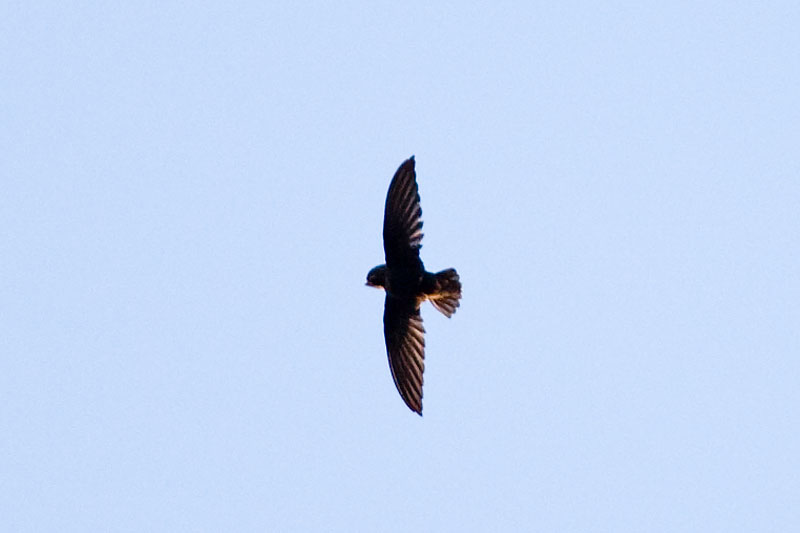
>Chaetura fumosa (Costa Rican Swift)

Costa Rican Swift


Costa Rican Swift
Conservation status

Least Concern (IUCN 3.1)
Scientific classification
Kingdom:Animalia
Phylum:Chordata
Class:Aves
Order:Apodiformes
Family:Apodidae
Genus:Chaetura
Species:C. fumosa
Binomial name
Chaetura fumosa
Salvin, 1870
The Costa Rican Swift (Chaetura fumosa) is a species of swift in the Apodidae family. It was split from the Band-rumped Swift, Chaetura spinacauda, in 1998.
It is found in Colombia, Costa Rica, and Panama with a natural habitat of subtropical or tropical moist lowland forests.
It is blackish and slim-winged with sharply contrasting pale-rump band and distinctly pale throat. Sooty- black coloration is tinged with glossy blue. Bill and feet are black. Compare with Band-rumped Swift.
Costa Rican Swifts usually feed on inscets in flight over open habitats and agricultural fields, although this species sometimes can be found over forest and semi-open habitats. Usually found in groups of 5-10, but forms flocks of up to 50 after breeding season. Associates with other small swifts (see Gray-rumped Swift, Band-rumped Swift and Vaux's Swift) where ranges overlap and where feeding is good. Nests in tree hole 30 ft. up in any sort of tree.

>Chaetura viridipennis (Mato Grosso Swift)

Mato Grosso Swift


Mato Grosso Swift
Conservation status

Least Concern (IUCN 3.1)
Scientific classification
Kingdom:Animalia
Phylum:Chordata
Class:Aves
Order:Apodiformes
Family:Apodidae
Genus:Chaetura
Species:C. viridipennis
Binomial name
Chaetura viridipennis
Cherrie, 1916
The Mato Grosso Swift (Chaetura viridipennis), also known as the Amazonian Swift, is a species of swift in the Apodidae family. It is found in Bolivia, Brazil, Colombia, Ecuador and Peru. Its natural habitats are subtropical or tropical moist lowland forests and heavily degraded former forest.

>Chaetura meridionalis (Sick's Swift)

Sick's Swift


Sick's Swift
Conservation status

Least Concern (IUCN 3.1)
Scientific classification
Kingdom:Animalia
Phylum:Chordata
Class:Aves
Order:Apodiformes
Family:Apodidae
Genus:Chaetura
Species:C. meridionalis
Binomial name
Chaetura meridionalis
Hellmayr, 1907
The Sick's Swift (Chaetura meridionalis) is a species of swift in the Apodidae family. It was previously considered conspecific with the smaller Ashy-tailed Swift, but Marín (1997) found that Sick's Swift was closer to the Chimney Swift.

Overview

It breeds in south-eastern Brazil and adjacent parts of Argentina, Paraguay and Bolivia, but is believed to spend the Austral winter further north in the Amazon basin, northern South Americaand Panama. Its exact wintering range is, however, poorly known due to the highly complex matter of field identification of a number of very similar Chaetura swifts found in central and northern South America. In addition to the previously mentioned countries, there are records from Colombia,Venezuela, Suriname and French Guiana.
The preferred habitat is forest and woodland, but it can be seen flying over virtually any habitat during migration.
It is generally common, but confirmed records outside its breeding range (where it is the only largeChaetura swift, and therefore relatively easy to identify) are infrequent.
Upperparts dark smoky brown. Rump and upper tail-coverts smoky tail. Tail ashy grey with dark shafts and protruding spines, Throat grey, lower underparts dark brown, bill and legs black.
The nest, typically placed in a chimney or a hollow tree, is an open cup similar in construction to that of the Chimney Swift. Constructed almost entirely of one type of dry leaf stalks having a length of 5 cm. The structure of the nest lacks density and is transparent. Adhesive saliva is used on the place of the attachment of the nest and to a lesser degree on its front side. The nest does not have a rear wall, which is represented by the side of the tree. the breeding period of the Chaetura corresponds with the end of the dry season to the beginning of the rainy period. Theis reused until it falls down, on which occasion the same location is used to build a new nest. Clutch size is 3-5 eggs, the female incubates but both parents feed the young.
Sick's Swift feeds in flight on flying insects. It is often low over roads or clearings in the morning or evening, rising high above the forest, often with other swifts, in the middle of the day.

>Chaetura andrei (Ashy-tailed Swift)

Ashy-tailed Swift


Ashy-tailed Swift
Conservation status
Not recognized (IUCN 3.1)
Scientific classification
Kingdom:Animalia
Phylum:Chordata
Class:Aves
Order:Apodiformes
Family:Apodidae
Genus:Chaetura
Species:C. andrei
Binomial name
Chaetura andrei
Berlepsch & Hartert, 1902
The Ashy-tailed Swift (Chaetura andrei) is a swift which is endemic to northern and central Venezuela.
The taxonomy of this group is confusing. The larger and far more widespread Sick's Swift was previously regarded as a subspecies of the Ashy-tailed Swift, but Marín (1997) found that Sick's Swift was closer to the Chimney Swift. Marín further suggested that the Ashy-tailed Swift was identical to Vaux's Swift of the subspecies aphanes. If following this approach, andrei (with aphanes as a junior synonym) becomes a subspecies of Vaux's Swift. This, however, is considered mistaken by Restall et al. (2006), where it is mentioned that they, while virtually identical under normal field conditions, actually do differ and also have different behavior and habitat preferences (Ashy-tailed Swift prefers forested lowland rivers, while Vaux's Swift race aphanes prefers mountain slopes).

>Chaetura brachyura (Short-tailed Swift)

Short-tailed Swift


Short-tailed Swift
Conservation status

Least Concern (IUCN 3.1)
Scientific classification
Kingdom:Animalia
Phylum:Chordata
Class:Aves
Subclass:Neornithes
Infraclass:Neognathae
(unranked):Cypselomorphae
Order:Apodiformes
Family:Apodidae
Genus:Chaetura
Species:C. brachyura
Binomial name
Chaetura brachyura
(Jardine, 1846)
The Short-tailed Swift (Chaetura brachyura) is a bird in the Apodidae, or swift family.

Taxonomy

The subspecies C. b. ocypetes is sometimes considered a full species, the Tumbes Swift Chaetura ocypetes Zimmer, 1953.

Distribution and habitat

The swift is a common resident of Trinidad, Tobago, Grenada
and Saint Vincent, and in tropical South America from Panama, 
Colombia and the Guianas south to Ecuador, Peru and Brazil; in Brazil, the entire Amazon Basin, excluding much of the southeastern Basin. It rarely occurs over 800 m ASL even in the hottest parts of its range and in mountaineous or hilly terrain it inhabits, but has been recorded as high as 1,300 m ASL. It is found in a range of habitats including savanna, open woodland, and cultivation.

Description

The Short-tailed Swift is about 10.5 cm long, and weighs 20 g. It has long narrow wings, a robust body and a short tail. The sexes are similar. It is mainly black with a pale rump and tail. It can be distinguished from related species in its range, such as the Band-rumped Swift(C. spinicauda) or the Gray-rumped Swift (C. cinereiventris) by the lack of contrast between the rump and the tail, the latter being much darker in the other species.

Behaviour

It is very gregarious and forms communal roosts when not breeding. Predation by bats at the nest sites has been suspected. The flight call is a rapid chittering sti-sti-stew-stew-stew.

Breeding

The nest is a 5 cm wide shallow half-saucer of twigs and saliva attached to a vertical surface. This is often a man-made structure like a chimney or manhole, as with its relative, the Chimney Swift (C. pelagica), but natural caves and tree cavities are also used. Up to seven white eggs (average 3 or 4) are incubated by both parents for 17–18 days. The young leave the nest in a further two weeks, but remain near it, clinging to the cavity wall without flying, for another two weeks.

Feeding

The swift feeds in flight on flying insects, including winged ants and termites.

>Chaetura chapmani (Chapman's Swift)

Chapman's Swift


Chapman's Swift
Conservation status

Least Concern (IUCN 3.1)
Scientific classification
Kingdom:Animalia
Phylum:Chordata
Class:Aves
Order:Apodiformes
Family:Apodidae
Genus:Chaetura
Species:C. chapmani
Binomial name
Chaetura chapmani
Hellmayr, 1907
The Chapman's Swift (Chaetura chapmani) is a species of swift in the Apodidae family. It is found in Brazil, Colombia, French Guiana, Guyana, Panama, Suriname, Trinidad and Tobago, and Venezuela. Its natural habitats are subtropical or tropical moist lowland forests and heavily degraded former forest.


Saturday, June 16, 2012

>Chaetura vauxi (Vaux's Swift)

Vaux's Swift


Vaux's Swift
Flock swirling into a 1920s elementary school chimney to roost for the night.
Conservation status

Least Concern (IUCN 3.1)
Scientific classification
Kingdom:Animalia
Phylum:Chordata
Class:Aves
Order:Apodiformes
Family:Apodidae
Genus:Chaetura
Species:C. vauxi
Binomial name
Chaetura vauxi
(Townsend, 1839)
Vaux's Swift (Chaetura vauxi) is a small swift native to North America and northern South America. It was named for the American scientist William Sansom Vaux.

Description

This is a small swift, even compared to other Chaetura species, at 10.7 to 11.2 cm long and weighing 18 g. The northern populations are slightly larger at 11.5 cm, probably according to the Bergmann's Rule, and/or migration requirements. It has a cigar-shaped body, crescentic wings and a short bluntly squared-off tail. The head, upperparts and wings are dusky black, and the underparts, rump and tail coverts are greyish brown. The throat is paler grey, becoming whitish in northern birds. The sexes are similar, but juveniles have dusky bases to the throat feathers.

Distribution and habitat

Vaux's Swift breeds in highlands from southern Alaska to central California and from southern Mexico, the northern Yucatán Peninsula, to eastern Panama and northern Venezuela. The United States' populations are migratory, wintering from central Mexico south through the Central American breeding range. The resident breeding birds in the southern part of the range are sometimes considered a separate species, Dusky-backed SwiftChaetura richmondi. Preferred habitats include old growth coniferous or deciduous forests consisting of coniferous and deciduous vegetation; requires large, hollow trees for nesting.

Behaviour

This is a gregarious species, with flocks of 30 or more birds, and often with other swift species, such as White-collared, especially at weather fronts. It flies with a mixture of stiff wing-beats and unsteady glides. It has more varied calls than others in the genus, with a mixture of chattering, buzzes, squeaks and chips.

Feeding

The swift feeds in flight on flying insects, including beetles, wasps, termites and flying ants. It forages over forests and more open areas, including towns.

Breeding

Vaux's Swift breeds in the mountains and foothills, from southeastern Alaska and Montana to central California, mainly above 700 m. It builds a cup nest of twigs and saliva on a vertical surface in a dark cavity, such as a tree hole, cliff crevice or attic. It lays three white eggs between March and July. It spends winters in the tropics.

Subspecies

The following subspecies are currently recognized:
  • Chaetura vauxi andrei Berlepsch & Hartert, 1902
  • Chaetura vauxi aphanes Wetmore & Phelps, 1956
  • Chaetura vauxi gaumeri Lawrence, 1882
  • Chaetura vauxi ochropygia Aldrich, 1937
  • Chaetura vauxi richmondi Ridgway, 1910
  • Chaetura vauxi tamaulipensis Sutton, 1941
  • Chaetura vauxi vauxi (J. K. Townsend, 1839)
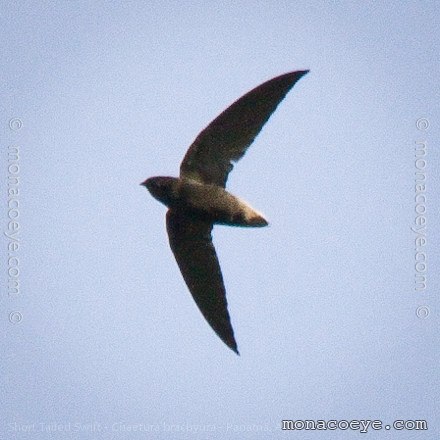
>Chaetura pelagica (Chimney Swift)

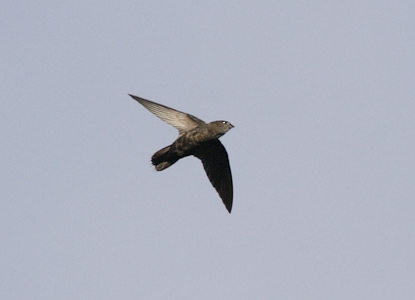
Chimney Swift


Chimney Swift
Conservation status

Near Threatened (IUCN 3.1)
Scientific classification
Kingdom:Animalia
Phylum:Chordata
Class:Aves
Order:Apodiformes
Family:Apodidae
Genus:Chaetura
Species:C. pelagica
Binomial name
Chaetura pelagica
(Linnaeus, 1758)
The Chimney Swift (Chaetura pelagica) is a small bird (a type of swift).

Physical description

In flight, this bird looks like a flying cigar with long slender curved wings. The plumage is a sooty grey-brown; the throat, breast, underwings and rump are paler. They have short tails. Chimney swifts also have the shortest legs of any bird native to Ontario.

Reproduction


At nest
The breeding season of Chimney Swifts is from May through July. Their breeding habitat is near towns and cities across eastern North America. Originally, these birds nested in large hollow trees, but now they mainly nest in man-made structures such as large open chimneys. The nest is made of twigs glued together with saliva and placed in a shaded location. They will lay three to seven white eggs, which the female will cover at night. The incubation period is 19-20 days, and the fledglings leave the nest after a month. Chimney swifts can nest more than once in a season. While Chimney swifts will roost together in large numbers, it is rare to find more than one nest per chimney. Nesting sites are normally small chimneys but nests are also built in large communal roosts. It is suspected that fledged young are often fed by their parents while the young roost together in large communal roosts.

Behavior

They are long distance migrants and winter in eastern Peru; other nesting locations in South America may exist. They migrate in flocks. This species has occurred as a very rare vagrant to western Europe. The gregarious nature of this species is reflected in that two individuals of this species turned up together on the Isles of Scilly.

Feeding habits

These birds live on the wing, foraging in flight. They eat flying insects. They usually feed in groups, flying closely together and making a high-pitched chipping noise. A vigilant observer can see them entering and exiting chimneys at a high speed, almost as if they were being shot out. Their flight is distinctive: they make rapid angular turns unlike most other birds.
Their population may have increased historically with the introduction of large chimneys as nesting locations. With suitable man-made habitat becoming less common, their numbers are declining in some areas. They were listed as Threatened by COSEWIC for several years with a likely listing of the species on Schedule 1 of the Species at Risk Act.

>Chaetura egregia (Pale-rumped Swift)

Pale-rumped Swift


Pale-rumped Swift
Conservation status

Least Concern (IUCN 3.1)
Scientific classification
Kingdom:Animalia
Phylum:Chordata
Class:Aves
Order:Apodiformes
Family:Apodidae
Genus:Chaetura
Species:C. egregia
Binomial name
Chaetura egregia
Todd, 1916
The Pale-rumped Swift (Chaetura egregia) is a species of swift in the Apodidae family. It is found in Bolivia, Brazil, Ecuador, and Peru. Its natural habitat is subtropical or tropical moist lowland forests.

>Chaetura cinereiventris (Grey-rumped Swift)

Grey-rumped Swift

Grey-rumped Swift (Chaetura cinereiventris) 


Grey-rumped Swift
Conservation status

Least Concern (IUCN 3.1)
Scientific classification
Kingdom:Animalia
Phylum:Chordata
Class:Aves
Order:Apodiformes
Family:Apodidae
Genus:Chaetura
Species:C. cinereiventris
Binomial name
Chaetura cinereiventris
(Sclater, 1862)
The Grey-rumped SwiftChaetura cinereiventris, is a small swift.
This species breeds in hill forests from Nicaragua south to Peru, Brazil and northern Argentina, and Grenada, Trinidad and Tobago. The nest is a half saucer of twigs glued to the inside of a tree hole, chimney or similar shaded location with saliva.
Grey-rumped Swift is 11.5 cm long and weighs 15 g. The upperparts are black with a grey triangular band across the rump, and the underparts are slate grey. It has a long black-grey tail.
Grey-rumped Swift feeds in flight on flying insects. It is often low over roads or clearings in the morning or evening, rising high above the forest, often with other swifts, in the middle of the day.
Grey-rumped Swift has a chittering call.

>Chaetura martinica (Lesser Antillean Swift)

Lesser Antillean Swift


Lesser Antillean Swift
Conservation status

Least Concern (IUCN 3.1)
Scientific classification
Kingdom:Animalia
Phylum:Chordata
Class:Aves
Order:Apodiformes
Family:Apodidae
Genus:Chaetura
Species:C. martinica
Binomial name
Chaetura martinica
(Hermann, 1783)
The Lesser Antillean Swift (Chaetura martinica) is a species of swift in the Apodidae family. It breeds on Dominica, Guadeloupe, Martinique, Saint Lucia and Saint Vincent. There is a possible record from Nevis. Its natural habitats are subtropical or tropical moist lowland forests and heavily degraded former forest.

>Chaetura spinicauda (Band-rumped Swift)

Band-rumped Swift

-Band ตะโพก Swift (Chaetura spinicauda)


Band-rumped Swift
Scientific classification
Kingdom:Animalia
Phylum:Chordata
Class:Aves
Order:Apodiformes
Family:Apodidae
Genus:Chaetura
Species:C. spinicaudus
Binomial name
Chaetura spinicaudus
(Temminck, 1839)
The Band-rumped SwiftChaetura spinicaudus, is a small swift. Until 1998, it was known as Chaetura spinicauda. At that time, the previously considered subspecies Costa Rican Swift, Chaetura fumosa, was split from this species and the scientific name was modified from C. spinacauda to C. spinacaudus.
It breeds in forested areas from Costa Rica south and east to Colombia, Ecuador, Venezuela, the Guianas, Trinidad and northeast Brazil. The nest is a half saucer of twigs glued to the inside of a tree hole or similar shaded location with saliva.
The Band-rumped Swift is a speedy slender bird, 11.5 cm long, weighing 15 g. The upperparts are blackish with a whitish band across the rump, and the underparts are dark brown with a paler throat. It has a short tail.
It feeds in flight on flying insects, often low over roads or clearings in the morning or evening, rising high above the forest, often with other swifts, in the middle of the day.
It has a chittering csinck call.