Showing posts with label Tribe Collocaliini. Show all posts

Tuesday, June 12, 2012

>Schoutedenapus schoutedeni (Schouteden's Swift)

Schouteden's Swift


Schouteden's Swift
Conservation status

Vulnerable (IUCN 3.1)
Scientific classification
Kingdom:Animalia
Phylum:Chordata
Class:Aves
Order:Apodiformes
Family:Apodidae
Genus:Schoutedenapus
Species:S. schoutedeni
Binomial name
Schoutedenapus schoutedeni
(Prigogine, 1960)
The Schouteden's Swift (Schoutedenapus schoutedeni) is a species of swift in the Apodidae family. It is endemic to Democratic Republic of the Congo.
Its natural habitats are subtropical or tropical moist lowland forests and subtropical or tropical moist montane forests. It is threatened by habitat loss.


>Schoutedenapus myoptilus (Scarce Swift)

Scarce Swift


Scarce Swift
Conservation status

Least Concern (IUCN 3.1)
Scientific classification
Kingdom:Animalia
Phylum:Chordata
Class:Aves
Order:Apodiformes
Family:Apodidae
Genus:Schoutedenapus
Species:S. myoptilus
Binomial name
Schoutedenapus myoptilus
(Salvadori, 1888)
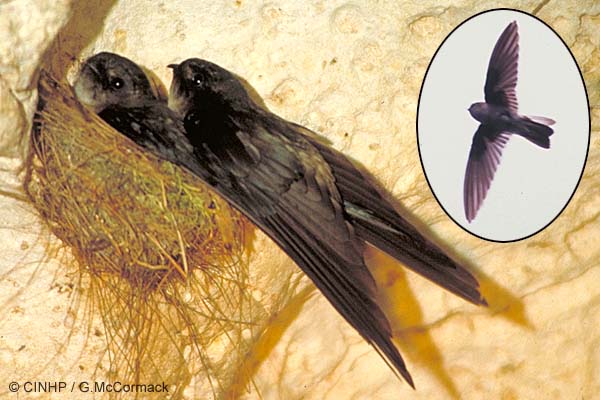
The Scarce Swift (Schoutedenapus myoptilus) is a species of swift in the Apodidae family. It is found in Angola, Burundi, Cameroon, Democratic Republic of the Congo, Equatorial Guinea,Ethiopia, Kenya, Malawi, Mozambique,
 Rwanda, Sudan, Tanzania, Uganda, Zambia, and Zimbabwe.

>>Genus Schoutedenapus

Schoutedenapus


Schoutedenapus
Scientific classification
Kingdom:Animalia
Phylum:Chordata
Class:Aves
Order:Apodiformes
Family:Apodidae
Tribe:Collocaliini
Genus:Schoutedenapus
De Roo, 1968
Schoutedenapus is a genus of swift in the Apodidae family. It contains the following species:
  • Scarce Swift (Schoutedenapus myoptilus)
  • Schouteden's Swift (Schoutedenapus schoutedeni)

>>Genus Hydrochous (Giant Swiftlet)

Giant Swiftlet


Giant Swiftlet
Conservation status

Near Threatened (IUCN 3.1)
Scientific classification
Kingdom:Animalia
Phylum:Chordata
Class:Aves
Order:Apodiformes
Family:Apodidae
Tribe:Collocaliini
Genus:Hydrochous
Brooke, 1970
Species:H. gigas
Binomial name
Hydrochous gigas
(Hartert & Butler, 1901)
Synonyms
Hydrochrous gigas (Hartert & Butler, 1901)
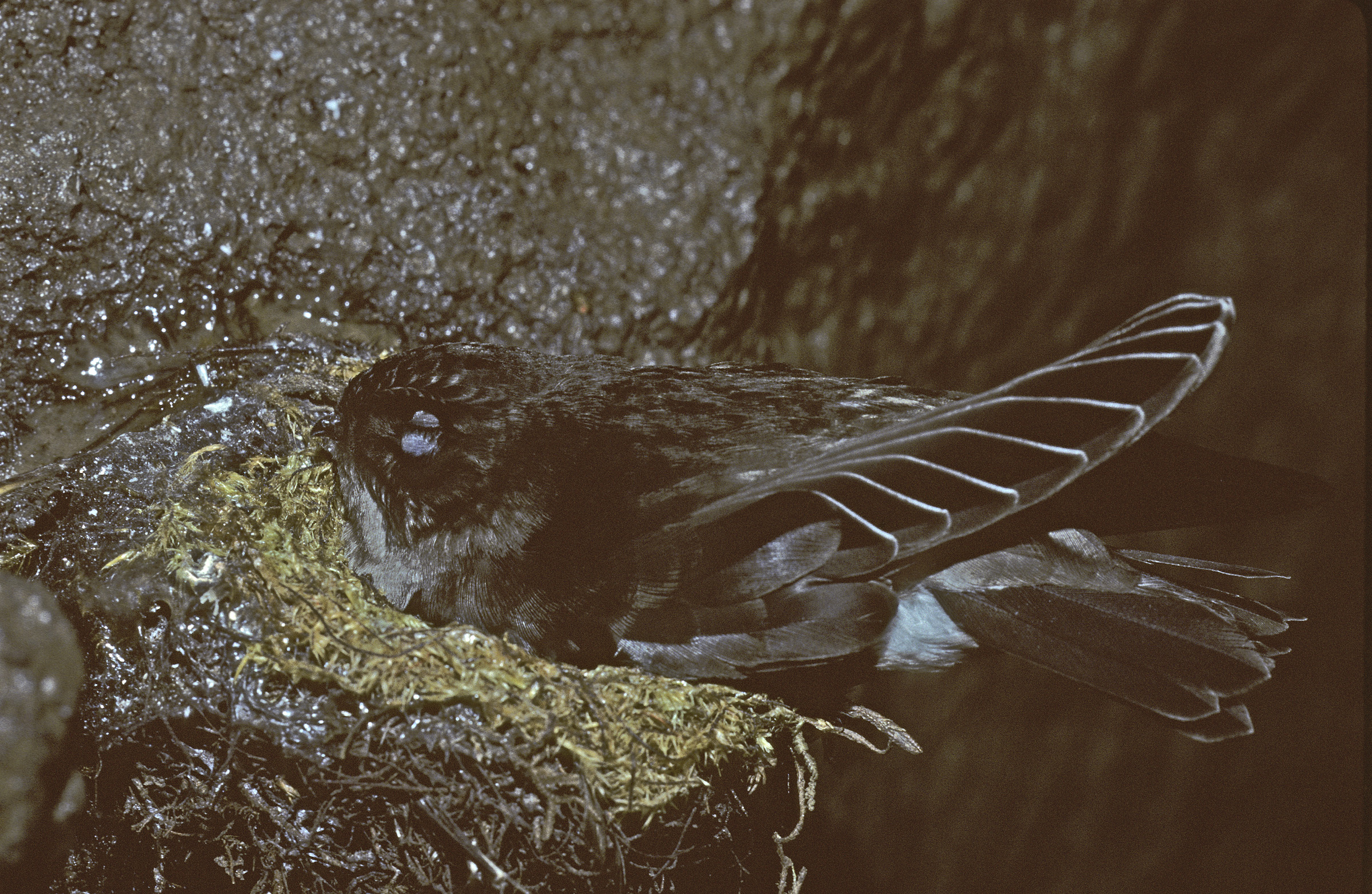
The Giant Swiftlet (Hydrochous gigas), also known as the Waterfall Swift, is a species of swiftin the Apodidae family. It is monotypic within the genus Hydrochous. It is found inIndonesia and Malaysia. Its natural habitats are subtropical or tropical moist montane forests and rivers. It is threatened by habitat loss.

Monday, June 11, 2012

>Aerodramus germani (German's Swiftlet)

German's Swiftlet


German's Swiftlet
Juvenile
Conservation status

Least Concern (IUCN 3.1)
Scientific classification
Kingdom:Animalia
Phylum:Chordata
Class:Aves
Order:Apodiformes
Family:Apodidae
Genus:Aerodramus
Species:A. germani
Binomial name
Aerodramus germani
Oustalet, 1876
Synonyms
Collocalia germani
The German's Swiftlet (Aerodramus germani) is a species of swift.
It is found in China, Indonesia, Laos, Malaysia, Myanmar, the Philippines, Singapore, Thailand, and Vietnam. Its natural habitats are subtropical or tropical moist lowland forests and subtropical or tropical moist montane forests.

Description

This swiftlet is 12 cm long and weighs 13 to 14 grams. The plumage is blackish-brown above, but much paler on the underparts. The tail is slightly forked and the wings are long and narrow. Thebill and feet are black. The nominate subspecies C. g. germani from Hainan south to Thailand and northern Malaysia has a whitish rump, but C. g. amechanus of the rest of Malaysia has a grey rump. These two forms are sometimes considered to be subspecies of the Edible-nest Swiftlet.
Several calls are uttered including a loud zwing and various chip calls used for echolocation in dark caves.
Himalayan Swiftlet winters within the range of German's Swiftlet, but is larger and bulkier, and has a greyer rump than C. g. germani.

Behaviour

This swiftlet feeds over a range of habitats from coastal areas to the mountains. Its diet consists of flying insects which are caught on the wing. It often feeds in large flocks with other species of swift and swallow.

A colony breeds on the interior walls of this Thai temple
It breeds in colonies in caves, in a cleft in a cliff or sometimes on a building. The bracket-shaped nest is white and translucent and is made of layers of hardened saliva attached to the rock. It measures about 6 cm across with a depth of 1.5 cm and a weight of about 14 grams. Two white, oval, non-glossy eggs are laid.

Status

German's Swiftlet has an extensive range, estimated at 1–10 million square kilometres (0.4–3.8 million square miles), and a large population. The species is not believed to approach the thresholds for the population decline criterion of the IUCN Red List (i.e., declining more than 30% in ten years or three generations), and is therefore evaluated as Least Concern.

>Aerodramus fuciphagus (Edible-nest Swiftlet)

Edible-nest Swiftlet


Edible-nest Swiftlet
Esculent Swallow and Nest by John Latham
Conservation status

Least Concern (IUCN 3.1)
Scientific classification
Kingdom:Animalia
Phylum:Chordata
Class:Aves
Order:Apodiformes
Family:Apodidae
Genus:Aerodramus
Species:A. fuciphagus
Binomial name
Aerodramus fuciphagus
(Thunberg, 1812)
Synonyms
Collocalia fuciphaga
The Edible-nest Swiftlet (Aerodramus fuciphagus) is a small bird of the swift family which is found in South-east Asia. Its nest is made of solidified saliva and is used to make bird's nest soup.

Description


Swift in flight
It is 11 to 12 cm long and weighs 15 to 18 grams. The plumage is blackish-brown above, paler on the underparts. The rump is slightly paler than the rest of the upperparts. The tail is slightly forked and the wings are long and narrow. The bill and feet are black.
The subspecies A. f. micans is paler and greyer while A. f. vestitus is darker with a rump that is less obviously paler.
Several calls are uttered including a loud, rattling call used for echolocation in dark caves.

Distribution and subspecies

There are six subspecies of the Edible-nest Swiftlet:
  • A. f. fuciphagus - The nominate subspecies found in Java, Bali and the western Lesser Sunda Islands
  • A. f. inexpectatus - Andaman and Nicobar Islands, vagrant to Burma
  • A. f. dammermani - Flores, known from only a single specimen
  • A. f. micans - eastern Lesser Sundas (Sumba, Savu and Timor)
  • A. f. vestitus - Sumatra and Borneo, sometimes considered to be a separate species, theBrown-rumped SwiftletAerodramus vestitus (Lesson, 1843).
  • A. f. perplexus - Maratua Archipelago off eastern Borneo
German's Swiftlet (Aerodramus germani), with two subspecies germani and amechanus, was formerly considered to be conspecific with the Edible-nest Swiftlet, but is now often considered to be a separate species. It occurs in the Malay Peninsula, central Thailand, coastal Vietnam and Cambodia, Hainan, northern Borneo and parts of the Philippines.

Behavior

It feeds over a range of habitats from coastal areas to the mountains, occurring up to 2,800 metres above sea-level on Sumatra and Borneo. Its diet consists of flying insects which are caught on the wing. It often feeds in large flocks with other species of swift and swallow.
It breeds in colonies in caves, in a cleft in a cliff or sometimes on a building. The bracket-shaped nest is white and translucent and is made of layers of hardened saliva attached to the rock. It measures about 6 cm across with a depth of 1.5 cm and a weight of about 14 grams. Two white, oval, non-glossy eggs are laid.

Relationship with man


The nest before use in bird's nest soup
The nest used in bird's nest soup are composed almost entirely of saliva with little or no plant material. The soup is made by soaking and steaming the nests in water and is said to be an aphrodisiac and to have various medicinal qualities. The nests can fetch high prices and many colonies are harvested commercially.
Some populations such as those in the Andaman and Nicobar Islands have been harvested extensively leading to them being considered critically threatened under the IUCN criteria.The use of artificial bird houses is growing. A detailed account of modern nest farming and marketing techniques is given by Jordan (2004).

>Aerodramus maximus (Black-nest Swiftlet)

Black-nest Swiftlet


Black-nest Swiftlet
Black-nest Swiftlet at Upper Peirce Reservoir,Singapore
Conservation status

Least Concern (IUCN 3.1)
Scientific classification
Kingdom:Animalia
Phylum:Chordata
Class:Aves
Order:Apodiformes
Family:Apodidae
Genus:Aerodramus
Species:A. maximus
Binomial name
Aerodramus maximus
Hume, 1878
Synonyms
Collocalia maxima
The Black-nest Swiftlet (Aerodramus maxima) is a species of swift in the Apodidae family. It is found in Brunei, Indonesia, Malaysia, Myanmar, the Philippines, Singapore, Thailand, and Vietnam. Its natural habitats are subtropical or tropical moist lowland forests and subtropical or tropical moist montane forests.
It is one of the main sources of edible nests for bird's nest soup.

>Aerodramus ocistus (Marquesan Swiftlet)

Marquesan Swiftlet


Marquesan Swiftlet
Conservation status

Least Concern (IUCN 3.1)
Scientific classification
Kingdom:Animalia
Phylum:Chordata
Class:Aves
Order:Apodiformes
Family:Apodidae
Genus:Aerodramus
Species:A. ocistus
Binomial name
Aerodramus ocistus
(Oberholser, 1906)
Synonyms
Collocalia ocista
The Marquesan Swiftlet (Aerodramus ocistus) is a species of swift in the Apodidae family. It isendemic to French Polynesia. Its natural habitat is subtropical or tropical moist lowland forests.

Sunday, June 10, 2012

>Aerodramus sawtelli (Atiu Swiftlet)

Atiu Swiftlet


Atiu Swiftlet
Conservation status

Vulnerable (IUCN 3.1)
Scientific classification
Kingdom:Animalia
Phylum:Chordata
Class:Aves
Order:Apodiformes
Family:Apodidae
Genus:Aerodramus
Species:A. sawtelli
Binomial name
Aerodramus sawtelli
Holyoak, 1974
Synonyms
Collocalia sawtelli
The Atiu Swiftlet (Aerodramus sawtelli) is a species of bird in the swift family and endemic to Atiu in the Cook Islands.
Its natural habitats are the islands fernlands and mixed horticultural areas over which it feeds and in makatea limestone caves within which it nests.

>Aerodramus manuoi (Mangaia Swiftlet)

Mangaia Swiftlet


Mangaia Swiftlet
Conservation status
Extinct
Scientific classification
Kingdom:Animalia
Phylum:Chordata
Class:Aves
Order:Apodiformes
Family:Apodidae
Genus:Aerodramus
Species:A. manuoi
Binomial name
Aerodramus manuoi
Steadman, 2002
Synonyms
  • Collocalia manuoi
The Mangaia Swiftlet (Aerodramusa manuoi) is an extinct species of bird in the swift family. It became extinct during prehistoric times. It was endemic to Mangaia, Cook Islands. It was closely allied with the extant Atiu Swiftlet (Aerodramus sawtelli) of Atiu, Mangaia's neighbouring island, though it was probably slightly larger.
It was described from six fossil bones recovered from a Holocene rock shelter deposit on Mangaia. The coracoid and carpometacarpus of the new species are larger and very different qualitatively from those of the Atiu species. This is the first species of Aerodramus to be described from fossils.

>Aerodramus bartschi (Mariana Swiftlet)

Mariana Swiftlet


Mariana Swiftlet
Conservation status

Endangered (IUCN 3.1
Scientific classification
Kingdom:Animalia
Phylum:Chordata
Class:Aves
Order:Apodiformes
Family:Apodidae
Genus:Aerodramus
Species:A. bartschi
Binomial name
Aerodramus bartschi
Mearns, 1909
Synonyms
  • Collocalia bartschi
The Mariana Swiftlet or Guam Swiftlet (Aerodramus bartschi) is a species of swiftlet in the Apodidae family.

Taxonomy

It was formerly lumped with the Island Swiftlet (Aerodramus inquietus).

Description

The swiftlet is about 11 cm in length with a dark grey-brown head and upperparts. Its throat and upper breast are grey-white with the rest of the underparts darker grey. The tail has a shallow fork and the plumage lacks gloss.

Distribution and habitat

The swiftlet is found in Guam as well as in Saipan and Aguiguan in the Northern Mariana Islands, and is locally extinct on Rota and Tinian. It was also introduced successfully to Oahu in the Hawaiian Islands in the early 1960s, though the population there remains small. Its natural habitats are tropical moist lowland forests,mangroves and grassland.

Behaviour

In its natural range the swiftlet builds shallow nests high on the interior walls and ceilings of limestone caves, including sites in zones of complete darkness, in colonies of a few to several hundred birds. A single egg constitutes a clutch, but the birds may breed more than once a year. The swiftlets utter twittering and chirping sounds as well as the echolocation clicks used to navigate inside the nesting and roosting caves. Most birds in a colony leave their cave at dawn to forage, returning at sunset to roost. They are aerial feeders that capture small insects in flight over forests and other vegetation.

Status and conservation

The Mariana Swiftlet is considered to be Endangered. The population on Guam declined because of predation by Brown Tree Snakes and the use of agricultural pesticides, though it is believed to have subsequently increased to an estimated 900 individuals in 2006. The population on Saipan was estimated in 2005 to consist of about 5400 individuals, though this is expected to decline substantially following the establishment of Brown Tree Snakes on the island. The estimated size of the Aguiguan population is about 400. The single known breeding colony on Oahu was estimated in 1997 to contain a minimum of 17 breeding pairs. Proposed conservation measures include continued population monitoring and limiting cave disturbance, the eradication of tree snakes on Saipan, the control of introduced mud dauber wasps and cockroaches where they damage nests, and the reintroduction of birds to Rota whence they were extirpated in the 1970s.