Friday, March 30, 2012

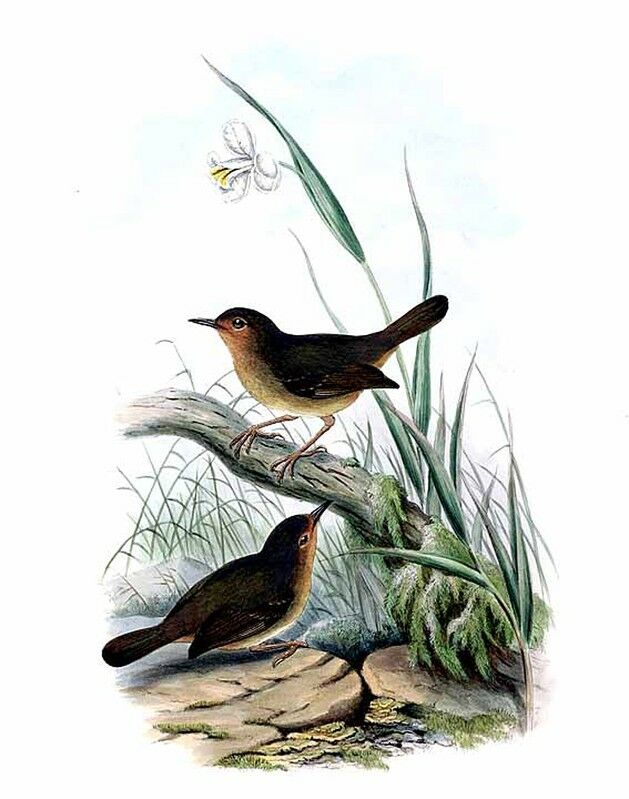
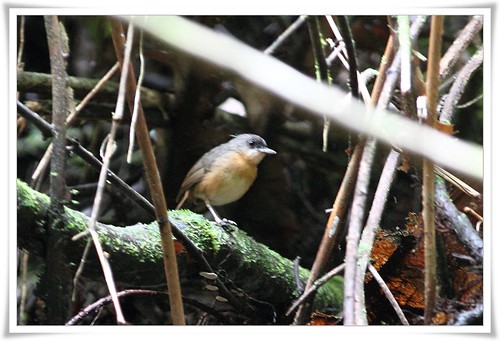
>Sericornis beccarii (Tropical Scrubwren)

Tropical Scrubwren


Tropical Scrubwren
Conservation status
Scientific classification
Kingdom:Animalia
Phylum:Chordata
Class:Aves
Order:Passeriformes
Family:Acanthizidae
Genus:Sericornis
Species:S. beccarii
Binomial name
Sericornis beccarii
Salvadori, 1874
The Tropical Scrubwren or Beccari's Scrubwren (Sericornis beccarii) is a bird species. Placed in the family Pardalotidae in the Sibley-Ahlquist taxonomy, this has met with opposition and indeed is now known to be wrong; they rather belong to the independent family Acanthizidae.
It is found in tropical moist forests of northern AustraliaIndonesia, and Papua New Guinea.
It is now[when?] considered conspecific with the Large-billed ScrubwrenS. magnirostris.

>Sericornis arfakianus (Grey-green Scrubwren)

Grey-green Scrubwren

  Séricorne Vert-de-Gris - Sericornis arfakianus
Grey-green Scrubwren
Conservation status
Scientific classification
Kingdom:Animalia
Phylum:Chordata
Class:Aves
Order:Passeriformes
Family:Acanthizidae
Genus:Sericornis
Species:S. arfakianus
Binomial name
Sericornis arfakianus
(Salvadori, 1876)
The Grey-green Scrubwren (Sericornis arfakianus) is a bird species. Placed in the familyPardalotidae in the Sibley-Ahlquist taxonomy, this has met with opposition and indeed is now known to be wrong; they rather belong to the independent family Acanthizidae.
It is found in Indonesia and Papua New Guinea. Its natural habitat is subtropical or tropical moistmontane forests.

>>Genus Sericornis

Sericornis


Scrubwrens
A female (left) White-browed Scrubwren(Sericornis frontalis) sings to its mate
Scientific classification
Kingdom:Animalia
Phylum:Chordata
Class:Aves
Order:Passeriformes
Family:Acanthizidae
Genus:Sericornis
Gould, 1838
Species
13, see text
Sericornis is a genus of small, mainly insectivorous, birds, the scrubwrens. They are placed in the family Acanthizidae which was included in the Pardalotidae in the Sibley-Ahlquist taxonomy. However, this placement was always controversial and indeed has since turned out to be false.
Despite the similarity in shape and habits, the true wrens (Troglodytidae) are a quite unrelated group of passerines.
Sericornis contains the following species and notable[verification needed] subspecies:
  • Grey-green Scrubwren, Sericornis arfakianus
  • Tropical Scrubwren or Beccari's Scrubwren, Sericornis beccarii - sometimes included in S. magnirostris
  • Yellow-throated Scrubwren, Sericornis citreogularis
  • White-browed Scrubwren, Sericornis frontalis
    • Spotted Scrubwren, Sericornis frontalis maculatus
    • Buff-breasted Scrubwren, Sericornis frontalis laevigaster
  • Tasmanian Scrubwren or Brown Scrubwren, Sericornis humilis - sometimes included in S. frontalis
  • Atherton Scrubwren, Sericornis keri
  • Large-billed Scrubwren, Sericornis magnirostris
  • Large Scrubwren, Sericornis nouhuysi
  • Papuan Scrubwren, Sericornis papuensis
  • Buff-faced Scrubwren, Sericornis perspicillatus
  • Vogelkop Scrubwren, Sericornis rufescens
  • Pale-billed Scrubwren, Sericornis spilodera
  • Perplexing Scrubwren, Sericornis virgatus

Thursday, March 29, 2012

>Crateroscelis robusta (Mountain Mouse-warbler)

Mountain Mouse-warbler


Mountain Mouse Warbler
Conservation status
Scientific classification
Kingdom:Animalia
Phylum:Chordata
Class:Aves
Order:Passeriformes
Family:Pardalotidae
Genus:Crateroscelis
Species:C. robusta
Binomial name
Crateroscelis robusta
(De Vis, 1898)
The Mountain Mouse-warbler (Crateroscelis robusta) is a species of bird in the Pardalotidaefamily. It is found in Indonesia and Papua New Guinea. Its natural habitat is subtropical or tropical moist montanes.

>Crateroscelis nigrorufa (Bicoloured Mouse-warbler)

Bicoloured Mouse-warbler


Bicoloured Mouse-warbler
Conservation status
Scientific classification
Kingdom:Animalia
Phylum:Chordata
Class:Aves
Order:Passeriformes
Family:Pardalotidae
Genus:Crateroscelis
Species:C. nigrorufa
Binomial name
Crateroscelis nigrorufa
(Salvadori, 1894)
The Bicoloured Mouse-warbler (Crateroscelis nigrorufa) is a species of bird in thePardalotidae family. It is found in Indonesia and Papua New Guinea. Its natural habitat is subtropical or tropical moist montanes.

>Crateroscelis murina (Rusty Mouse-warbler)

Rusty Mouse-warbler


Rusty Mouse Warbler
Conservation status
Scientific classification
Kingdom:Animalia
Phylum:Chordata
Class:Aves
Order:Passeriformes
Family:Acanthizidae
Genus:Crateroscelis
Species:C. murina
Binomial name
Crateroscelis murina
(Sclater, 1858)
The Rusty Mouse-warbler (Crateroscelis murina), is a species of bird in the Pardalotidae family. It is found in Indonesia and Papua New Guinea. Its natural habitats are subtropical or tropical moist lowland forests and subtropical or tropical moist montanes.

>>Genus Crateroscelis

Crateroscelis

Crateroscelis
Scientific classification
Kingdom:Animalia
Phylum:Chordata
Class:Aves
Order:Passeriformes
Family:Acanthizidae
Genus:Crateroscelis
Sharpe, 1883
Crateroscelis is a songbird genus of the Australasian "warblerfamily (Acanthizidae). It was formerly placed in the Pardalotidae, which are now considered monotypic to genus. The common name of these birds is mouse-warblers.
It contains the following species:
  • Rusty Mouse-warbler, Crateroscelis murina
  • Bicoloured Mouse-warbler, Crateroscelis nigrorufa
  • Mountain Mouse-warbler, Crateroscelis robusta

>>Genus Oreoscopus >Fernwren

Fernwren

Fernwren
Conservation status
Scientific classification
Kingdom:Animalia
Phylum:Chordata
Class:Aves
Order:Passeriformes
Family:Acanthizidae
Genus:Oreoscopus
North, 1905
Species:O. gutturalis
Binomial name
Oreoscopus gutturalis
(De Vis, 1889)
The Fernwren (Oreoscopus gutturalis) is a species of bird in the Pardalotidae family. It ismonotypic within the genus Oreoscopus.
It is endemic to northern Queensland in Australia. Its natural habitats are subtropical or tropicalmoist lowland forests and subtropical or tropical moist montanes.

>>Genus Origma >Rockwarbler

Rockwarbler


Rockwarbler
Conservation status
Scientific classification
Kingdom:Animalia
Phylum:Chordata
Class:Aves
Order:Passeriformes
Family:Acanthizidae
Genus:Origma
Gould, 1838
Species:O. solitaria
Binomial name
Origma solitaria
(Lewin, 1808)
The Rockwarbler or Origma (Origma solitaria), is a bird in the Acanthizidae family. The species is the only member of the genus Origma. It is the only bird species endemic to the state of New South Wales in Australia.
The Rockwarbler is 14 cm in length. It is usually seen hopping erratically over rocks whilst flicking its tail. Its preferred habitat is woodlands with sandstone or limestone. Its distribution is central eastern New South Wales.

>>>Subfamily Sericornithinae >>Genus Pycnoptilus >Pilotbird

Pilotbird

Pilotbird
Pilotbird, Monga NP
Conservation status
Scientific classification
Kingdom:Animalia
Phylum:Chordata
Class:Aves
Order:Passeriformes
Family:Acanthizidae
Genus:Pycnoptilus
Gould, 1851
Species:P. floccosus
Binomial name
Pycnoptilus floccosus
Gould, 1851
The Pilotbird (Pycnoptilus floccosus) is a species of bird in the Acanthizidae family. It is monotypicwithin the genus Pycnoptilus. The exact taxonomic placement of this species is disputed, as it bears some resemblance to the bristlebirds. The species is endemic to south east New South Wales and east Victoria in Australia. Its natural habitat is temperate wet sclerophyll forests and occasionally temperate rainforest. There are two subspecies Pycnoptilus floccosus floccosus lives in alpine areas of New South Wales such as the Snowy Mountains and Pycnoptilus floccosus sandfordilives in lowland forest from Newcastle to Melbourne.
The Pilotbird is a large, plump species of acanthizid, measuring around 18 centimetres (7.1 in) in length and weighing 27 grams (0.95 oz). It has a large head and a short bill. The plumage is mostly brown with scalloping on the chest and an orangeish throat. The species is highly terrestrial. The name of the species comes from its supposed habit of following lyrebirds, taking prey that they flush. This habit is well known but seldom observed.

>>>>Acanthizidae

Acanthizidae


Acanthizidae
Brown Thornbill (Acanthiza pusilla)
Scientific classification
Kingdom:Animalia
Phylum:Chordata
Class:Aves
Order:Passeriformes
Suborder:Passeri
Superfamily:Meliphagoidea
Family:Acanthizidae
Sundevall, 1872
Genera
14, see list
The Acanthizidae, also known as the Australasian warblers, are a family of passerinebirds which include gerygonesthornbills, and scrubwrens. The Acanthizidae consists of small to medium passerine birds, with a total length varying between 8 and 19 cm. They have short rounded wings, slender bills, long legs, and a short tail. Most species have olive, grey, or brown plumage, although some have patches of a brighter yellow. The smallest species of acanthizid, and indeed the smallest Australian passerine, is the Weebill, the largest is thePilotbird

Distribution

Acanthizids are native to Australia, Indonesia, New Zealand, and the south-west Pacific. Most species are found in Australia and New Guinea, with Australia having 35 endemic species and New Guinea 15. A single species is found in VanuatuNew Caledonia and the Solomon Islands, and three species occur in the New Zealand region, including endemic species in the Chatham Islands and Norfolk Island. In Asia two species are restricted to Indonesia and another is found in the Philippines and on mainland Asia. Most species are not migratory, with the exception of the gerygones. The family occupies a range of habitats from rainforests to arid deserts.

Behaviour

Most species are terrestrial, feeding primarily on insects, although also eating some seeds. In particular the whitefaces consume large numbers of seeds, and other species will take fruits. The secretions of sap-sucking insects are favoured by some species, as are the insects themselves. Some species are less terrestrial, such as the Weebill, which forages in the treetops, or the rock-dwelling Rockwarbler. Unusually for birds of their size, they lay only one or two eggs in a clutch, possibly because they are relatively long-lived, with many species living to over ten years of age in the wild.

Conservation status

Most taxa are considered as least concern. One species - the Lord Howe Gerygone (Gerygone insularis) - became extinct by rat predation in the early 1930s. The Norfolk Island Gerygone (Gerygone modesta) is vulnerable, and the Chestnut-breasted Whiteface (Aphelocephala pectoralis) is regarded as near threatened.

Taxonomy

Following the Sibley-Ahlquist taxonomy (1990) they were previously regarded as subfamily Acanthizinae within the Pardalotidae family. However, current revisions (Christidis & Boles, 1994; Schodde & Mason 1999) don't support this arrangement. The Dasyornithidae (which include the bristlebirds) are variously seen either as subfamily Dasyornithinae within the Acanthizidae or Pardalotidae family or as own family (Schodde & Mason 1999).

Genera

The Acanthizidae family consists of the two subfamilies Sericornithinae and Acanthizinae (Schodde & Mason 1999), 14 genera, 63 species and 196 taxa.
FAMILY: ACANTHIZIDAE
  • Subfamily: Sericornithinae
    • Genus: Pycnoptilus - Pilotbird
    • Genus: Origma - Rockwarbler
    • Genus: Oreoscopus - Fernwren
    • Genus: Crateroscelis - Mouse-warblers (3 species)
    • Genus: Sericornis - Scrubwrens (13 species)
    • Genus: Acanthornis - Scrubtit
    • Genus: Hylacola - Heathwrens (2 species)
    • Genus: Calamanthus - Fieldwrens (2 species)
    • Genus: Pyrrholaemus - (2 species)
  • Subfamily: Acanthizinae
    • Genus: Smicrornis - Weebill
    • Genus: Gerygone - Gerygones (19 species, one now extinct)
    • Genus: Acanthiza - Thornbills (13 species)
    • Genus: Aphelocephala - Whitefaces (3 species)

Wednesday, March 28, 2012

>Melierax poliopterus (Eastern Chanting Goshawk)

Eastern Chanting Goshawk


Eastern Chanting Goshawk
Conservation status
Scientific classification
Kingdom:Animalia
Phylum:Chordata
Class:Aves
Order:Falconiformes (or Accipitriformes, q.v.)
Family:Accipitridae
Genus:Melierax
Species:M. poliopterus
Binomial name
Melierax poliopterus
(Cabanis, 1868)
The Eastern (Pale) Chanting Goshawk or Somali Chanting Goshawk (Melierax poliopterus) is a bird of prey of East Africa.

Taxonomy

This species is intermediate between the smaller Dark Chanting Goshawk (widespread to the west and south) and the Pale Chanting Goshawk (southern Africa) in color, size, and leg length, but not in range. It has often been considered a subspecies of the latter, but because of this disparity between geography and characters, it is now considered a separate species, as agreed by many authorities.

Description

This species averages 49 to 55 cm long, with a wingspan of 96 to 110 cm and a tail length of 20 to 25 cm. Males average 85% of the size of females. Like the other chanting goshawks, it resembles an accipiter but the tail is shorter and graduated (the feathers increase in length from the edges to the center), and the wings are broader.
Adults have grey head, neck, breast, and upperparts, except for the white or lightly barred upppertail coverts. The belly has narrow grey and white bars and the undertail coverts are white. The belly and wing linings are white, the secondaries are light grey, and the primaries are dark, giving an impression from below of a white bird with grey head and dark wingtips. The tail is blackish above and white below with grey bars. The cere is yellow, and the legs are orange-red. Juveniles are dull brown above with a pale stripe over the eye. They have white underparts with brown streaks on the throat and breast, brown bars on the belly coverts, and faint or no barring on the undertail coverts. The tail is brown with widely spaced darker brown bars. The rump is white, partially barred or unmarked. They are indistinguishable from some juvenile Dark Chanting Goshawks except for the less barred undertail coverts and rump. Also, the legs are slightly longer at all ages than the Dark Chanting Goshawk's.

Distribution and habitat

It occurs in semidesert, dry bush, and wooded grassland below 2000 m in southern EthiopiaDjibouti, western Somalia, eastern Kenya, northeastern Tanzania, and adjacent Uganda.

Behavior

The Eastern Chanting Goshawk is usually seen alone. It often perches on the tops of trees and utility poles. Its wingbeats are shallow and "straight-arm". It holds its wings flat, or sometimes in a V, when it glides.
Its calls are "a melodious piping whee-pee-pee-pee, and a long high-pitched kleee-yeu", slightly lower-pitched than those of the Dark Chanting Goshawk,or "peeu-peeu-peeu-pee-pee-pee-pee..." in the nesting season, the source of its name