Wednesday, April 24, 2013

>Turnix castanotus (Chestnut-backed Buttonquail)

Chestnut-backed Buttonquail


Chestnut-backed Buttonquail
Conservation status

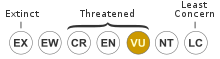
Least Concern (IUCN 3.1)
Scientific classification
Kingdom:Animalia
Phylum:Chordata
Class:Aves
Order:Gruiformes
Family:Turnicidae
Genus:Turnix
Species:T. castanotus
Binomial name
Turnix castanotus
(Gould, 1840)
Distribution of the Chestnut-backed Buttonquail
The Chestnut-backed Buttonquail (Turnix castanotus) is a species of bird in the Turnicidae family. It is endemic to Australia.
Its natural habitats are dry savanna, subtropical or tropical dry shrubland, and subtropical or tropical dry lowland grassland.

Tuesday, April 23, 2013

>Turnix varius (Painted Buttonquail)

Painted Buttonquail


Painted Buttonquail
Conservation status

Least Concern (IUCN 3.1)
Scientific classification
Kingdom:Animalia
Phylum:Chordata
Class:Aves
Order:Turniciformes
Family:Turnicidae
Genus:Turnix
Species:T. varius
Binomial name
Turnix varius
(Latham, 1802)
Distribution of the Painted Button quail
Synonyms
  • Turnix varia (Latham, 1802) (lapsus)
  • Turnix novaecaledoniae
The Painted Buttonquail (Turnix varius) is a species of buttonquail, the family Turnicidae, which resemble, but are unrelated to, the quails of Phasianidae. This species is resident in Australia. A subspecies, the Abrolhos Painted Button-quail (Turnix varius scintillans), is endemic to the Houtman Abrolhos islands.


Description

The Painted Buttonquail is about 19–20 cm long. It is found in grassy forests and woodlands. It feeds on insects and seeds, and males incubate the eggs for a fortnight and then care for the young.
The female is the more brightly coloured of the sexes. Her eyes are red, and her crown, face and breast is flecked with white. Her shoulders are chestnut with thin white streaking above them. The male is slightly smaller and duller.

>Turnix melanogaster (Black-breasted Buttonquail)

Black-breasted Buttonquail


Black-breasted Buttonquail
Conservation status

Near Threatened (IUCN 3.1)
Scientific classification
Kingdom:Animalia
Phylum:Chordata
Class:Aves
Order:Turniciformes
Family:Turnicidae
Genus:Turnix
Species:T. melanogaster
Binomial name
Turnix melanogaster
(Gould, 1837)
The Black-breasted Buttonquail (Turnix melanogaster) is a rare buttonquail endemic to eastern Australia, where it is usually found in rainforest. Like other buttonquails, it is unrelated to the true quails. Both sexes have marbled black, rufous, pale brown and white plumage, but the female is larger than the male and has a more extensive black face and chin.

Taxonomy

The Black-breasted Buttonquail was originally described by ornithologist John Gould in 1837. Its specific epithet is derived from the Ancient Greek terms melano- "black", and gaster"belly".Along with other buttonquails, the Black-breasted Buttonquail was traditionally placed in the order Gruiformes, but more recent molecular analysis shows it belongs to an ancient lineage of shorebirds (Charadriiformes).


Description

The Black-breasted Buttonquail is a plump quail-shaped bird of predominantly marbled black, rufous and pale brown, marked prominently with white spots and stripes, and white eyes. Like other buttonquails, the female is larger and more distinctively coloured than the male. Measuring up to 20 cm (8 in), it has a black face and chin, sprinkled with fine white markings. The smaller male measures up to 19 cm (7.5 in) and lacks the black markings.
The female makes a low-pitched oom call.


Distribution and habitat

The Black-breasted Buttonquail is found from Hervey Bay in central Queensland south to the northeastern corner of New South Wales. It is rare and its habitat fragmented. It is found in rainforest and nearby areas, as well as Hoop Pine (Araucaria cunninghamii) plantations,and lantana thickets. It is found in Palmgrove National Park, which has consequently been identified by BirdLife International as an Important Bird Area for the species.
The Black-breasted Buttonquail was once populous on Inskip Point on Fraser Island, but the numbers are now assumed to be one.Mike West, former president of Birds Queensland, blames dingoes and wild dogs for wiping out the population.


Conservation status

The species was classified as vulnerable until 2012 when it downlisted to near threatened; most of the Black-breasted Buttonquail's original habitat has been cleared and the remaining populations are fragmented. The population has been estimated at 5000 breeding birds and declining.


Breeding

The usual sex roles are reversed in the buttonquail genus, as the larger and more brightly coloured female mates with multiple male partners and leaves them to incubate the eggs.One or two broods are probably laid each year; the nest is a shallow depression scraped out of the leaf litter and ground, lined with dried vegetation. Three or four shiny grey-white or buff eggs splotched with dark brown-black and lavender are laid measuring 28 mm x 23 mm.

Monday, April 22, 2013

>Turnix ocellatus (Spotted Buttonquail)

Spotted Buttonquail


Spotted Buttonquail
Conservation status

Least Concern (IUCN 3.1)
Scientific classification
Kingdom:Animalia
Phylum:Chordata
Class:Aves
Order:Gruiformes
Family:Turnicidae
Genus:Turnix
Species:T. ocellatus
Binomial name
Turnix ocellatus
(Scopoli, 1786)
The Spotted Buttonquail (Turnix ocellatus) is a species of bird in the Turnicidae family. It is endemic to the Philippines.

>Turnix nigricollis (Madagascar Buttonquail)

Madagascar Buttonquail


Madagascar Buttonquail
At San Diego Zoo
Conservation status

Least Concern (IUCN 3.1)
Scientific classification
Kingdom:Animalia
Phylum:Chordata
Class:Aves
Order:Charadriiformes
Family:Turnicidae
Genus:Turnix
Species:T. nigricollis
Binomial name
Turnix nigricollis
(Gmelin, 1789)

Ambola, Madagascar
The Madagascar Buttonquail (Turnix nigricollis) is a species of bird in the buttonquail family Turnicidae. It is endemic to Madagascar.

Sunday, April 21, 2013

>Turnix suscitator (Barred Buttonquail)

Barred Buttonquail


Barred Buttonquail
Conservation status

Least Concern (IUCN 3.1)
Scientific classification
Kingdom:Animalia
Phylum:Chordata
Class:Aves
Order:Turniciformes
Family:Turnicidae
Genus:Turnix
Species:T. suscitator
Binomial name
Turnix suscitator
(Gmelin, 1789)
The Barred Buttonquail or Common Bustard-Quail (Turnix suscitator) is a buttonquail, one of a small family of birds which resemble, but are unrelated to, the true quails. This species is resident from India across tropical Asia to south China, Indonesia and the Philippines.


Distribution

All of India up to about 2500 m in the Himalayas; Sri Lanka; Bangladesh; Burma; Indonesia and most of Southeast Asia, Philippines. Four geographical races differ somewhat in colour.
Within South Asia, it is known by many local names: Sansorai (Assam); Daoduma (Cachar); lnruibuma (Kacha Naga); Vohbubum (Kuki); Simokpho (Lepcha); linisk (Bhutea); Gulu,Gundra, Gundlu, Salui gundra (Hindi); Gulu (Bengal); Kalada - male, Pured - female (Telugu); Ankadik - male, Kurung kadik - female (Tamil); Durwa (Ratnagiri); Karechakki (Kannada); Bala watuwa (Sri Lanka).
Found in most habitats except dense forest and desert. Partial to scrub jungle, light deciduous forest, and neighbourhood of cultivation.
Widespread and common throughout its large range, the Barred Buttonquail is evaluated as Least Concern on the IUCN Red List of Threatened Species.


Description


A female of race taigoor
A typical little buttonquail, rufous-brown above, rusty and buff below. Chin, throat and breast closely barred with black. Female larger and more richly coloured, with throat and middle of breast black. The blue-grey bill and legs, and yellowish white eyes are diagnostic, as are also the pale buff shoulder-patches on the wings when in flight. Absence of hind toe distinguishes Bustard and Button quails from true quails. Pairs, in scrub and grassland.
Unlike other buttonquail, are not as difficult to see, since it tends to cross, or run along, savannah tracks, and is readily viewed from a vehicle.
Feeds on insects and seeds, and is reluctant to fly.
The calls are a motorcycle-like drr-r-r-r-r-r and a loud hoon- hoon-hoon.


Nesting


ssp. powelli
Differs from true quails chiefly in the female being polyandrous. The female is the brighter of the sexes, initiates courtship and builds the ground nest. She fights with other females for the possession of a cock, uttering a loud drumming drr-r-r-r-r as a challenge to rival hens and also to announce herself to a cock. Eggs when laid are left to be incubated by the cock who also tends the young, which can run as soon as they are hatched. The hen goes off to acquire another husband, and perhaps yet another, and so on, evidently only one at a time.
  • Season: practically throughout the year, varying locally.
  • Nest - a grass-lined scrape or depression in scrub jungle or crops, often arched over by surrounding grass. Eggs - 3 or 4, greyish white profusely speckled with reddish brown or blackish purple.

>Turnix tanki (Yellow-legged Buttonquail)

Yellow-legged Buttonquail


Yellow-legged Buttonquail
Conservation status

Least Concern (IUCN 3.1)
Scientific classification
Kingdom:Animalia
Phylum:Chordata
Class:Aves
Order:Turniciformes
Family:Turnicidae
Genus:Turnix
Species:T. tanki
Binomial name
Turnix tanki
Blyth, 1843
The Yellow-legged Buttonquail (Turnix tanki) is a buttonquail, one of a small family of birds which resemble, but are unrelated to, the true quails. They are endemic to the Indian Subcontinent and Southeast Asia.
This family is peculiar in that the females are more colourful than the males and are polyandrous. Females have a bright rufous nape collar which is moulted during the non-breeding season. Females offer food to males during courtship and once the eggs are laid, the females leave incubation to the male. The eggs hatch after about 12 days (in captivity) and the chicks follow the male after hatching.

Saturday, April 20, 2013

>Turnix hottentottus (Black-rumped Buttonquail)

Black-rumped Buttonquail


Black-rumped Buttonquail
Conservation status

Least Concern (IUCN 3.1)
Scientific classification
Kingdom:Animalia
Phylum:Chordata
Class:Aves
Order:Gruiformes
Family:Turnicidae
Genus:Turnix
Species:T. hottentottus
Binomial name
Turnix hottentottus
Temminck, 1815
The Black-rumped Buttonquail (Turnix hottentottus) is a small species of bird in the buttonquail genus.
It is found in open grassland through much of Africa outside the forested and more arid regions. It is resident in the central parts of the range but is a migratory breeder further north.
This species has a brown back, rufous chest, and pale belly. As usual for buttonquails but not for most birds, the female is larger and brighter than the male. This species is shy and difficult to flush.
Most of the range is occupied by the subspecies T. h. nanus, which has brown irides and a black rump, and is sometimes split into a distinct species. The nominate subspecies, T. h. hottentottus, the Hottentot Buttonquail, which is confined to coastal fynbos in South Africa, has pale irides and a paler rump.

>Turnix everetti (Sumba Buttonquail)

Sumba Buttonquail


Sumba Buttonquail
Conservation status

Vulnerable (IUCN 3.1)
Scientific classification
Kingdom:Animalia
Phylum:Chordata
Class:Aves
Order:Gruiformes
Family:Turnicidae
Genus:Turnix
Species:T. everetti
Binomial name
Turnix everetti
Hartert, 1898
The Sumba Buttonquail (Turnix everetti) is a species of bird in the Turnicidae family. The scientific name commemorates British colonial administrator and zoological collector Alfred Hart Everett.


Distribution and habitat

It is endemic to Indonesia. Its natural habitats are dry savanna, subtropical or tropical moist shrubland, subtropical or tropical dry lowland grassland, and arable land. It is threatened by habitat loss.

Friday, April 19, 2013

>Turnix worcesteri (Worcester's Buttonquail)

Worcester's Buttonquail


Worcester's Buttonquail
Conservation status

Data Deficient (IUCN 3.1)
Scientific classification
Kingdom:Animalia
Phylum:Chordata
Class:Aves
Order:Charadriiformes
Family:Turnicidae
Genus:Turnix
Species:T. worcesteri
Binomial name
Turnix worcesteri
McGregor, 1904
The Worcester's Buttonquail or Luzon Buttonquail (Turnix worcesteri) - named after Dean Conant Worcester - is a species of bird in the Turnicidae family. It is endemic to the island of Luzon in the Philippines. Its natural habitat is subtropical or tropical high-altitude grassland.
Locally known as "Pugo", they are known to inhabit rice paddies and scrub lands near farm areas because of the availability of seeds and insects that they feed on regularly. These birds are characterized by their black heads with white spots, a brown or fawn colored body and yellow legs on males and the females are brown with white and black spots. These birds are very secretive, choosing to make small path ways through the rice fields, which unfortunately leads to their deaths as well, they are hunted by children and young men by means of setting spring traps along their usual path ways.
Previously only known from drawings and descriptions, actual photographs of the bird were taken in early 2009. A local birdwatching group, the Wild Bird Club of the Philippines, found the quail at a public market in the Caraballo mountains. The lone specimen of the threatened species, which the group took pictures and videos of, was being sold as a simple food item by locals.


Recent sighting

A news feature about the Worcester's Buttonquail was aired in the Philippines recently by documentary film-maker Howie Severino, a member of the GMA Network. It was mentioned that the documentary was the first time an actual live photo of the bird was taken. The photo was taken in Nueva Vizcaya in northern Luzon.

>>Genus Turnix >Turnix sylvaticus (Common Buttonquail)

Common Buttonquail


Kurrichane Buttonquail
Conservation status

Least Concern (IUCN 3.1)
Scientific classification
Kingdom:Animalia
Phylum:Chordata
Class:Aves
Order:Turniciformes
Family:Turnicidae
Genus:Turnix
Species:T. sylvaticus
Binomial name
Turnix sylvaticus
Desfontaines, 1789
The Kurrichane Buttonquail, Small Buttonquail, Common Buttonquail, or Andalusian Hemipode (Turnix sylvaticus) is a buttonquail, one of a small family of birds which resemble, but are unrelated to, the true quails. This species is resident from southern Spain and Africa through India and tropical Asia to Indonesia.
This tiny buttonquail is notoriously difficult to see. It is a small 15 cm long drab running bird, which avoids flying. It is a species which inhabits warm grasslands or scrub jungle and feeds on insects and seeds.
Small Buttonquail resembles a Common Quail. It has streaked sandy brown upperparts, buff underparts with black flank markings and a plain face. In flight, a whitish wingbar contrasts with the grey wing. Sexes are similar, but immature birds are more spotted below.

Painting by John Gould
The female initiates courtship and builds the ground nest. The male incubates the normally four speckled greyish eggs, and tends the young, which can run as soon as they are hatched. The nesting season is June to September. The nest is a slight pad of grass placed in a natural hollow in the ground where it is usually tucked away amongst the stems of a tuft of grass. Very occasionally the grass is bent over it in a sort of canopy.
The female calls with a deep hoom-hoom-hoom and the male replies kek-kek-kek.
Widespread throughout its large range, the Small Buttonquail is evaluated as Least Concern on the IUCN Red List of Threatened Species.
Avoids thick forest and hilly country, and lives by preference in cornfields and stretches of grassy plain though it may also be found in any type of low herbage and open scrub jungle. It skulks and is flushed with difficulty, rising often close by one's feet. When flushed it flies low over the ground and soon settles again, after which it is very difficult to put up a second time.

Thursday, April 18, 2013

>>Genus Ortyxelos >Quail-plover (Ortyxelos meiffrenii)

Quail-plover


Quail-plover
Conservation status

Least Concern (IUCN 3.1)
Scientific classification
Kingdom:Animalia
Phylum:Chordata
Class:Aves
Order:Charadriiformes
Family:Turnicidae
Genus:Ortyxelos
Vieillot, 1825
Species:O. meiffrenii
Binomial name
Ortyxelos meiffrenii
(Vieillot, 1819)
The Lark Buttonquail or Quail-plover (Ortyxelos meiffrenii) is a species of bird in the Turnicidae family. It is monotypic within the genus Ortyxelos. It is found in Benin, Burkina Faso, Cameroon, Chad, Ivory Coast, Ethiopia, Ghana, Kenya, Mali, Niger,Nigeria, Senegal, Sudan, Tanzania, Togo, and Uganda.