Showing posts with label Genus Pycnonotus. Show all posts

Saturday, July 28, 2012

>Pycnonotus hualon (Bare-faced Bulbul)

Bare-faced Bulbul


Bare-faced Bulbul
Conservation status

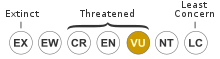
Least Concern (IUCN 3.1)
Scientific classification
Kingdom:Animalia
Phylum:Chordata
Class:Aves
Order:Passeriformes
Suborder:Passeri
Family:Pycnonotidae
Genus:Pycnonotus
Species:P. hualon
Binomial name
Pycnonotus hualon
Woxvold, Duckworth & Timmins, 2009
The Bare-faced Bulbul (Pycnonotus hualon) is a species of bulbul described from Laos in 2009. It is one of the very few Asian songbirds with a bald (featherless) face and is the first new species of bulbul to be described from Asia in over a century.

Description

The mainly olive-green Bare-faced Bulbul is distinctive in having a bare pink face with blueish skin around the eyes. The species epithet hualon is from the Lao word for "bald-headed". The two specimens so far collected were around 20 cm in length and weighed 32-40 g. The breast and belly are fawn-grey, the uppersides olive and the throat is off-white.

Habitat

The Bare-faced Bulbul is known only from the limestone karst region near Pha Lom in central Laos. The area is characterised by steep terrain with bare limestone and low (less than 4 m in height) deciduous trees and shrubs. It seems likely that the species is restricted entirely to this habitat, though it may occur at other sites in Laos with similar habitats. Observations of similar birds were made in 1995 at another site. Limestone karst is the habitat of several newly discovered endemics, including the unusual Laotian rock rat Laonastes aenigmamus.

Behaviour

PycnonotusHualon.svg
The Bare-faced Bulbul is mainly arboreal but sometimes perches on rocks on the steep hillsides. It is a conspicuous species, foraging during the day in pairs or as singles. Single birds tend to call regularly, and will link up with another before flying to a new area to forage. According to researchers its call is a "dry bubbly tweet". They have not been observed to join mixed-species feeding flocks. The breeding behaviour of this species has not yet been observed.

Status and conservation

The Bare-faced Bulbul was assessed for the first time in 2010 by Birdlife International as of Least Concern, on the basis that the species has a large range, and there is insufficient evidence on population trend and size. In the paper describing the species it was suggested that it be listed as data deficient until further surveys of likely habitat were undertaken. The limestone karst in which it lives is threatened by quarrying and habitat degradation caused by overgrazing.

>Pycnonotus capensis (Cape Bulbul)

Cape Bulbul


Cape Bulbul
In Addo Elephant National Park, Eastern Cape, South Africa
Conservation status

Least Concern (IUCN 3.1)
Scientific classification
Kingdom:Animalia
Phylum:Chordata
Class:Aves
Order:Passeriformes
Family:Pycnonotidae
Genus:Pycnonotus
Species:P. capensis
Binomial name
Pycnonotus capensis
(Linnaeus, 1766)
The Cape BulbulPycnonotus capensis, is a member of the bulbul family of passerine birds. It is an endemic resident breeder in coastal bush, open forest, gardens and fynbos in southern South Africa. This species nests mainly in the southern spring from September to November. The nest is thick walled cup concealed by foliage in a small tree or shrub.

Identification

The Cape Bulbul is 19–21 cm long, mainly dull, blackish brown with a diagnostic white eye-ring, and yellow undertail coverts. The head has a small crest. The short, straight bill, legs and feet are black and the iris is dark brown. The sexes are similar in plumage.
This species is much darker than the other South African bulbuls, and differs in the eye ring colour and brown lower belly, whereas the other dark bulbuls have a pale lower belly. The dark belly helps to identify juveniles, which lack the distinctive eye ring of the adult.

Behaviour

The Cape Bulbul is a common and conspicuous bird, which tends to perch at the top of a bush. It is active and noisy, usually seen in pairs or small groups foraging for fruit, nectar and insects.
The most typical call of this species is a liquid whistle of two or more varied notes pit-peet-pitmajol, piet-piet-patata.
In part of its range, it gets parasitized by the Jacobin cuckoo.

Gallery


>Pycnonotus xanthopygos (White-spectacled Bulbul)

White-spectacled Bulbul


White-Spectacled Bulbul
Conservation status

Least Concern (IUCN 3.1)
Scientific classification
Kingdom:Animalia
Phylum:Chordata
Class:Aves
Order:Passeriformes
Family:Pycnonotidae
Genus:Pycnonotus
Species:P. xanthopygos
Binomial name
Pycnonotus xanthopygos
(Hemprich & Ehrenberg, 1833)
The White-spectacled Bulbul also known as the Yellow-vented BulbulPycnonotus xanthopygos, is a small bird, a bit bigger than a sparrow. It is 20-25 centimeters in length, and its wingspan is 20–25 centimeters. A stable bird that lives in fruit plantations, gardens, cities etc. It is the most common member of the Bulbul family in Israel and Lebanon. In Turkey, it is mainly found in the coastal Mediterranean region but its range extends from Patara/Gelemiş near Kaş in the west to Türkoğlu in the east.. Breeding populations are found from Central and Southern Turkey to Western Syria, The Lebanon, Western Jordan, Israel, Sinai and Western, Central and Southern Arabia.
Both sexes are similar; juveniles have a browner hood and less obvious eye-rings than the adults. The nest – a small cup of thin twigs, grass stems, leaves and moss – is generally located in bushes and lined with hair, shredded bark and small roots. They can be considered as pets if raised by humans at an age not exceeding three weeks. When being raised, people usually feed them with bananas using a stick.

>Pycnonotus erythropthalmos (Spectacled Bulbul)

Spectacled Bulbul


Spectacled Bulbul
Subspecies P. e. erythropthalmos in Panti forest, Johor; photo by Lip Kee Yap
Conservation status

Least Concern (IUCN 3.1)
Scientific classification
Kingdom:Animalia
Phylum:Chordata
Class:Aves
Order:Passeriformes
Family:Pycnonotidae
Genus:Pycnonotus
Species:P. erythropthalmos
Binomial name
Pycnonotus erythropthalmos
(Hume, 1878)
Synonyms
  • Pynonotus pusillus
The Spectacled Bulbul (Pycnonotus erythropthalmos), also known as the Lesser Brown Bulbul, is a bird in the bulbul family. It is known in Malay as Merbah Kecil. It is endemic to Southeast Asia.

>Pycnonotus leucotis (White-eared Bulbul)

White-eared Bulbul


White-eared Bulbul
White-eared Bulbul on a garden perch
Conservation status

Least Concern (IUCN 3.1)
Scientific classification
Kingdom:Animalia
Phylum:Chordata
Class:Aves
Order:Passeriformes
Family:Pycnonotidae
Genus:Pycnonotus
Species:P. leucotis
Binomial name
Pycnonotus leucotis
(Gould, 1836)
Distribution of P. leucotis (light green) and P. leucogenys (dark green) in the South Asian region
The White-eared BulbulPycnonotus leucotis is a member of the bulbul family. It is found in Kuwait, Bahrain, mid and southern Iraq, southern Iran, Afghanistan, Pakistan, north-western India, in parts of Maharashtra, Madhya Pradesh, and on the Arabian peninsula. The species was earlier considered a conspecific of Pycnonotus leucogenys.


Description


At Bharatpur, Rajasthan, India.
This species is very similar in appearance to the Himalayan White-cheeked Bulbul Pycnonotus leucogenys  but smaller and uncrested and with a larger white cheek patch. It has a pale bare eye-ring. The vent is orange yellow. Sexes are alike.
It is found in scrub forest and gardenland. Also found in flocks or pairs in the mangroves, gorging on the fruits of the Meswak bush. Usually seen in pairs or small groups. It feeds on fruits and insects, and breeds in March-June.

Galleria


Friday, July 27, 2012

>Pycnonotus goiavier (Yellow-vented Bulbul)

Yellow-vented Bulbul


Yellow-vented Bulbul
A pair in the Philippines
Conservation status

Least Concern (IUCN 3.1)
Scientific classification
Kingdom:Animalia
Phylum:Chordata
Class:Aves
Order:Passeriformes
Family:Pycnonotidae
Genus:Pycnonotus
Species:P. goiavier
Binomial name
Pycnonotus goiavier
(Scopoli, 1886)
The Yellow-vented BulbulPycnonotus goiavier, is a member of the bulbul family of passerine birds. It is resident breeder in southeast Asia from southern Thailand and Cambodia south to Borneo and the Philippines.
It is found in a wide variety of open habitats, but not deep forest. It is one of the most common birds in cultivated areas. They appear to be nomadic, roaming from place to place regularly.
The Yellow-vented Bulbul builds a well-camouflaged but fragile, loose, deep, cup-shaped nest from grass, leaves, roots, vine stems, and twigs. The nest is untidy on the outside, but it is neatly lined with plant fibers. It may be built in a wide range of places from low bushes to high trees. This is a species adapted to humans and may even nest in gardens. The Yellow-vented Bulbul lays 2-5 eggs in February to June.
The Yellow-vented Bulbuls eats berries and small fruits. They also sip nectar, nibble on young shoots, and take some insects.

>Pycnonotus sinensis (Light-vented Bulbul)

Light-vented Bulbul


Light-vented Bulbul
Light-vented Bulbul, Pycnonotus sinensis
Conservation status

Least Concern (IUCN 3.1)
Scientific classification
Kingdom:Animalia
Phylum:Chordata
Class:Aves
Order:Passeriformes
Family:Pycnonotidae
Genus:Pycnonotus
Species:P. sinensis
Binomial name
Pycnonotus sinensis
(Gmelin, 1789)
The Light-vented Bulbul (Pycnonotus sinensis), also known as the Chinese Bulbul, is a bird and a member of the bulbul family.

Description

The particular characteristic is the large white patch covering the nape and the sides of its black head. It also sings very brightly and variably with a 'cha-ko-lee...cha-ko-lee...' sound.

Distribution

The bulbul is common in East Asia, including Hong Kong, mainland China, Taiwan, Korea and Japan. The birds of Taiwan are of an endemic subspecies.

>Pycnonotus xantholaemus (Yellow-throated Bulbul)

Yellow-throated Bulbul


Yellow-throated Bulbul
Conservation status

Vulnerable (IUCN 3.1)
Scientific classification
Kingdom:Animalia
Phylum:Chordate
Class:Aves
Order:Passeriformes
Family:Pycnonotidae
Genus:Pycnonotus
Species:P. xantholaemus
Binomial name
Pycnonotus xantholaemus
(Jerdon, 1845)
Synonyms
Ixos xantholaemus
Brachypus xantholaemus
The Yellow-throated Bulbul is a species of bulbul endemic to southern peninsular India. They are found on scrub habitats on steep, rocky hills many of which are threatened by granite quarrying. It is confusable only with the White-browed Bulbul with which its range overlaps but is distinctively yellow on the head and throat apart from the yellow vent. The calls of this species are very similar to that of the White-browed Bulbul.

Description

This uncrested species of bulbul is olive grey above with a yellow throat, undertail coverts and tail tips. The head is plain while the breast and belly have a grey wash. The closest resembling species is the White-browed Bulbul but this has a supercilium and lacks the yellow throat. Males and females are similar in plumage.
The name of Konda-poda-pigli in Telugu was noted by TC Jerdon.

Distribution and habitat


In scrub habitat
The habitat of the species is rocky, scrub covered hills mostly in the Eastern Ghats and central peninsular India but also in some places in the Western Ghats. The distribution is highly fragmented and populations are very local making hilly habitats of very special conservation concern. Many of these hill forests are threatened by granite quarrying, forest fires and grazing.It has vanished from many sites where it was earlier known.
Some well known locations include the Nandi Hills, Horsley Hills,Gingee,Yercaud and the Biligirirangans.The species is also seen in some parts of the Western Ghats including the Anamalais.The northern limit is believed to be in the Nallamala range but it is suspected that the species may extend in range into the northern Eastern Ghats of Orissa.

Behaviour and ecology

This bird is usually shy and hidden within scrub and is usually detected by its sudden cackling outbursts of calls which are similar to those of the White-browed Bulbul. They feed on insects and the berries of various scrub plant species including Lantana camaraSecurinega leucopyrusToddalia asiaticaErythroxylon monogynumSolanum indicumSantalum album,ZiziphusFicus benghalensisFicus nervosaFicus montanaCanthium dicoccum and Phyllanthus reticulata.

1847 illustration
During hot afternoons and in the dry-season they visit pools of water both to drink and bathe.
The breeding season is June to August. The nest is built in the fork of small tree. Two eggs are laid which hatch in 20 days with the chicks fledging 13 days later.

>Pycnonotus priocephalus (Grey-headed Bulbul)

Grey-headed Bulbul


Grey-headed Bulbul
Conservation status

Near Threatened (IUCN 3.1)
Scientific classification
Kingdom:Animalia
Phylum:Chordata
Class:Aves
Order:Passeriformes
Family:Pycnonotidae
Genus:Pycnonotus
Species:P. priocephalus
Binomial name
Pycnonotus priocephalus
(Jerdon, 1839)
Synonyms
Brachypus priocephalus
Brachypodius poiocephalus
Micropus phaeocephalus
Microtarsus poioicephalus
Ixos fisquetti
The Grey-headed Bulbul (Pycnonotus priocephalus) is a member of the bulbul family ofpasserine birds. It is endemic to the Western Ghats of south-west India, found from Goa south to Tamil Nadu, at altitudes up to 1200m. It is found in dense reeds or thickets mainly near rivers and swampy areas inside forests. They have a distinctive call that reveals their presence inside dense vegetation that makes them hard to spot. Their taxonomic position within the bulbuls is not clear.

Description


"Brachypus parvicephalus" from Jerdon'sIllustrations of Indian Ornithology (1847)
This bulbul is resident in moist broadleaved evergreen forest with bamboo and dense undergrowth. Its plumage is olive-green, with a medium-grey on the crown head, nape and throat. The forehead is yellow-green. The back, wings are olive green becoming lighter towards the vent. The rump has yellowing green feathers edged in black giving a barred appearance. The flanks are dark and grey edged. The undertail coverts are gray. The beak is greenish and grey while the legs are pinkish yellow. The iris is distinctly bluish white. The tail is grey on the central feathers (the shaft being black), the outer ones are black and are broadly tipped with grey. Both sexes are similar but juveniles have the head dark olive with the yellow on the forehead duller. (Length 143-152mm; head 33-35mm; tail 74-77mm)
Found singly or in small groups. Breeds from January to June with a peak in April. The nest is a typical platform placed inside a low bush. The typical clutch is one egg or sometimes two eggs that are incubated for 12 to 14 days. The nestlings leave the nest after 11 to 13 days. The eggs are pale pink to lavender and flecked in red, more densely on the broad end. Both parents take part in incubation and feeding.Feeds mainly on fruits. Call is a sharp chraink.

Taxonomy and systematics


Illustration from the Voyage autour du monde exécuté pendant les années 1836 et 1837 sur la corvette La Bonite commandée par M. Vaillant (The voyage of the Bonita)
The species was described by Thomas Jerdon under the name of Brachypus priocephalus but said to have been "emended" in error by Edward Blyth to Brachypodius poiocephalus and the confusion carried forward in literature.
The call is distinct in having a single syllable unlike those of the core Pycnonotus genus members.The genusPycnonotus as currently defined has been identified as polyphyletic and the genus placement for this species may change in the future. This species has not been used in recent molecular phylogeny studies of the group.

Behaviour and ecology

The breeding season is mainly between January to May. The build their nest over a period of a week. The nests are made with vines and grasses or leaves. Many nests in a study in the Silent Valley National park were found to be made on saplings of Syzygium species or in reeds of Ochlandra travancorica. The typical clutch was two eggs which were incubated for about 14 days. The young fledge after about 12 days. Eggs are sometimes destroyed and eaten by the palm squirrels (Funambulus tristriatus).

>Pycnonotus atriceps (Black-headed Bulbul)

Black-headed Bulbul


Black-headed Bulbul
Conservation status

Least Concern (IUCN 3.1)
Scientific classification
Kingdom:Animalia
Phylum:Chordata
Class:Aves
Order:Passeriformes
Family:Pycnonotidae
Genus:Pycnonotus
Species:P. atriceps
Binomial name
Pycnonotus atriceps
(Temminck, 1822)
The Black-headed Bulbul (Pycnonotus atriceps) is a member of the bulbul family of passerine birds. It is found in forests in south-east Asia. It has a mainly olive-yellow plumage with a glossy bluish-black head. A grey morph where most of the olive-yellow is replaced by grey also exists. The distinctive taxon from the Andamans has most of the head olive, and is increasingly treated as a separate species, the Andaman Bulbul (P. fuscoflavescens). The Black-headed Bulbul resembles the Black-crested Bulbul, but has blue eyes (though not reliable in juveniles), a broad yellow tip to the tail, and never shows a crest (however, some subspecies of the Black-crested are also essentially crestless, but they have red or yellow throats). The Black-headed Bulbul mainly feeds on small fruit and berries, but will also take insects. It commonly occurs in small flocks, comprising 6-8 individuals.