Showing posts with label Family Sylviidae. Show all posts

Friday, October 12, 2012

>Paradoxornis (Suthora) nipalensis (Black-throated Parrotbill)

Black-throated Parrotbill


Black-throated Parrotbill
Conservation status

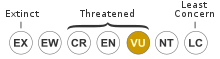
Least Concern (IUCN 3.1)
Scientific classification
Kingdom:Animalia
Phylum:Chordata
Class:Aves
Order:Passeriformes
Family:Sylviidae (see text)
Genus:Paradoxornis
Species:P. nipalensis
Binomial name
Paradoxornis nipalensis
(Hodgson, 1837)
Synonyms
Suthora nipalensis
The Black-throated Parrotbill (Paradoxornis nipalensis) is a bird species often placed with the Old World babblers (family Timaliidae) or in a distinct family Paradoxornithidae, but it actually seems to belong to the Sylviidae.
It is found in Bhutan, China, India, Laos, Myanmar, Thailand, and Vietnam. Its natural habitat is subtropical or tropical moist montane forests.


Thursday, October 11, 2012

>Paradoxornis (Sinoparadoxornis) przewalskii (Przevalski's Parrotbill)

Przevalski's Parrotbill


Przevalski's Parrotbill
Conservation status

Vulnerable (IUCN 3.1)
Scientific classification
Kingdom:Animalia
Phylum:Chordata
Class:Aves
Order:Passeriformes
Family:Timaliidae
Genus:Paradoxornis
Species:P. przewalskii
Binomial name
Paradoxornis przewalskii
(Berezowski & Bianchi, 1891)
Synonyms
Sinosuthora przewalskii
The Przevalski's Parrotbill or Rusty-throated Parrotbill (Paradoxornis przewalskii) is a species of bird in the Timaliidae family. It is endemic to a small area of central China. Its natural habitat is temperate forests. It is threatened by habitat loss.

>Paradoxornis (Sinoparadoxornis) zappeyi (Grey-hooded Parrotbill)

Grey-hooded Parrotbill


Grey-hooded Parrotbill
Conservation status

Vulnerable (IUCN 3.1)
Scientific classification
Kingdom:Animalia
Phylum:Chordata
Class:Aves
Order:Passeriformes
Family:Timaliidae
Genus:Paradoxornis
Species:P. zappeyi
Binomial name
Paradoxornis zappeyi
(Thayer & Bangs, 1912)
The Grey-hooded Parrotbill (Paradoxornis zappeyi) is a species of bird in the Timaliidae family. It is endemic to China. Its natural habitats are temperate forests and temperate shrubland. It is threatened by habitat loss.


>Paradoxornis (Sinoparadoxornis) webbianus (Vinous-throated Parrotbill)

Vinous-throated Parrotbill


Vinous-throated Parrotbill
P. w. bulomachus, Taiwan
Conservation status

Least Concern (IUCN 3.1)
Scientific classification
Kingdom:Animalia
Phylum:Chordata
Class:Aves
Order:Passeriformes
Family:Sylviidae
Genus:Paradoxornis
Species:P. webbianus
Binomial name
Paradoxornis webbianus
(Gould, 1852)
Synonyms
Suthora webbianus
Sinosuthora webbiana
The Vinous-throated Parrotbill (Paradoxornis webbianus) is a species of bird in the Sylviidae family; formerly, it was placed in the closely related Timaliidae. It is found in China,Japan, North Korea, South Korea, Mongolia, Russia, Taiwan, and Vietnam. Its natural habitatis subtropical or tropical moist montane forests.


Taxonomy and systematics


Illustration by Joseph Wolf (1866)
The Vinous-throated Parrotbill was described in 1852 by John Gould and placed in the genusSuthora, where it sat with other small browner parrotbills. Later parrotbills were merged into two genera, Conostoma and Paradoxornis; with this species being placed in Paradoxornis. Recent DNA studies have shown that the genus Paradoxornis is paraphyletic, and that it should be split. It is suggested that the Vinous-throated Parrotbill should be placed in the genus Sinoparadoxornis. The Vinous-throated Parrotbill is very closely related to the Ashy-throated Parrotbill, and hybrids have been reported between the two species in Vietnam and China, as well as in Italy where both species have become established.
The specific name webianus commemorates the English botanist Philip Barker Webb. The species is sometimes referred to as Webb's Parrotbill.

Habitat and movements

The Vinous-throated Parrotbill occurs from northern Vietnam to southern Manchuria, and occupies a wide range of habitats across its range. It is generally found in somewhat open wooded habitats, including scrub, woodland of early successional to late mature secondary stages, forest edges, thickets and bamboo stands. It also occurs in hedges, reeds and marshes. They also will adapt to human modified habitats such as tea plantations and plant nurseries. In China it is found in lower montane areas, in Sichuan it is replaced at 1,000 m (3,300 ft) above sea level by the Ashy-throated Parrotbill, whereas in Taiwan, where it is the only species of parrotbill, it occurs from sea level to 3,100 m (10,200 ft) and occupies the widest niche of any bird on that island.

Description

The Vinous-throated Parrotbill is a relatively small and long-tailed parrotbill. It measures between 11–12.5 cm (4.3–4.9 in) in length. The weight varies slightly by sex, with males weighing between 8.5–11 g (0.30–0.39 oz) and the females weighing 7–12 cm (2.8–4.7 in). The tail is graduated and like other parrotbills the bill is short and has the nostrils concealed by feather bristles. The plumage is similar for both sexes, which in the nominate is warm brown on the upperparts, dark brown on the wings (tinged with chestnut on the flight feathers). The upper breast and throat are pinkish-cream with brown streaks on the throat. The flanks are similar to the upperparts but slightly buffy, and the belly is cream-buff merging into the breast. The crown and forehead is rufescent brown, with a pale grey iris and the bill is either slate grey or brown with a paler or yellow tip.

Behaviour

Like other parrotbills and indeed related babblers, the Vinous-throated Parrotbill is a highly social species, usually encountered in groups. These flocks vary in size through the year, being at their smallest during the breeding season and increasing to as many as 140 individual birds in the winter.The members of winter flocks in Taiwan were described by a study as having four categories of member; core members, which never left the flock; regular members, which generally stayed in the flock but visited or briefly joined other flocks; floaters, which moved around between flocks; and peripheral members, which were only seen for less than two months and were assumed to be visitors from other areas. The ranges of large winter flocks can overlap with that of other flocks and flocks passing close together retain their cohesion.

Wednesday, October 10, 2012

>Paradoxornis (Sinoparadoxornis) alphonsianus (Ashy-throated Parrotbill)

Ashy-throated Parrotbill


Ashy-throated Parrotbill
Conservation status

Least Concern (IUCN 3.1)
Scientific classification
Kingdom:Animalia
Phylum:Chordata
Class:Aves
Order:Passeriformes
Family:Sylviidae
Genus:Paradoxornis (but see text)
Species:P. alphonsianus
Binomial name
Paradoxornis alphonsianus
(J.Verreaux, 1870)
Synonyms
Suthora alphonsiana J.Verreaux, 1870
Sinosuthora alphonsiana
The Ashy-throated ParrotbillParadoxornis alphonsianus, is a songbird. In old sources, it may be called Alphonse's Crow-tit; though superficially resembling a tit it is not a member of the Paridae. The native range of this species extends from south-west China to northern Vietnam, and it might have become naturalised in one area in Italy.


Description and systematics

This is a medium-sized tawny-coloured parrotbill with the large bill typical of these birds. The specific epithet commemorates the French ornithologist Alphonse Milne-Edwards.
Formerly placed in a distinct parrotbill family Paradoxornithidae or with the Old World babblers in the Timaliidae or the tits and chickadees in the Paridae, they are now included with the typical warblers (Sylvia) in the Sylviidae.
They might be less close to the Great Parrotbill (Conostoma oemodium) – which was also in the "Paradoxornithidae" – than to Chrysomma, or to the fulvettas (Fulvetta) which were often included in the wastebin genus Alcippe. Another relative might be the Wrentit (Chamaea fasciata), the only known American member of the Sylviidae in the modern circumscription. The former two, and occasionally also the Wrentit, were traditionally considered Old World babblers.
Together with the other lineages of parrotbills, these and the Golden-breasted Fulvetta (Lioparus chrysotis) and White-browed Chinese Warbler (Rhopophilus pekinensis) form an Asian counterpart to the westward radiation of the typical warblers. Rather than two genera –Paradoxornis and the monotypic Conostoma –, the parrotbills are better considered several independent lineages which show pronounced convergent evolution, due to adaptation to reedbed habitat and a more granivorous diet than their skulking warbler-like ancestor. In this case, the Ashy-throated Parrotbill would probably be assigned to genus Sinoparadoxornis.

Lago di Varese (front) and Lago di Comabbio, with the Brabbia Swamp Nature Reserve left of center

Possible naturalisation in Italy

A population of parrotbills was first discovered in northern Italy in 1995, at the Riserva naturale Palude Brabbia (Brabbia Swamp Nature Reserve), between Cazzago Brabbia on Lago di Varese and Varano Borghi on Lago di Comabbio. In March 1998, 21 individuals were captured and photographed, and provisionally identified as Ashy-throated Parrotbills. It is not entirely clear, however, whether the birds are indeed P. alphonsianus, its close relative the P. webbianus (Vinous-throated Parrotbill), both species, or even hybrids between them (as are known from their natural range). While they do not seem to be Brown-winged Parrotbills (P. brunneus, another close relative), certain identification to species may be impossible without analysis of both nDNA and mtDNA sequence data.
The population is believed to originate from birds escaping from a nearby bird-trader. By 1999, the number of birds in the swamp had grown to at least a hundred individuals; in December 1998, the parrotbills were also observed in two localities on the Lago di Varese. By the early 21st century, the birds are well-established as resident breeders. They are the only self-sustaining parrotbill population found in Europe, as it was discovered that the Bearded Reedling (Panurus biarmicus) – long believed to be an aberrant parrotbill – is actually a distinct lineage with no known relatives among the Passerida.

Ecology

Contrary to their western Eurasian relatives (the typical warblers), these East Asian birds are small omnivores adapted to living in reed beds. In its native range, the Ashy-throated Parrotbill inhabits bamboo stands and areas with tall grasses. The parrotbills in Brabbia Swamp Nature Reserve inhabit Common Reed (Phragmites australis) beds and drier land overgrown with Meadowsweet (Filipendula ulmaria), Grey Willow (Salix cinerea) and Giant Goldenrod (Solidago gigantea).
It feeds on arthropods, seeds and buds; in winter, the Italian birds seem to sustain themselves on insects that hibernate in reed stalks. As in its relatives in (sub)genus Sinoparadoxornis, its eggs are small by parrotbill standards, whitish- to light-blue and unspotted.
This bird will disappear if wetlands are drained, but its range is considerable and much of its habitat is remote and little accessed. It is thus considered a Species of Least Concern by the IUCN.

Monday, October 8, 2012

>Psittiparus ruficeps (Rufous-headed Parrotbill)

Rufous-headed Parrotbill


Rufous-headed Parrotbill
P. ruficeps in Arunachal Pradesh
Conservation status

Least Concern (IUCN 3.1)
Scientific classification
Kingdom:Animalia
Phylum:Chordata
Class:Aves
Order:Passeriformes
Family:Sylviidae (see text)
Genus:Paradoxornis
Species:P. ruficeps
Binomial name
Paradoxornis ruficeps
Blyth, 1842
The Rufous-headed Parrotbill or Greater Rufous-headed Parrotbill (Paradoxornis ruficeps) is a bird species often placed with the Old World babblers (family Timaliidae) or in a distinct family Paradoxornithidae, but it actually seems to belong to the Sylviidae.

Greater Rufous-headed Parrotbill


It is found in Bangladesh,Bhutan, China, India, Laos,Myanmar, and Vietnam. Its natural habitats are subtropical or tropical moist lowland forests and subtropical or tropical moist montane forests.
It is sometimes split into two species: White-breasted Parrotbill (P. ruficeps) and Rufous-headed Parrotbill (P. bakeri).

>Psittiparus margaritae - formerly (Black-headed Parrotbill)

Black-headed Parrotbill


Black-headed Parrotbill
Conservation status

Near Threatened (IUCN 3.1)
Scientific classification
Kingdom:Animalia
Phylum:Chordata
Class:Aves
Order:Passeriformes
Family:Sylviidae (see text)
Genus:Paradoxornis
Species:P. margaritae
Binomial name
Paradoxornis margaritae
Delacour, 1927
Synonyms
Psittiparus margaritae
The Black-headed Parrotbill (Paradoxornis margaritae) is a bird species often placed with the Old World babblers (family Timaliidae) or in a distinct family Paradoxornithidae, but it actually seems to belong to the Sylviidae.
It is found in Cambodia and Vietnam. Its natural habitat is subtropical or tropical moist montane forests.

>>Genus Psittiparus >Psittiparus gularis (Grey-headed Parrotbill)

Grey-headed Parrotbill


Grey-headed Parrotbill
Conservation status

Least Concern (IUCN 3.1)
Scientific classification
Kingdom:Animalia
Phylum:Chordata
Class:Aves
Order:Passeriformes
Family:Sylviidae
Genus:Paradoxornis
Species:P. gularis
Binomial name
Paradoxornis gularis
Gray, 1845
Synonyms
Psittiparus gularis
The Grey-headed Parrotbill (Paradoxornis gularis) is a bird species often placed with the Old World babblers (family Timaliidae) or in a distinct family Paradoxornithidae, but it actually seems to belong to the Sylviidae.
It is found in Bangladesh, Bhutan, Cambodia, China, India, Laos, Myanmar, Nepal, Thailand, and Vietnam. Its natural habitat is subtropical or tropical moist montane forests.
The subspecies P. g. margaritae of southern Vietnam and eastern Cambodia is usually regarded as a separate species, the Black-headed Parrotbill or Black-crowned Parrotbill.

Sunday, October 7, 2012

>Paradoxornis flavirostris (Black-breasted Parrotbill)

Black-breasted Parrotbill


Black-breasted Parrotbill
Conservation status

Vulnerable (IUCN 3.1)
Scientific classification
Kingdom:Animalia
Phylum:Chordata
Class:Aves
Order:Passeriformes
Family:Sylviidae
Genus:Paradoxornis
Species:P. flavirostris
Binomial name
Paradoxornis flavirostris
Gould, 1836
The Black-breasted Parrotbill (Paradoxornis flavirostris) is a 19 cm long, large, thick-billed parrotbill with black patches on the head-sides and throat. Formerly considered a distinct family, the parrotbills are now placed with the typical warblers in the Sylviidae (Jønsson & Fjeldså 2006).
The bird is more or less brown all over, with an extensive black area on upper breast and uniform rufous-buff remainder of underparts. The similar Spot-breasted Parrotbill, a close relative, has arrow-shaped spotting on breast and pale buff underparts. The voice is a gruffhowhjeehw or jahw, the song a rhythmic series, aw jahw jahw jahw and uhwi uhwi uhwi uhwi. Alternatively, a higher-pitched wi chi'chi'chi'chi'chi, wi yi'yi'yi'yi'yi; wi'uwi-uwi-uwi wi chu-chu-chu is given.(BLI 2006)
Paradoxornis flavirostris is endemic to the Indian subcontinent and in modern times possibly the country of India, where it is known from the plains and foothills of the Brahmaputra valley in Arunachal Pradesh and Assam. Historically, it was also recorded in Bangladesh and possibly eastern Nepal. It used to be a fairly widespread and locally common species. There are, however, recent records from only three locations, one in Arunachal Pradesh and two in Assam, at one of which it appears to be common. There are les than 10.000 mature individuals believed to remain in the wild.(BLI 2006)

>>Genus Paradoxornis >Paradoxornis guttaticollis (Spot-breasted Parrotbill)

Spot-breasted Parrotbill


Spot-breasted Parrotbill
Conservation status

Least Concern (IUCN 3.1)
Scientific classification
Kingdom:Animalia
Phylum:Chordata
Class:Aves
Order:Passeriformes
Family:Timaliidae
Genus:Paradoxornis
Species:P. guttaticollis
Binomial name
Paradoxornis guttaticollis
David, 1871
Synonyms
Paradaoxornis austeni Gould, 1874
The Spot-breasted Parrotbill (Paradoxornis guttaticollis) is a species of bird in the Timaliidae family. It is found in Bangladesh, China, India, Laos, Myanmar, Thailand, and Vietnam.

Saturday, October 6, 2012

>Paradoxornis (Hemirhynchus) unicolor (Brown Parrotbill)

Brown Parrotbill


Brown Parrotbill
Conservation status

Least Concern (IUCN 3.1)
Scientific classification
Kingdom:Animalia
Phylum:Chordata
Class:Aves
Order:Passeriformes
Family:Paradoxornithidae
Genus:Paradoxornis
Species:P. unicolor
Binomial name
Paradoxornis unicolor
(Hodgson, 1843)
Synonyms
Cholornis unicolor
The Brown Parrotbill (Paradoxornis unicolor) is a species of bird found in the central and eastern Himalayas. It has earlier been called a Brown Suthora but is now placed in the distinct family Paradoxornithidae.

Illustration by John Gould
This is a 17-19 cm long grey brown bird with a long tail and a characteristic small yellowish parrot-like bill. A dark stripe runs above the eyes and along the sides of the crown. They move in small groups and will sometimes join mixed species foraging flocks. It is found in Bhutan,China, India, Myanmar, and Nepal.
Originally described by Brian Houghton Hodgson in the genus Hemirhynchus this species was later included in the genus Heteromorpha. They are now usually treated as members of the family Paradoxornithidae within which its closes relative is the Three-toed Parrotbill. Subspeciescanaster described by Thayer and Bangs in 1912 from Hsikang and saturatior described by Rothschild in 1921 froom Yunnan are generally not considered valid.

>>Genus Conostoma >Conostoma oemodium (Great Parrotbill)

Conostoma oemodium


Great Parrotbill
Conservation status

Least Concern (IUCN 3.1)
Scientific classification
Kingdom:Animalia
Phylum:Chordata
Class:Aves
Order:Passeriformes
Family:Sylviidae
Genus:Conostoma
Hodgson, 1841
Species:C. oemodium
Binomial name
Conostoma oemodium
Hodgson, 1842
The Great Parrotbill (Conostoma oemodium) is a bird species often placed with the Old World babblers (family Timaliidae) or in a distinct family Paradoxornithidae, but it actually seems to belong to the Sylviidae. Its genus Conostoma is monotypic.
It is found in Bhutan, China, India, Myanmar, and Nepal.


>>>Parrotbill

Parrotbill


Parrotbills
Rufous-headed Parrotbill
Scientific classification
Kingdom:Animalia
Phylum:Chordata
Class:Aves
Order:Passeriformes
Suborder:Passeri
Family:Sylviidae
Genus:Paradoxornis
Gould, 1836
Species
About 21, see text
The parrotbills are a group of peculiar birds native to East and Southeast Asia, though feral populations are known from elsewhere. They are generally small, long-tailed birds which inhabit reedbeds and similar habitat. They feed mainly on seeds, e.g. of grasses, to which their bill, as the name implies, is well-adapted. Living in tropical to southern temperate climates, they are usually non-migratory.
The Bearded Reedling or "Bearded Tit", an Eurasian species long placed here, is more insectivorous by comparison, especially in summer. It also strikingly differs in morphology, and was time and again placed in a monotypic family Panuridae. DNA sequence data supports this.
As names like "Bearded Tit" imply, their general habitus and acrobatic habits resemble birds like the Long-tailed tits. Together with these and others they were at some time placed in the titmouse family Paridae. Later studies found no justification to presume a close relationship between all these birds, and consequently the parrotbills and Bearded Reedling were removed from the tits and chickadees and placed into a distinct family, Paradoxornithidae. As names like Paradoxornis paradoxus - "puzzling, paradox bird" - suggest, their true relationships were very unclear, although by the latter 20th century they were generally seen as close to Timaliidae ("Old World babblers") and Sylviidae ("Old World warblers").
Since 1990 (Sibley & Ahlquist 1990), molecular data has been added to aid the efforts of discovering the parrotbills' true relationships. As Paradoxornis species are generally elusive and in many cases little-known birds, usually specimens of the Bearded Reedling which are far more easy to procure were used for the analyses. Often, the entire group was entirely left out of analyses, being small and seemingly insignificant in the large pattern of bird evolution (e.g. Barker et al. 2002, 2004). The Bearded Reedling tended to appear close to larks in phylogenies based on e.g. DNA-DNA hybridization (Sibley & Ahlquist 1990), or on mtDNA cytochrome b and nDNA c-myc exon 3, RAG-1 and myoglobin intron 2 sequence data (Ericson & Johansson 2003). Placement in a superfamily Sylvioidea which contained birds such as Sylviidae, Timaliidae and long-tailed tits - but not Paridae - was confirmed.
Cibois (2003a) analyzed mtDNA cytochrome b and 12S/16S rRNA sequences of some Sylvioidea, among them several species ofParadoxornis but not the Bearded Reedling. These formed a robust clade closer to the Sylvia typical warblers and some presumed "Old World babblers" such as Chrysomma sinense than to other birds. The puzzle was finally resolved by Alström et al. (2006), who studied mtDNA cytochrome b and nDNA myoglobin intron 2 sequences of a wider range of Sylvioidea: The Bearded Reedling was not a parrotbill at all, but forms a distinct lineage on its own, the relationships of which are not entirely resolved at present. The parrotbills' presence in the clade containing Sylvia, on the other hand, necessitates that the Paradoxornithidae are placed in synonymy of the Sylviidae. Cibois (2003b) even suggested that these themselves were to be merged with the remaining Timaliidae and the latter name to be adopted. This has hitherto not been followed and researchers remain equivocal as many taxa in Sylviidae and Timaliidae remain to be tested for their relationships. In any case, it is most likely that the typical warbler-parrotbill group is monophyletic and therefore agrees with the modern requirements for a taxon. Hence, whether to keep or to synonymize it is entirely a matter of philosophy, as the scientific facts would agree with either approach.
The interesting conclusion from an evolutionary point of view is that the morphologically both internally homogenous and compared to each other highly dissimilar typical warblers and parrotbills form the two extremes in the divergent evolution of the Sylviidae. This is underscored by looking at the closest living relatives of the parrotbills in the rearranged Sylviidae: The genus Chrysomma are non-specialized species altogether intermediate in habitus, habitat and habits between the typical warblers and the parrotbills. Presumably, the ancestral sylviids looked much like these birds. How dramatic the evolutionary changes wrought upon the parrotbills in their adaptation to feeding on grass caryopses and similar seeds were can be seen by comparing them with the typical fulvettas, which were formerly considered Timaliidae and united with the alcippes (Pasquet 2006). These look somewhat like drab fairy-wrens and have none of the parrotbills' adaptations to food and habitat. Yet it appears that the typical fulvettas' and parrotbills' common ancestor evolved into at least two parrotbill lineages independently (Cibois 2003a) & (Yeung et al. 2006). Only the Wrentit, the only American sylviid, resembles the parrotbills much in habitus, though not in color pattern, and of course, as an insectivore, neither in bill shape.

Species of parrotbills

Paradoxornis is apparently paraphyletic with Conostoma. Deep divergences were found between major clades; basally Conostoma with a clade of large species followed by two clades of smaller species which differ markedly in plumage pattern. This with egg coloration data (Walters 2006) lends considerable support for splitting it up into at least three genera and possibly up to eight. 

Clade of large species

Genus Conostoma
  • Great Parrotbill, Conostoma oemodium
Genus Paradoxornis
(Sub)Genus Hemirhynchus or Cholornis
  • Three-toed Parrotbill, Paradoxornis (Hemirhynchus) paradoxus
  • Brown Parrotbill, Paradoxornis (Hemirhynchus) unicolor
(Sub)Genus Paradoxornis
Eggs white with various amounts of brown sprinkling or speckling. More basal lineage, possibly close to Golden-breasted Fulvetta(Lioparus chrysotis) and/or White-browed Chinese Warbler (Rhopophilus pekinensis).
  • Spot-breasted Parrotbill, Paradoxornis guttaticollis
  • Black-breasted Parrotbill, Paradoxornis flavirostris
(Sub)Genus Psittiparus
Eggs pale cream or bluish with more intense pattern
  • Grey-headed Parrotbill, Paradoxornis (Psittiparus) gularis
  • Black-headed Parrotbill, Paradoxornis (Psittiparus) margaritae - formerly included in P. gularis
  • Rufous-headed Parrotbill, Greater Rufous-headed Parrotbill, Paradoxornis (Psittiparus) ruficeps
(Sub)Genus Calamornis
Eggs pale green to white, patterned like in Psittiparus.
  • Reed Parrotbill, Paradoxornis (Calamornis) heudei
    • Northern Parrotbill, Paradoxornis (Calamornis) (heudei) polivanovi

Clade of small brownish species

Small unmarked eggs, mid-blue or paler. Possibly close to any or all of Fulvetta (typical fulvettas), Chrysomma, or Wrentit
(Sub)Genus Chleuasicus
  • Pale-billed Parrotbill, Paradoxornis (Chleuasicus) atrosuperciliaris
(Sub)Genus Sinoparadoxornis
  • Spectacled Parrotbill, Paradoxornis (Sinoparadoxornis) conspicillatus
  • Brown-winged Parrotbill, Paradoxornis (Sinoparadoxornis) brunneus
    • Yunnan Parrotbill, Paradoxornis (Sinoparadoxornis) brunneus ricketti
  • Ashy-throated Parrotbill, Paradoxornis (Sinoparadoxornis) alphonsianus
  • Vinous-throated Parrotbill, Paradoxornis (Sinoparadoxornis) webbianus
  • Grey-hooded Parrotbill, Paradoxornis (Sinoparadoxornis) zappeyi
  • Przewalski's Parrotbill, Paradoxornis (Sinoparadoxornis) przewalskii

Clade of small yellowish species

Small unmarked eggs, mid-blue or paler. Possibly close to any or all of Fulvetta (typical fulvettas), Chrysomma, or Wrentit
(Sub)Genus Suthora
  • Fulvous Parrotbill, Paradoxornis (Suthora) fulvifrons
  • Black-throated Parrotbill, Paradoxornis (Suthora) nipalensis
    • Blyth's Parrotbill, Paradoxornis (Suthora) (nipalensis) poliotis
  • Golden Parrotbill, Paradoxornis (Suthora) verreauxi

Incertae sedis

  • Short-tailed Parrotbill, Paradoxornis (Neosuthora) davidianus

Paradoxornithinae?

Conceivably, the parrotbills and their closest relatives might be considered a distinct subfamily Paradoxornithinae; they appear to form a fairly well-supported clade though the position in regard to basal Sylviidae is unclear (Cibois 2003a, Jønsson & Fjeldså 2006).
  • Genus Lioparus - formerly in Alcippe (Timaliidae)
    • Golden-breasted Fulvetta, Lioparus chrysotis
  • Genus Fulvetta - typical fulvettas. Formerly in Alcippe (Timaliidae)
    • Spectacled Fulvetta, Fulvetta ruficapilla
    • Chinese Fulvetta, Fulvetta striaticollis
    • White-browed Fulvetta, Fulvetta vinipectus
    • Grey-hooded Fulvetta, Fulvetta cinereiceps
    • Taiwan Fulvetta, Fulvetta formosana - formerly in F. cinereiceps
    • Streak-throated Fulvetta, Fulvetta manipurensis - formerly in F. cinereiceps
    • Ludlow's Fulvetta, Fulvetta ludlowi - tentatively placed here
  • Genus Chrysomma - formerly in Timaliidae
    • Yellow-eyed Babbler, Chrysomma sinense
    • Jerdon's Babbler, Chrysomma altirostre
      • Burmese Jerdon's Babbler, Chrysomma altirostre altirostre - extinct (1940s)
    • Rufous-tailed Babbler, Chrysomma poecilotis
  • Genus Chamaea - Wrentit
  • Genus Rhopophilus - White-browed Chinese Warbler